The World after 1945: Research, Sources and Applications
Course · English for Sociology and Economics (Grade 12, Lebanon), chapter 6 · Lebanon, Grade 12 · the beginning of the chapter, the rest on Adloun
In June 1947, two years after the end of the Second World War, Europe was still in ruins: its factories were worn out, its cities hungry, its money mistrusted. On the fifth of that month the American Secretary of State, General George C. Marshall, spoke briefly at Harvard University, where he had come to receive an honorary degree. His speech gave rise to a vast program of aid to Europe. Eighteen months later, in Paris, the General Assembly of the United Nations adopted the Universal Declaration of Human Rights, which a Lebanese delegate, Charles Malik, had helped to draft. These two documents will be your material; but the real subject of this last unit is you, as a researcher and as a candidate. You will learn to take notes from a source, to summarize it and to write an abstract, to follow a lecture and comment on it, to plan a research project, to cite what you borrow, to revise what you write — and, since Grade 12 ends with applications, to fill in a form in which every box counts.
Curriculum: LB-SE
Learning outcomes
- Reading: make summaries and abstracts; make notes for research.
- Listening: summarize a lecture; make relevant comments.
- Speaking: make a timed presentation on a pre-assigned topic, supported by data and references.
- Writing: prepare a research project; use a wide variety of resources and references; follow proper documentation procedures; draft, re-draft and proofread; fill in application forms.
- Thinking: predict the outcomes of events; present a critique of sources and of the work of others.
6.1 Key terms: reconstruction, research, applications
6.1.1 Words for the post-war world
| Destruction and recovery | States and organizations | Rights |
|---|---|---|
| ruins, to ruin; a shortage (not enough of something); to rebuild, reconstruction; recovery (the return to health); rehabilitation; aid, assistance, relief; a loan a grant (a gift of money); a remedy; a cure a palliative (which relieves without curing). | a government; a member state; a delegate; an assembly; a charter, a treaty, a declaration; to draft (to write a first version), to adopt, to sign; to vote for against, to abstain; a resolution. | a right a duty; to be entitled to (to have a right to); dignity; freedom; equality; discrimination; social security; a standard of living; compulsory (required by law) optional. |
6.1.2 Words for research
- A primary source is a document that comes from the time and the people studied: a speech, a law, a letter, a statistic, a photograph. Marshall's speech and the Universal Declaration are primary sources.
- A secondary source is a work written afterwards about those documents and events: a history book, an article, a textbook.
- A reference work (an encyclopedia, a dictionary, an atlas) sums up what secondary sources have established; it is a place to begin, not a place to stop.
- A quotation reproduces the exact words of a source, between quotation marks, with a reference.
- A paraphrase restates an idea of a source in your own words and your own sentence structure — still with a reference.
- A summary restates the main ideas of a whole text in much shorter form, in your own words.
- An abstract is a very short summary (a few sentences) placed at the head of a research paper, which tells the reader its subject, its method and its conclusion.
- Plagiarism is presenting the words or the ideas of another as one's own, by leaving out the quotation marks or the reference. It is dishonest, and in a university it is punished.
- A citation is the short mention of a source in the text; a reference is its full description in the list at the end; that list is the bibliography or list of references.
6.1.3 Words for applications
| On the form | Meaning |
|---|---|
| applicant, candidate | the person who applies |
| surname, family name given name(s), first name | Haddad Lina |
| block capitals | separate capital letters: HADDAD |
| date of birth (DD/MM/YYYY) | day, month, year in figures: 07/03/2009 |
| nationality; place of birth; permanent address | as on the official identity document |
| N/A (not applicable) | written in a box that does not concern you |
| referee | a person (a teacher, for example) who agrees to recommend you |
| personal statement | a short text in which you present yourself and your reasons |
| enclosures, supporting documents | the papers sent with the form (transcript, copy of passport) |
| deadline | the last date on which the application is accepted |
6.2 Reading: from the source to the note, the summary and the abstract
6.2.1 A primary source: Marshall at Harvard
Author : George C. Marshall (1880–1959), speech at Harvard University, 5 June 1947
Chief of Staff of the United States Army during the Second World War, George C. Marshall became Secretary of State — the American minister of foreign affairs — in 1947. On 5 June he received an honorary degree at Harvard and spoke about the condition of Europe. The program of aid that followed, officially the European Recovery Program, is known as the Marshall Plan; it earned him the Nobel Peace Prize in 1953. The text is that of the version distributed by the State Department, as published by the George C. Marshall Foundation.
The farmer has always produced the foodstuffs to exchange with the city dweller for the other necessities of life. This division of labor is the basis of modern civilization. At the present time it is threatened with breakdown. The town and city industries are not producing adequate goods to exchange with the food-producing farmer. Raw materials and fuel are in short supply. […]
The truth of the matter is that Europe's requirements for the next three or four years of foreign food and other essential products–principally from America–are so much greater than her present ability to pay that she must have substantial additional help, or face economic, social and political deterioration of a very grave character.
The remedy lies in breaking the vicious circle and restoring the confidence of the European people in the economic future of their own countries and of Europe as a whole. The manufacturer and the farmer throughout wide areas must be able and willing to exchange their products for currencies the continuing value of which is not open to question.
[…] It is logical that the United States should do whatever it is able to do to assist in the return of normal economic health in the world, without which there can be no political stability and no assured peace. Our policy is directed not against any country or doctrine but against hunger, poverty, desperation and chaos. Its purpose should be the revival of a working economy in the world so as to permit the emergence of political and social conditions in which free institutions can exist.

{ Five dates for this unit.}
First reading. Marshall reasons like an economist. He starts from the idea that you met in Unit 1 with Adam Smith: “This division of labor is the basis of modern civilization.” The farmer feeds the town; the town supplies the farmer. In 1947 the exchange is breaking down, because the town has nothing to offer. From this diagnosis he draws a prediction — Europe “must have substantial additional help, or face economic, social and political deterioration of a very grave character” — and a policy, defined by what it opposes: “not against any country or doctrine but against hunger, poverty, desperation and chaos”.
6.2.2 Making notes for research
A researcher does not copy a source: he or she questions it, and keeps only what answers the question. Suppose that your research question is: Why did the United States decide to help Europe in 1947?
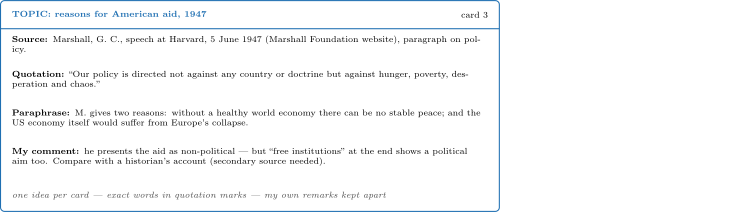
{ A research note card.}
Method : Making notes for research
- Start from a question. Without one, everything seems worth copying.
- Record the source first, completely: author, title, date, where you found it, page or paragraph. A note whose origin is lost cannot be used.
- One idea per card (or per entry in your file), with a heading: you will be able to sort the cards when you make your plan.
- Distinguish three kinds of content, and mark them: a quotation (exact words, in quotation marks); a paraphrase (your words); your own comment. Most accidental plagiarism begins with a note in which these were mixed.
- Quote little: only what is striking, disputed or impossible to say otherwise.
- Note what the source does not tell you: it is the list of what to look for next.
6.2.3 From notes to a summary, from a summary to an abstract
Method : Writing a summary
- Read the whole text and find its thesis; then divide it into its parts and note the main idea of each.
- Leave out examples, repetitions, figures of speech and minor details.
- Write in your own words, in the order of the text, about a third of its length or less; begin by naming the source (In his speech of 5 June 1947, Marshall…).
- Add nothing: no opinion, no information from elsewhere.
- Check against the original: is every main idea there? Is anything distorted?
Summary (about 85 words for 260). In his Harvard speech of 5 June 1947, Marshall explains that the exchange between farmers and towns, on which modern economies rest, is breaking down in Europe: the towns no longer produce the goods that farmers want. Europe needs far more food and essential products than it can pay for, and will decline gravely without outside help. The United States should therefore help to restore the world economy, without which peace is impossible; its policy is aimed at poverty and chaos, not at any country.
Abstract (about 35 words). Marshall's Harvard speech (1947) argues that Europe's economic exchange has broken down, predicts grave deterioration without substantial foreign help, and proposes American assistance aimed at restoring a working world economy as the condition of peace.
Exercises of the chapter
- Sources, notes and honest borrowing solved
- Notes, summary and abstract: Marshall's remedy solved
- Reading an official text: social security, work and rest solved
- Listening: a lecture on the Universal Declaration solved
- Speaking: a timed research presentation solved
- Writing: from the research question to the documented paragraph solved