The Context of Utterance: Narrative, Discourse and Verb Tenses
Course · English (Grade 10, Lebanon), chapter 1 · Lebanon, Grade 10 · the beginning of the chapter, the rest on Adloun
Every literary or informative text comes from a particular act of speaking or writing in which a speaker addresses an addressee in a given place and at a given time. Understanding a text in Grade 10 (first year of secondary school) therefore begins with identifying this context of utterance, spotting the traces that speakers leave in what they say (person, place and time deixis, modality markers), and distinguishing the two great systems of verb tenses described by modern linguistics: the discourse mode (anchored in the present of the person speaking) and the narrative mode (cut off from the moment of utterance). To this command of grammar and style we add the decoding of implicit meaning (presuppositions and implied meanings), which is essential for grasping the irony, the polemic or the poetry of a work.
Curriculum: LB-2
Learning objectives
- Identify the parameters of the context of utterance (speaker, addressee, place and time of utterance) and list the person, place and time deixis of a text.
- Distinguish an utterance anchored in its context (discourse mode) from an utterance cut off from its context (narrative mode).
- Analyze the time, aspect and modal meanings of English verb forms (simple present, present progressive, present perfect, simple past, past progressive, past perfect, will and would, modal verbs).
- Assess how objective or subjective a text is by studying its modality markers (connotation, adverbs, verbs of opinion, modal verbs, figures of speech).
- Distinguish explicit from implicit meaning and tell a presupposition (built into the language) from an implied meaning (dependent on the context).
1.1 Utterance, context of utterance and deixis
1.1.1 The act of utterance and its four parameters
Since the work of the linguist Émile Benveniste (Problems in General Linguistics, 1966), literary analysis has carefully distinguished the finished product — the utterance — from the living act that produces it — the act of utterance.
The act of utterance is the individual act by which a speaker produces a piece of language in given circumstances. The utterance is the verbal result (spoken or written) of this act: a sentence, a speech, a poem or a novel.
Every context of utterance is defined by four complementary parameters, which answer four basic questions:
- Who is speaking? The speaker (or writer; the narrator in a work of fiction).
- To whom? The addressee (listener, reader, audience).
- Where? The place of utterance (the physical or institutional space in which the act of speaking takes place).
- When? The moment of utterance (), which serves as the reference point in time for the act of speaking.
In a work of fiction (novel, short story, tale) or in a lyric poem, never confuse the author (the real, historical person who wrote the work) with the narrator or speaker (the fictional voice that does the telling inside the text). Only in autobiography, the essay, the real letter or the newspaper article are the author and the speaker the same person.
1.1.2 Deixis and reference: two ways of pointing
To designate a person, a place or a moment, the language has two opposite systems of reference: deictic reference (relative to the moment and place where one speaks) and absolute or text-internal reference (independent of the immediate act of speaking).
Deictic words (from the Greek deixis, ``showing, pointing'') are the words whose reference can only be determined from the context of utterance (I – here – now). They fall into three categories:
- Person deixis: the first-person pronouns and possessives that designate the speaker (I, me, we, us, my, our, mine) and the second-person forms that designate the addressee (you, your, yours; the archaic thou, thee, thy).
- Place deixis: adverbs, phrases and demonstratives that locate space in relation to the speaker's position (here, there, over there, this room, that hill, come, go).
- Time deixis: adverbs and phrases that locate time in relation to the moment of utterance (now, today, yesterday, tomorrow, the day before yesterday, next week, three days ago, at present).
Property : — Third-person pronouns and anaphoric reference
Unlike first- and second-person pronouns, whose reference changes every time someone new speaks, third-person pronouns (he, she, it, they, him, her, them) are not deictic words: most of the time they are anaphoric, that is, they refer back to a noun phrase already mentioned in the text (the co-text).
Let us read the opening of Benjamin Franklin's Autobiography, begun in 1771 at Twyford, in England, in the form of a letter to his son William:
Dear Son: I have ever had pleasure in obtaining any little anecdotes of my ancestors. You may remember the inquiries I made among the remains of my relations when you were with me in England, and the journey I undertook for that purpose. Imagining it may be equally agreeable to you to know the circumstances of my life, many of which you are yet unacquainted with, and expecting the enjoyment of a week's uninterrupted leisure in my present country retirement, I sit down to write them for you.
Analysis of the utterance:
- Traces of the speaker (Franklin): the first-person singular is everywhere, as a subject pronoun (I, four times), as an object pronoun (with me) and in possessive determiners (my ancestors, my relations, my life, my present country retirement).
- Traces of the addressee (the son): the salutation Dear Son, the pronoun you (five times) and the shared memory when you were with me in England. The private letter creates intimacy between father and son, and through them with every reader.
- Time deixis: my present country retirement situates the writing at the moment of utterance; the clause when you were with me in England points back to a past shared by the two speakers.
- Dominant tenses: the present of utterance (I sit down to write, a present that accompanies the very act it describes) is surrounded by the present perfect (I have ever had pleasure), which sums up a lifelong attitude still true at , and by the simple past (I made, you were, I undertook), which narrates finished events.
Author : Benjamin Franklin (1706–1790) — The Autobiography (written 1771–1790)
Printer, scientist, inventor of the lightning rod and one of the Founding Fathers of the United States, Benjamin Franklin began his memoirs as a letter to his son. Written in a plain, lively and ironic style, the Autobiography tells how a poor apprentice from Boston became a respected citizen of the world. It is one of the founding texts of American life writing: the old man who writes in the present looks back with humor at the young man he once was.
1.2 Discourse mode and narrative mode
1.2.1 Émile Benveniste's linguistic distinction
By studying how verb tenses and pronouns are distributed in language, Émile Benveniste showed that utterances are organized on two distinct planes: the plane of discourse (an utterance anchored in the context of utterance) and the plane of narrative, which he called histoire (an utterance cut off from the context of utterance). In English, the opposition is carried mainly by the choice between the present and present perfect on one side and the simple past and past perfect on the other.
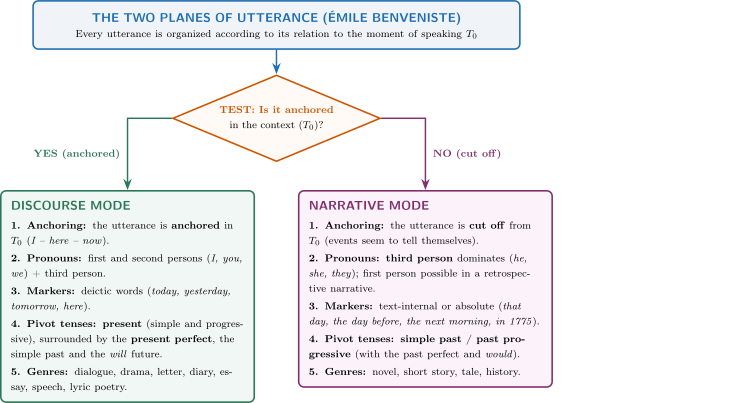
1.2.2 Comparative table of time and place markers
When an anchored utterance (discourse) is turned into a cut-off utterance (narrative), every deictic word becomes a text-internal marker, which takes as its reference point a moment of the past already mentioned in the text. This is exactly what happens in English reported speech (``backshift''):
Exercises of the chapter
- Identifying the context of utterance and the deixis in a private letter solved
- Cross transposition between the discourse mode and the narrative mode solved
- Aspect and stylistic value of the tenses in a narrative (Jack London) solved
- The present of general truth and modality in the essay (Francis Bacon) solved
- Linguistic and pragmatic analysis of presuppositions and implied meanings solved
- Narrative, discourse and subjectivity in “The Tell-Tale Heart” (Edgar Allan Poe) solved