Narrative Texts: Structure, Characters and Point of View
Course · English (Grade 10, Lebanon), chapter 2 · Lebanon, Grade 10 · the beginning of the chapter, the rest on Adloun
Telling a story, real or imaginary, is one of the fundamental functions of human language and the driving force of literary genres such as the novel, the short story, the tale and autobiography. In Grade 10 (first year of secondary school), the study of the narrative text goes beyond summarizing the plot: it requires a rigorous distinction between the story that is told (the story world) and the narration (the way it is told). Who tells the story (the narrator)? Through whose eyes or consciousness are the events perceived (point of view)? According to what dramatic architecture (plot structure) and what system of forces (actantial model) does the action progress? How does the novelist handle space, the order and the speed of time (narrative pace), and how does he or she insert the living speech of the characters? These are the keys to analysis that this chapter sets up.
Curriculum: LB-2
Learning objectives
- Recognize the basic features of the narrative text and distinguish author, narrator and character.
- Determine the type of narrator (first-person, participant narrator vs third-person, non-participant narrator) and identify the point of view (omniscient, limited, objective) and its literary effects.
- Bring out the structure of a narrative with the plot structure (exposition, inciting incident, rising action, climax, resolution) and analyze the system of characters with the actantial model (A. J. Greimas's six forces).
- Study the setting, the order of narration (chronology, flashback, flash-forward) and the four speeds of narrative pace (pause, scene, summary, ellipsis).
- Analyze the insertion of dialogue in the narrative (direct speech, reported speech, free indirect speech, narrated speech) and the marks of spoken language, and characterize the main narrative genres (novel, short story, tale, autobiography).
2.1 The narrative voice: narrator and point of view
2.1.1 Author, narrator, character and story world
Every literary narrative rests on an implicit reading contract that separates the real world (in which the writer and the reader live) from the fictional world built by the text (the story world).
- The author: the real, historical person who conceives and writes the literary work (for example Charles Dickens, Jane Austen or Mark Twain).
- The narrator: the fictional voice (the speaker inside the text) that does the telling of the story.
- The character: a ``paper being'' who performs or undergoes the actions inside the world that is told (the story world).
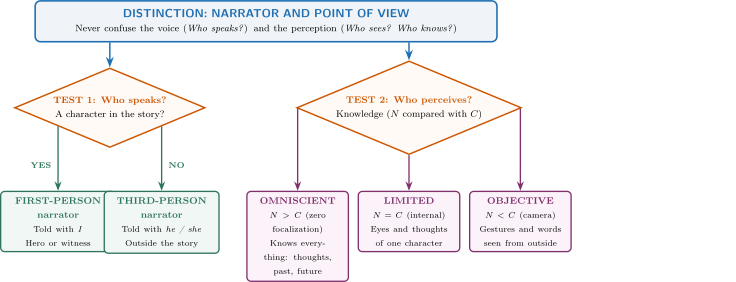
Following the literary theorist Gérard Genette (Narrative Discourse, 1972), we avoid a frequent confusion by separating two radically different questions: Who speaks?''** (the narrator) and **
2.1.2 Who speaks? First-person and third-person narrators
To determine the type of narrator, we ask whether or not the narrator is a character in the story he or she tells:
Property : — Participant narrator vs non-participant narrator
- The first-person (participant) narrator: the narrator is a character in the story he or she tells. The narrative is then told in the first person (I). There are two cases:
- The narrator is the main character of his or her own story: this is the case of autobiography (Frederick Douglass's Narrative) and of the first-person novel (Charles Dickens's Great Expectations, Charlotte Brontë's Jane Eyre).
- The narrator is a secondary witness who tells the adventure of another protagonist: Dr. Watson, the friend and witness of Sherlock Holmes in Arthur Conan Doyle's stories, or Ishmael, who tells the story of Captain Ahab in Herman Melville's Moby-Dick.
- The third-person (non-participant) narrator: the narrator is not a character in the story; he or she stays outside the story world and tells the events in the third person (he, she, they). This is the case of most of the great realist novels (Pride and Prejudice, Oliver Twist, The Mayor of Casterbridge).
2.1.3 Who sees? The three points of view
When a narrator (especially a third-person narrator) tells a scene, he or she chooses how wide the field of perception and how much information are given to the reader, according to three points of view:
- The omniscient point of view (zero focalization): . The narrator knows more than any character. Like a ``god'' overlooking the world he or she has created, the narrator knows the past, the future, the secret thoughts and the hidden motives of all the characters, and can move freely from one place to another.
- Literary effect: a panoramic view, the power to explain and to judge (typical of Jane Austen, Charles Dickens, George Eliot), dramatic irony when the reader knows what a character does not.
- The limited point of view (internal focalization): . The narrative is filtered through the consciousness, the eyes and the feelings of a single character (the focal character, or ``center of consciousness'' in Henry James's words). The narrator only says what this character sees, hears, thinks or feels. It is recognized by verbs of perception and thought (he saw, he noticed, he recognized, he wondered, it seemed to him) and by free indirect speech. A first-person narrative is, by nature, told from a limited point of view.
- Literary effect: identification and empathy with the character; the reader discovers the world progressively through his or her eyes (frequent in Henry James, Stephen Crane, Kate Chopin).
- The objective point of view (external focalization): . The narrator knows less than the characters. Like a camera placed outside, he or she records only visible appearances, gestures and audible words, without ever entering the characters' minds or revealing their identity or private thoughts.
- Literary effect: mystery, suspense, enigma (frequent in the openings of novels, in tales of mystery and in detective fiction).
- Objective point of view (opening of The Mayor of Casterbridge, Thomas Hardy, 1886):
One evening of late summer, before the nineteenth century had reached one-third of its span, a young man and woman, the latter carrying a child, were approaching the large village of Weydon-Priors, in Upper Wessex, on foot. They were plainly but not ill clad, though the thick hoar of dust which had accumulated on their shoes and garments from an obviously long journey lent a disadvantageous shabbiness to their appearance just now.
The characters are seen from the outside, like strangers on a road: they have no name (a young man and woman), and the narrator only records their clothes and the dust on their shoes. The adverb obviously even shows that he deduces the long journey from what he sees, as a witness would. The reader wants to know who these people are: the objective point of view creates suspense.
- Limited point of view (a young soldier's first march into battle in The Red Badge of Courage, Stephen Crane, 1895):
Once the line encountered the body of a dead soldier. He lay upon his back staring at the sky. He was dressed in an awkward suit of yellowish brown. The youth could see that the soles of his shoes had been worn to the thinness of writing paper, and from a great rent in one the dead foot projected piteously. […] The youth looked keenly at the ashen face. The wind raised the tawny beard. It moved as if a hand were stroking it.
The narrator is a third-person narrator, but the point of view is strictly limited to the eyes of the young recruit Henry Fleming, called the youth (could see, looked keenly). The details are those that a fascinated, inexperienced young man would notice: the worn shoes, the beard moved by the wind. Because he has never seen war, he perceives the dead man through a strangely gentle image (as if a hand were stroking it), and the reader shares his shock.
- Omniscient point of view (opening of Emma, Jane Austen, 1815):
Emma Woodhouse, handsome, clever, and rich, with a comfortable home and happy disposition, seemed to unite some of the best blessings of existence; and had lived nearly twenty-one years in the world with very little to distress or vex her.
Here the omniscient narrator sums up in one sentence the heroine's qualities, her fortune and twenty-one years of her life, and already judges her: the verb seemed suggests that this happiness is only an appearance. No character in the story could know and judge so much.
Exercises of the chapter
- Distinguishing the narrator and the point of view in four classic extracts solved
- Rewriting workshop: changing the point of view of the same scene solved
- Plot structure and actantial model in a short story (Kate Chopin, “The Story of an Hour”) solved
- Story time, discourse time and narrative pace (Washington Irving, “Rip Van Winkle”) solved
- Dialogue and power struggle (Jane Austen, Pride and Prejudice) solved
- The autobiographical pact and the double perspective (Frederick Douglass) solved