Descriptive Texts: Characterization, the Senses and Figures of Speech
Course · English (Grade 10, Lebanon), chapter 3 · Lebanon, Grade 10 · the beginning of the chapter, the rest on Adloun
To describe is to make the reader see, hear and feel a person, an object or a place through words. Far from being a mere ornament that slows down the action of a novel, the descriptive text plays a strategic part in literature: it builds the illusion of reality, reveals the character of the people through their portrait or their surroundings, prepares the turns of the plot, and transforms the world through the poet's eye. In Grade 10 (first year of secondary school), studying and writing description requires understanding its spatial organization, its literary functions, the grammatical tools of characterization (the modifiers of the noun phrase), the vocabulary of the five senses (sensory imagery) and the exact working of the main figures of speech.
Curriculum: LB-2
Learning objectives
- Identify the features of the descriptive text (verb tenses, spatial connectives, verbs of perception and of state) and analyze its spatial organization (planes, movements of the eye).
- Distinguish objective (factual) description from subjective description (positive or negative connotations, physical and moral portrait, direct and indirect characterization, landscape as a mirror of the mind).
- Bring out the four main literary functions of description: informative, symbolic, dramatic and aesthetic.
- Analyze grammatically the means of characterization and the modifiers of the noun phrase (attributive and predicative adjectives, prepositional phrases, relative clauses, order of adjectives, comparative and superlative).
- Study the expression of sensations (sensory imagery, synesthesia) and identify, name and interpret the main figures of speech (simile, metaphor, personification, allegory, hyperbole, enumeration and accumulation, antithesis, oxymoron, anaphora).
3.1 Organization, point of view and functions of description
3.1.1 The linguistic features and the spatial organization of the descriptive text
While the narrative text is organized according to the chronological succession of actions (the axis of time), the descriptive text spreads out in space the parts and qualities of its subject (the axis of space).
A descriptive passage can be recognized by four basic features:
- Verb tenses: in a past narrative, description uses the simple past of state verbs (The house was old; the walls looked gray), the past progressive for ongoing background activity (Smoke was rising from the chimneys) and there was / there were; the action stops while the narrator describes (descriptive pause). In a guidebook, an encyclopedia or a poem anchored in the present, the simple present is used (The valley lies between two ranges of mountains).
- Verbs: a predominance of state verbs (be, seem, appear, look, remain), verbs of position and existence (stand, lie, rise, stretch, overlook, dominate), verbs of perception (see, notice, make out, hear, smell) and verbs of descriptive movement (wind, climb, plunge, slope).
- Spatial connectives: adverbs and prepositional phrases that build the geometry of the picture along three axes:
- Depth (successive planes): in the foreground, in the middle ground, in the background, in the distance, on the horizon.
- Verticality: at the top, on the summit, above, overhead at the bottom, at the foot of, below, beneath.
- Sides and inside: on the left, on the right, on either side, in the center, in the middle, inside, outside.
- The movement of the eye: description can be static (the observer stands still and sweeps the space with a horizontal or vertical panorama, or zooms in from the general to the particular) or dynamic (the character moves and discovers the place as he walks).
3.1.2 Objective and subjective description: portrait and landscape
Depending on the writer's intention and on the point of view, the same object or place can be described in a neutral way or in a strongly evaluative way:
- Objective description (scientific, technical or factual): it aims at informing accurately (dimensions, materials, neutral colors, precise vocabulary), without value judgment.
- Subjective description (literary and expressive): it transforms reality through the feelings of the narrator or of the character who sees. Its words carry positive connotations (wonder, beauty, harmony) or negative connotations (ugliness, anxiety, satire).
This subjectivity works especially in two kinds of description:
- The portrait: it combines the physical description (figure, bearing, clothes, face, eyes, voice) and the moral portrait (qualities, faults, character, social habits). English textbooks also distinguish direct characterization (the narrator states what the character is like: He was a cruel man) and indirect characterization (the reader infers it from the character's speech, thoughts, effect on others, actions and looks). In realist novelists such as Charles Dickens, the body, the clothes and the house are the mirror of the soul and of the social condition.
- The landscape: in Romantic literature, nature is not a mere background but a mirror of the mind: storms, autumn, dusk or a calm sea reflect the inner torments or the peace of the subject. The critic John Ruskin called pathetic fallacy this way of lending human feelings to nature (the angry sea, the weeping sky).
3.1.3 The four literary functions of description
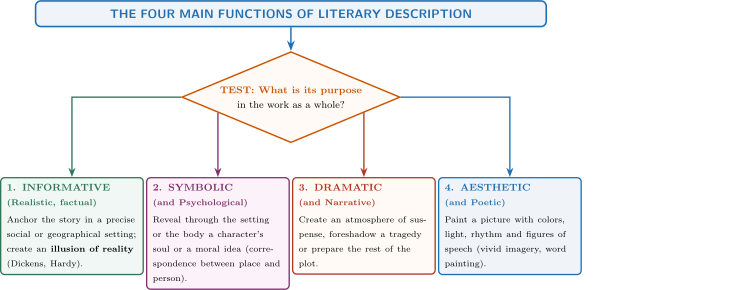
In chapter 8 of Great Expectations (1861), young Pip is taken to the dark house of Miss Havisham, a rich lady who was abandoned by her bridegroom on her wedding day, many years before:
She was dressed in rich materials,—satins, and lace, and silks,—all of white. Her shoes were white. And she had a long white veil dependent from her hair, and she had bridal flowers in her hair, but her hair was white. […]
It was not in the first few moments that I saw all these things, though I saw more of them in the first moments than might be supposed. But I saw that everything within my view which ought to be white, had been white long ago, and had lost its lustre and was faded and yellow. I saw that the bride within the bridal dress had withered like the dress, and like the flowers, and had no brightness left but the brightness of her sunken eyes.
Analysis of the functions of the description:
- A portrait seen by a child (limited point of view): the anaphora I saw that (twice here, and once more in the next sentence of the novel) follows the slow discovery of the details by Pip's eye. The enumeration of rich materials (satins, and lace, and silks) and the repetition of white (six times) first suggest a splendid bride.
- A turning point: the conjunction but (but her hair was white) and the opposition ought to be white / faded and yellow reveal decay. The double simile had withered like the dress, and like the flowers assimilates the woman to her clothes: time has stopped for her, but not for her body.
- Symbolic function: the house and the dress explain the character. Miss Havisham has refused to live since the day she was abandoned; her faded wedding dress is the image of a life frozen in the past. The description prepares the whole novel: Pip's fascination for a world of wealth which is in fact a world of ruin.
Exercises of the chapter
- Spatial organization and noun phrase modifiers in a landscape by Washington Irving solved
- Physical description, moral portrait and symbolic function (Charles Dickens, A Christmas Carol) solved
- Senses, synesthesia and personification in Charles Dickens (A Christmas Carol) solved
- Figures of amplification, personification and symbolic function in Charles Dickens (Bleak House) solved
- The landscape as a mirror of the mind in Romantic poetry (William Wordsworth) solved
- Characterization, irony and social criticism in a satirical portrait (Charles Dickens, Hard Times) solved