Informative and Explanatory Texts, Note-Taking and Oral Presentations
Course · English (Grade 10, Lebanon), chapter 4 · Lebanon, Grade 10 · the beginning of the chapter, the rest on Adloun
At school and university, as in our lives as citizens, a large part of what we read and write aims neither at telling a fictional story nor at defending a personal opinion, but at passing on reliable knowledge (informing) and at making its causes and mechanisms understood (explaining). In Grade 10 (first year of secondary school), mastering the informative and explanatory text means analyzing its neutral, objective voice, its organization of information (thematic progression), its grammatical tools of cohesion (reference, substitution and nominalization) and its explanatory techniques. The official curriculum links this written skill directly to study skills and spoken communication: research, structured note-taking, paraphrasing and summarizing, and giving an oral presentation to an audience.
Curriculum: LB-2
Learning objectives
- Distinguish the informative purpose (What? Who? Where? When?) from the explanatory purpose (Why? How?) and identify the markers of objectivity (impersonal voice, simple present of general truth, technical vocabulary).
- Identify the theme and the rheme (given and new information) of a sentence, and recognize the three kinds of thematic progression: constant theme, linear progression and derived (split) themes.
- Recognize and use the explanatory techniques: definition, naming, reformulation, example, analogy, function, and classification or division.
- Master the tools of cohesion and condensation: reference by pronouns, lexical substitution, passive and impersonal constructions, and nominalization (from verbs and from adjectives).
- Apply note-taking techniques (symbols, abbreviations, layout in levels), summarize documentary data and give a clear, well-structured oral presentation.
4.1 Features and structure of the informative and explanatory text
4.1.1 Informing and explaining: two complementary purposes
Although they are very often combined in the same encyclopedia article, school textbook or popular science magazine, informative writing and explanatory writing correspond to two different intellectual operations:
- The informative text presents facts, events, dates or figures that can be checked. It answers factual questions: Who? What? Where? When? How many?
- The explanatory text goes beyond facts to throw light on their causes, their working or their consequences, with a didactic intention (to teach the reader and remove a difficulty of understanding). It answers the questions: Why? How?
Property : — The five linguistic markers of didactic objectivity
To guarantee the scientific or documentary reliability of what it says, the informative and explanatory text has five constant features:
- The writer stays in the background: few first- and second-person pronouns (except the academic we of modesty or the inclusive you and one); the third person dominates (it, they), with impersonal constructions (there is, it is estimated that, it appears that) and the passive voice (Solar energy is absorbed by chlorophyll), very frequent in English scientific writing.
- No subjective modality markers: no emotional or evaluative vocabulary (neither praise nor blame); neutral declarative sentences dominate.
- The simple present of general truth: the pivot tense, which states laws, definitions and permanent properties (Water boils at 100°{}C at sea level).
- Specialized vocabulary (technical terms): precise words with a single meaning, belonging to a field of knowledge (medicine, geology, history, linguistics, economics), with figures and units of measurement.
- Paratext and organizing connectives: titles, subheadings, lead paragraphs, footnotes, diagrams, and logical or sequencing connectives (first, then, in fact, that is why, thus, consequently, in short).
4.1.2 The logical structure of the explanatory sequence
A complete explanatory text is generally organized in three phases:
- The question phase (statement of the problem): it presents the phenomenon observed and asks the question to be solved, either explicitly, as a direct or indirect question (Why is the sky blue? One may wonder how…), or implicitly, in the title.
- The explanation phase: it develops the causes, the stages of the mechanism and the explanatory techniques that answer why and how.
- The conclusion phase: it sums up the general law or the main consequences of the phenomenon explained.
4.2 The progression of information and textual cohesion
4.2.1 Theme, rheme and the three kinds of thematic progression
For an informative text to be coherent and easy to read, each sentence must start from information already known to the reader in order to bring him new information. Text linguistics (M. A. K. Halliday) distinguishes two poles in each sentence:
- The theme (): what the sentence is about, the given information, usually placed at the beginning of the sentence as the grammatical subject.
- The rheme (): the new information given about the theme (the verb phrase and its complements).
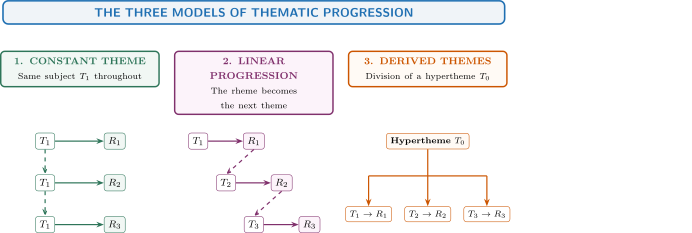
From one sentence to the next, themes and rhemes are linked according to three main models of thematic progression:
- Constant theme progression: the same theme is taken up from sentence to sentence (by a pronoun or a synonym), and each sentence gives it a new rheme ().
- [] Example: The cedar of Lebanon () is a majestic conifer of the high mountains (). It () can reach forty meters in height (). This ancient tree () has provided a rot-resistant timber, highly prized since antiquity ().
- Linear (zigzag) progression: the rheme (or part of the rheme) of one sentence becomes the theme of the next (, then , then ).
- [] Example: The Phoenicians () founded many trading posts along the coasts (). These port cities () encouraged the rise of Mediterranean trade (). This flourishing commerce () allowed the rapid spread of the alphabet ().
- Derived (split) theme progression: a first sentence announces a general hypertheme (), and the following sentences take as their themes () the different parts or subcategories of this whole.
- [] Example: The relief of Lebanon () is organized in four parallel strips running from north to south. The coastal plain () contains the large port cities and the citrus orchards (). The Mount Lebanon range () rises to more than three thousand meters at Qurnat as-Sawda (). The Bekaa Valley () forms a rich agricultural corridor (), while the Anti-Lebanon () marks the eastern border ().
4.3 Explanatory techniques and the tools of cohesion (substitution and nominalization)
4.3.1 The seven main explanatory techniques
To make a complex notion accessible to the reader, the writer of an explanatory text uses seven didactic techniques, which you must be able to identify and name precisely:
Exercises of the chapter
- Distinguishing the informative and the explanatory purpose in a scientific text (Charles Darwin) solved
- Thematic progression, cohesion and nominalization solved
- Technical explanation and the spirit of the Enlightenment (Benjamin Franklin, Autobiography) solved
- Explanation and analogy in natural history (Charles Darwin, The Formation of Vegetable Mould through the Action of Worms) solved
- From a spoken lecture to structured notes and an oral conclusion (Michael Faraday) solved
- From a table of data to a written informative and explanatory text solved