Argumentative Texts and Logical Connectives
Course · English (Grade 10, Lebanon), chapter 5 · Lebanon, Grade 10 · the beginning of the chapter, the rest on Adloun
As soon as a moral, social, political or aesthetic question can no longer be settled by a scientific proof but depends on a choice of values, human speech enters the field of argumentation. To argue is to take sides on a controversial issue and to build a structured line of reasoning in order to lead an addressee to share an opinion (a claim) or to change his or her behavior. In Grade 10 (first year of secondary school), the study of the argumentative text has a central place: it requires you to distinguish the strategies of argumentation (convincing, persuading, deliberating), to break down the structure of an argument (topic, claim, counterclaim, arguments, evidence), to master the grammar of connectives (in the simple sentence, in the complex sentence and between paragraphs) and to write a PEEL paragraph or take part in a debate.
Curriculum: LB-2
Learning objectives
- Identify the features and the purpose of an argumentative text, and distinguish the three ways of winning agreement: convincing (reason, logos), persuading (emotions, pathos, and the speaker's credibility, ethos) and deliberating (weighing the pros and cons).
- Identify precisely the components of an argument: the topic, the claim (stated or implied), the counterclaim (the opposing view that is refuted), the arguments and the evidence (illustrative or argumentative examples).
- Analyze and express the seven main logical relations (addition, cause, consequence, purpose, contrast, concession, condition) with prepositions, coordinating conjunctions, conjunctive adverbs and subordinating conjunctions, and use the conditional sentences correctly.
- Identify the marks of the arguer's involvement and subjectivity (pronouns, positive and negative evaluative words, rhetorical questions, irony, strategic concession).
- Write a complete argumentative paragraph (PEEL), build a dialectical or thematic outline, and take part constructively in a debate.
5.1 The purposes and components of argumentation
5.1.1 Convincing, persuading and deliberating: three ways of winning agreement
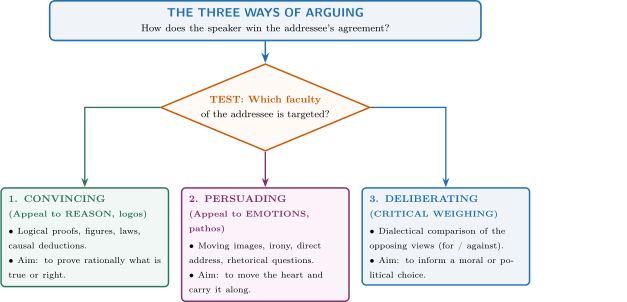
Every argumentative text seeks to act upon its addressee, but it can follow three complementary approaches inherited from ancient rhetoric:
- Convincing means winning the addressee's agreement by appealing to his or her reason and powers of analysis. The speaker relies on logical proofs, historical facts, figures and rigorous deductions (logos).
- Persuading means moving the addressee by appealing to the heart, to sensitivity, imagination and emotions (indignation, pity, fear, enthusiasm). The speaker then uses emotional eloquence, striking images, hyperbole and the rhythm of oratory (pathos). Persuasion also relies on the image of the speaker himself or herself, on his or her honesty and authority (ethos).
- Deliberating means examining and weighing methodically the arguments for and against several options before making an informed decision (in a tragic soliloquy, a philosophical essay or a citizens' assembly).
5.1.2 The internal structure of an argument
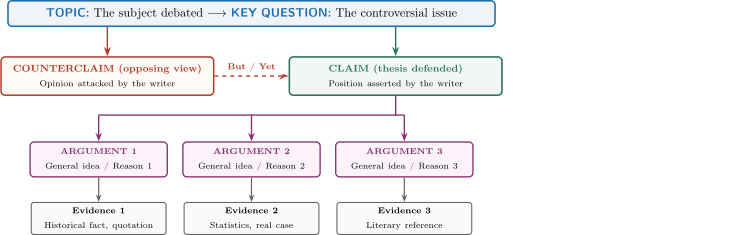
When you analyze an argumentative text, you must never confuse the topic, the claim, the argument and the evidence:
- The topic (or subject): what the text is about, stated as a neutral noun phrase (e.g. capital punishment, the education of women, freedom of the press).
- The claim (or thesis): the opinion, the precise position that the writer wants the reader to accept about the topic (e.g. ``Capital punishment is a cruel and useless penalty that must be abolished''). It is always stated as a complete sentence.
- The counterclaim (or opposing view): the opposite opinion (that of opponents or of common opinion) which the writer attacks, criticizes and takes apart (indictment or rebuttal).
- The arguments: the general ideas, the logical or moral reasons put forward to prove that the claim is valid (or that the opposing view is false).
- The evidence (examples): the precise facts, historical anecdotes, literary references, personal experiences or statistics that support the argument in concrete reality. We distinguish:
- The illustrative example: placed after the abstract argument (introduced by thus, for example, for instance, as … shows), it throws light on an idea that has already been proved and makes it concrete.
- The argumentative example: carries the whole weight of the proof on its own (as in the fable, the parable or the satirical tale), forcing the reader to draw the general lesson from a striking case.
5.2 Expressing logical relations: connectives
The strength of an argument depends on the explicit or implicit links between clauses and paragraphs. In English grammar, the same logical relation can be expressed at three syntactic levels, and you must be able to change one into another:
- In the simple sentence: with a preposition followed by a noun phrase or a gerund (because of his tiredness, despite the storm, in spite of being tired, in order to win).
- By coordination or a conjunctive adverb: two independent clauses linked by punctuation (a colon for an explanation or a consequence, a semicolon), by a coordinating conjunction (and, but, or, nor, for, yet, so) or by a conjunctive adverb (however, therefore, moreover, nevertheless, consequently, indeed). A conjunctive adverb between two clauses requires a semicolon or a full stop before it: The road was icy; however, the bus left on time.
- In the complex sentence, by subordination: an adverbial clause linked to the main clause by a subordinating conjunction (because, since, as, so that, although, even though, whereas, if, unless, provided that). The choice of conjunction, of tense and of modal verb depends on the relation: real or unreal condition, purpose, concession.
Exercises of the chapter
- Identifying claim, arguments, evidence and connectives in a text of the Enlightenment (Thomas Paine) solved
- Syntactic gymnastics: expressing five logical relations in all their forms solved
- Emotional plea and hidden reasoning against child labor (William Blake, "The Chimney-Sweeper") solved
- The satirical fable and indirect argument in Jonathan Swift (Gulliver's Travels, Part I, chapter 4) solved
- Argumentative writing workshop: a concessive transition and two PEEL paragraphs solved
- Preparing and chairing a debate in class solved