Advertising: Persuasion Strategies and Reading Images
Course · English (Grade 10, Lebanon), chapter 11 · Lebanon, Grade 10 · the beginning of the chapter, the rest on Adloun
On the billboards that line the coastal highways of Lebanon, in the pages of magazines, on the radio, on television and inside the very apps we open every day, advertising has become an all-present language of today's society. Already flourishing in the newspapers of eighteenth-century London — where Samuel Johnson observed in 1759 that ``Promise, large promise, is the soul of an advertisement'' — it grew with the Industrial Revolution, the mass press and the rise of department stores and patent medicines, which H. G. Wells and Theodore Dreiser described in Tono-Bungay (1909) and Sister Carrie (1900). Advertising does not merely inform consumers that a product exists and what it costs: it uses a true rhetoric of persuasion, which combines the music of the slogan, the seduction of the image and the subtle devices of implicit meaning (presuppositions, implications, connotations of happiness, youth or prestige). How can we analyze an advertising poster methodically? How can we study the figures of speech of a slogan and tell a commercial advertisement from a public-service campaign? This chapter gives Grade 10 students all the linguistic, visual and literary tools they need so as no longer to be passive targets of advertising, but to read it as clear-sighted citizens.
Curriculum: LB-2
Learning outcomes
- Master the vocabulary of advertising (advertiser, target audience, headline, slogan, logo, brand identity, body copy) and of the consumer society.
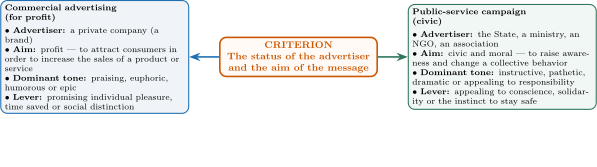
- Distinguish commercial advertising (for profit) from institutional or public-service advertising (prevention, health, the environment, solidarity) according to the advertiser and the aim.
- Analyze the grammatical, rhythmic and rhetorical devices of the slogan (imperative, verbless sentence, wordplay, alliteration, rhyme, hyperbole, metaphor, antithesis, paradox).
- Uncover the implicit meaning of an advertising message by distinguishing the presupposition (built into the language) from the implied meaning (inferred from the context) and from flattering connotations.
- Apply the method for reading a still image (composition, framing, shot sizes, camera angle, colors, anchorage and relay between text and image) and argue about the role of advertising in society.
11.1 The vocabulary of advertising, the participants and the aims
11.1.1 From the ``puff'' to modern marketing: the specialized vocabulary
In eighteenth-century England, a puff was an exaggerated notice slipped into a newspaper to praise a book, a play or a product — the playwright Richard Brinsley Sheridan even named a character Mr. Puff in The Critic (1779). The word advertisement (from the Latin advertere, to turn toward'') first meant simply a
Every advertisement involves five precise elements, which must be identified from the introduction of an analysis:
- The advertiser (the real sender): the company, the public institution (Ministry of Health, Ministry of the Environment) or the humanitarian organization (the Red Cross, an NGO) that orders and pays for the campaign.
- The advertising agency (the designer): the creative team (copywriters, art directors, photographers) that produces the verbal and visual message.
- The target audience (the intended receiver): the precise group of people the message addresses, according to age, occupation, tastes or needs (teenagers, parents, athletes, young urban professionals, all citizens).
- The channel and the medium: the means used (billboards, the press, radio or television commercials, digital banners, sponsored posts).
- The referent and the aim (the conative or persuasive function): the object, service or behavior promoted, with the purpose of acting on the receiver (to make people buy or to make them adopt a responsible behavior).
Let us also learn the technical terms of advertising design and of its critical study:
- The parts of a poster: the headline (or hook, a sentence placed at the top of the poster to catch the eye and arouse curiosity), the visual (the central photograph or drawing), the body copy (a short paragraph detailing the qualities of the product), the slogan (a short, memorable phrase summing up the promise of the brand), the logo (the graphic symbol that identifies the brand) and the tagline (the signature line that accompanies it).
- The critical vocabulary of consumption: consumer society, impulse buying, artificial needs, conditioning, advertising bombardment, overconsumption, planned obsolescence (deliberately shortening the life of a device to force its replacement), greenwashing (the trick by which a polluting company gives itself a misleading environmentally friendly image).
11.1.2 Distinguishing commercial advertising from public-service campaigns
11.2 The rhetoric of the slogan and the mechanisms of implicit meaning
11.2.1 The art of the slogan: brevity, rhythm and figures of speech
The word slogan comes from the Scottish Gaelic sluagh-ghairm, which originally meant the ``battle cry of a clan''. In advertising, a slogan is a short, striking, easy-to-remember phrase meant to fix the brand in the memory of the receiver. To obtain the greatest impact in a few words, copywriters use three kinds of devices:
- Grammatical devices and direct address:
- The verbless phrase (an effect of timeless, obvious truth):
Pure elegance, every moment''*; * - The imperative, a friendly invitation (conative function), and the pronoun you, which address the reader directly:
Open a world of freshness''*; * - The simple present of general truth, which turns the promise into an unquestionable law: ``A diamond is forever'' (De Beers, 1947).
- Sound and rhythm (memory devices):
- Binary parallelism and the rule of three:
Melts in your mouth, not in your hand''* (two parallel groups, with an antithesis); * - Alliteration, assonance and internal rhyme:
Guinness is good for you''* (1929); *Have a break, have a Kit Kat''*; * - Wordplay and echoes of proverbs: proverbs owe their survival to the same devices (
No pain, no gain''*; *A friend in need is a friend indeed''*); a slogan often imitates or twists them: *
- Figures of meaning and of thought:
- Hyperbole and the superlative (praising exaggeration): ``The purest crystal from the peaks of Lebanon''.
- Metaphor and personification:
Put a tiger in your tank''* (Esso, 1959: a metaphor of feline energy); * - Antithesis and paradox (which surprise the mind):
One small click for you, one giant leap for the planet''* (an echo of Neil Armstrong's words on the Moon); * - The pun (double meaning): ``Our mattresses: you'll fall for them'' (to fall asleep on them and to fall in love with them).
Exercises of the chapter
- Mastering the vocabulary of advertising and of reading images solved
- Uncovering presuppositions, implied meanings and fallacious arguments solved
- Theodore Dreiser and the “persuasion of fashion” (Sister Carrie, 1900) solved
- A comparative reading of two posters: commercial seduction versus civic shock solved
- Designing a poster to promote Lebanon's cultural heritage solved
- Building an argumentative paragraph on advertising and the freedom of the consumer solved