The Media: Informing, Explaining and Thinking Critically
Course · English (Grade 10, Lebanon), chapter 10 · Lebanon, Grade 10 · the beginning of the chapter, the rest on Adloun
Called as early as the nineteenth century the Fourth Estate'', next to the legislative, executive and judicial powers, **the media** --- the press, radio, television and today digital platforms --- shape our knowledge of the world and keep democratic debate alive. Since John Milton defended in 1644
Curriculum: LB-2
Learning outcomes
- Master the specialized vocabulary of the press (front-page layout, sections, journalistic genres), of broadcasting and of digital media.
- Distinguish rigorously the news and explanatory genres (wire story, brief, report, feature, investigation) from the opinion genres (editorial, op-ed, column, review, cartoon).
- Find in a news article the five Ws and H (Who? What? When? Where? Why? How?), the news circuit, the sources and the degree of objectivity or subjectivity of the writer.
- Study how great writers looked at the press, critically or with commitment (Milton, Dickens, Twain, Nellie Bly, Ida B. Wells).
- Write a news article (headline, standfirst, body) from given facts and argue about the freedom of the press and critical thinking in the face of disinformation and fake news.
10.1 The vocabulary of the media, the front page and the journalistic genres
10.1.1 The vocabulary of the press and the layout of the front page
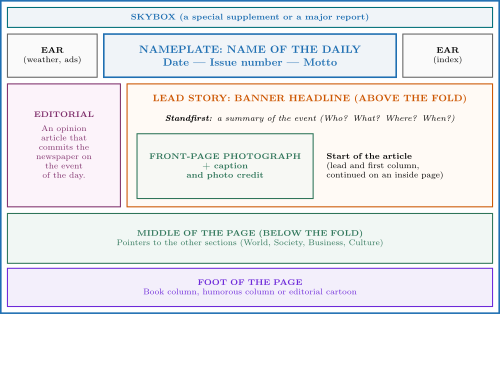
The Latin word medium (``means, intermediary'', plural media) gave English the word media, which refers to any channel of mass communication. In the press (dailies, weeklies, monthlies), the first page — the front page — is the shop window of the newspaper: its layout ranks the news in order of importance to catch the reader's attention, and it reveals the editorial line of the newsroom.
- The skybox (or teaser strip): a horizontal strip at the very top of the front page, above the name of the newspaper, announcing a special supplement or an important story.
- The nameplate (or flag): the top area of the front page giving the name of the newspaper (its logo), the date, the price, the issue number and sometimes a motto. It is flanked on the left and on the right by the ears (small boxes for advertisements, the weather or the index).
- The lead story: the most prominent position, just below the nameplate, where the banner headline of the main news appears with a dominant photograph or illustration. On a folded newspaper, the top half of the page, above the fold, is the most valuable space.
- The middle and the foot of the page (below the fold): the central and lower parts of the front page, with pointers to secondary articles, a serial or a column.
- The display type and the structure of an article: a complete article has an overline (or eyebrow, indicating the context or the section), a headline (short and striking), a subheadline, a standfirst (a short paragraph, often in bold, summing up the essentials of the article above the columns), a byline (the name of the journalist) and a dateline (the place and date of writing), a lead (or lede, the first sentence), crossheads that break up the columns, captions under the photographs and a kicker (a punchy last sentence).
10.1.2 The news circuit and the vocabulary of digital media
Before it reaches the reader, a piece of news follows a precise path:
- Sources and news agencies: world or national agencies (the Associated Press, Reuters, Agence France-Presse, Lebanon's National News Agency) gather facts twenty-four hours a day through their correspondents and send out wire stories (short, purely factual texts, timed to the minute) to the newsrooms of newspapers, radio and television stations.
- The work of the newsroom: under the direction of the editor-in-chief, journalists (reporters, special correspondents, columnists, copy editors) select the news, cross-check their sources (two independent sources at least), write the articles and lay them out in sections (Politics, World, Society, Business, Science, Culture, Sports, Local news).
- Today's digital ecosystem: with the Internet and social networks, news circulates in real time (the 24-hour news cycle), but it exposes citizens to new risks that must be named:
- information overload (a ceaseless flood of news in which the essential is drowned in the trivial);
- rumor (unverified news that spreads by word of mouth or by viral sharing), misinformation (false information shared in good faith) and disinformation or fake news (false information deliberately invented to deceive the public, to defame or to manipulate);
- the filter bubble (the mechanism by which the algorithms of platforms show users only content that matches their existing opinions, which reinforces prejudice).
Against these risks, journalistic ethics (the moral and professional rules that oblige journalists to check their sources, to respect the presumption of innocence, to refuse bribes and to separate facts from comment) remain the first safeguard.
Exercises of the chapter
- Mastering the vocabulary of the front page, the journalistic genres and digital media solved
- Analyzing subjectivity and point of view through three treatments of the same event solved
- Mark Twain and the reverse side of newspaper criticism (“How I Edited an Agricultural Paper”) solved
- John Milton and the defense of the freedom of the press (Areopagitica, 1644) solved
- From raw facts to an informative standfirst and an editorial comment solved
- Building a balanced argument on social networks and information solved