Women: Portraits, Social Condition and Emancipation
Course · English (Grade 10, Lebanon), chapter 9 · Lebanon, Grade 10 · the beginning of the chapter, the rest on Adloun
For centuries confined by laws and customs to the domestic sphere, or celebrated in poetry as a silent muse, woman gradually wins in literature written in English, from the late seventeenth century to the twentieth, the status of an independent subject who thinks, works, creates and claims her rights. As early as 1697, Daniel Defoe calls the refusal to educate girls one of the most barbarous customs in the world''; in 1792, Mary Wollstonecraft publishes *A Vindication of the Rights of Woman*, the founding text of modern feminism in English; in 1848, the women and men gathered at Seneca Falls, in the State of New York, rewrite the Declaration of Independence to proclaim that
Curriculum: LB-2
Learning outcomes
- Master and use the vocabulary of women's condition, of subordination, education, emancipation, civil rights and equal representation.
- Analyze the organization and purpose of a portrait of a woman in literature (physical, moral and social portrait; positive or satirical characterization).
- Study the major texts on the education and freedom of women (Defoe, Austen, Wollstonecraft, the Seneca Falls Declaration, Charlotte Brontë, Sojourner Truth, Hardy, Kate Chopin).
- Identify the rhetorical devices of committed writing (parallelism and the rewriting of a founding text at Seneca Falls, rhetorical questions and the pathetic register in speeches and protest poetry, realism and social criticism in the novel).
- Write a positive portrait of a woman in action and build a structured argument on equal rights and on the role of women in today's society.
9.1 The vocabulary of women's condition, of the portrait and of emancipation
9.1.1 From guardianship to emancipation: the key concepts
To analyze literary texts rigorously and write balanced essays on the theme Women, it is essential to distinguish the vocabulary of historical subordination from that of the conquest of independence.
- Patriarchy (from the Greek pat\=er,
father'', and *arkh\=e*,rule'') is a social and legal organization founded on the dominant authority of the father or the husband, in which a woman is placed under permanent **guardianship**. Under the English common-law doctrine of **coverture**, a married woman's legal existence was absorbed into her husband's: she could not own property, sign a contract or keep her own wages. The Seneca Falls Declaration (1848) sums it up: the law has made her, - Emancipation (from the Latin legal term emancipare, ``to free from the father's authority'') is the historical, intellectual and legal process by which women free themselves from guardianship and prejudice in order to exercise fully their freedom of thought, of action and of citizenship.
- Equal rights means that the law grants women and men the same civil, political and professional freedoms; parity (or gender balance) aims to ensure an equal representation of women and men in elected assemblies and in decision-making bodies.
The following table sums up the main word networks of the chapter:
| Theme | Precise vocabulary (nouns, adjectives, verbs) |
|---|---|
| Dependence and prejudice | subjection, subordination, guardianship, coverture, confinement, obscurantism, misogyny, sexism, discrimination, the gender pay gap, the glass ceiling; submissive, resigned, hampered, dependent, silenced; to confine, to relegate, to subjugate, to belittle. |
| Education and the mind | education, literacy, learning, erudition, pedantry (a showy display of learning), judgment, clear-sightedness, free will, a literary or scientific vocation; educated, cultivated, clear-sighted, perceptive, articulate; to learn, to reason, to debate, to publish. |
| Work and social dignity | labor, worker, seamstress, employee, pioneer, financial independence, economic autonomy, motherhood, the ``double shift'', solidarity, everyday courage; hardworking, valiant, fearless, tenacious, dignified; to provide for, to undertake, to lead. |
| Winning rights | emancipation, enfranchisement, claim, suffrage (the right to vote), eligibility, citizenship, civil equality, social justice, inalienable dignity; independent, self-governing, free, committed; to claim, to win, to legislate, to sit (in an assembly). |
9.1.2 The vocabulary of the portrait: beyond the clichés
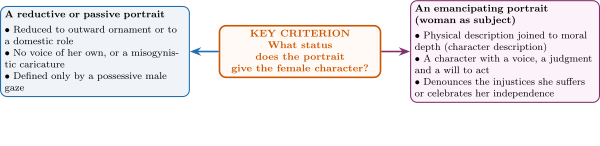
In the literary tradition, the portrait of a female character combines three dimensions:
- the physical description (features of the face, eyes, carriage of the head, bearing, gestures, clothes, voice);
- the character description (moral and intellectual portrait: temperament, virtues, strength of mind, intelligence, sensitivity, aspirations);
- the social and dramatic setting (the portrait ``in action'', revealed by work, by speech or by a trial the character goes through).
9.2 Education and the rights of women: from Defoe and Austen to Seneca Falls
9.2.1 The quarrel over women's education (1697--1813)
In the seventeenth and eighteenth centuries, the education of girls of the middle and upper classes was often limited to needlework, housekeeping, a little music and drawing, and the rules of good manners. In 1697, in An Essay upon Projects, Daniel Defoe (1660--1731), the future author of Robinson Crusoe, imagined an Academy for Women'' and denounced the inhuman custom'' that kept women ignorant and then blamed them for their ignorance. A century later, Jane Austen (1775--1817) turned the question into comedy. In *Pride and Prejudice* (1813), the rich and snobbish Miss Bingley, who hopes to marry Mr. Darcy, and Darcy himself list in front of the heroine, Elizabeth Bennet, the qualities required of an
Exercises of the chapter
- Mastering the word networks of guardianship, the portrait and emancipation solved
- Satire, argument and the question of education: Daniel Defoe, “An Academy for Women” (1697) solved
- The eloquence of a revolutionary age: Mary Wollstonecraft, A Vindication of the Rights of Woman (1792) solved
- A miner's wife: D. H. Lawrence, “Odour of Chrysanthemums” (1911) solved
- Writing the evolving portrait of a pioneering woman solved
- Rebutting an opposing argument in a debate on parity and women's work solved