Autotrophy and photosynthesis
Course · Life Sciences (Grade 10, Lebanon), chapter 1 · Lebanon, Grade 10 · the beginning of the chapter, the rest on Adloun
In the Bekaa plain, a potato field receives nothing but water, mineral salts, air and sunlight; yet a few months later, tons of tubers full of starch are harvested from it. On the slopes of Mount Lebanon, a cedar or an olive tree likewise builds its wood, its leaves and its fruits without ever consuming another living being. Where does this matter come from? In which organ, then in which part of the cell, is it made? And what exchanges does the plant carry out with the air while it makes it?
Curriculum: LB-2
Required skills
- Recall what autotrophy is and its importance in the synthesis of organic matter.
- Show, from experimental results, that an illuminated green leaf makes starch.
- Make a labeled diagram of the general organization of a chlorophyllic cell and locate the chloroplasts in it.
- Relate the presence of starch in the chloroplasts to the fact that they are the site of photosynthesis.
- Label the ultrastructure of a chloroplast.
- Describe chlorophyllic gas exchange in the light and distinguish it from the exchange carried out in darkness.
1.1 Autotrophy: making one's own organic matter
1.1.1 Mineral matter, organic matter
The matter of living beings is largely organic matter: carbohydrates (glucose, starch, cellulose), lipids, proteins. These molecules are all built around carbon atoms. Water, carbon dioxide and the mineral salts of the soil, on the contrary, belong to mineral matter.
An animal or a fungus cannot do without the organic matter of others: it must take it from its food. A green plant, however, grows on a medium that contains only mineral matter.
- An autotrophic living being makes its own organic matter from mineral matter only: water, mineral salts and carbon dioxide. This is the case of chlorophyllic plants, which use the energy of light to do so.
- A heterotrophic living being must find ready-made organic matter in its environment. This is the case of animals and fungi.
Chlorophyllous plants are the producers of organic matter: all the organic matter consumed by heterotrophic living beings, directly (herbivores) or indirectly (carnivores, decomposers), was first made by an autotrophic living being. Without autotrophy, there would be neither harvests nor food chains.
1.1.2 Reminder: detecting starch with iodine solution
Starch is a storage carbohydrate that is very widespread in plants. It is detected by a simple test, already practiced in middle school.
Method : : Iodine solution test
Iodine solution is an orange-yellow liquid. Placed on a sample:
- it takes a blue-black color if the sample contains starch (positive test);
- it keeps its orange-yellow color in the absence of starch (negative test).
This test makes it possible to follow the making of organic matter by a plant: where starch appears, organic matter has just been produced.
1.2 The illuminated green leaf makes starch
Problem. Under what conditions does a leaf make starch?
1.2.1 The partly covered leaf experiment
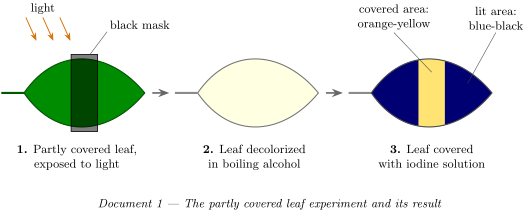
A geranium plant (pelargonium) is used, first placed in darkness for 48 hours: its leaves then no longer contain any starch. Part of a leaf is then covered with a black paper mask, on both of its faces, and the plant is exposed to light for several hours. The leaf is then picked and treated in three steps:
- it is dipped for one minute in boiling water, which kills the cells and makes them permeable;
- it is decolorized in boiling alcohol (in a water bath), which dissolves the chlorophyll;
- once rinsed, it is covered with iodine solution.
Proof (Analysis)
Only the part of the leaf that received light turns blue-black: it contains starch. The covered part stays orange-yellow: it contains none. Since the two parts belong to the same leaf and differ only in illumination, it is concluded that light is essential to the synthesis of starch.
1.2.2 Two other conditions: chlorophyll and carbon dioxide
The same approach, applied to other leaves, gives two complementary results.