Supplying the plant with raw materials
Course · Life Sciences (Grade 10, Lebanon), chapter 2 · Lebanon, Grade 10 · the beginning of the chapter, the rest on Adloun
In spring, in the vineyards of the Bekaa, the vine shoots that have just been pruned “weep”: a clear liquid beads at the cut for several days. In summer, an olive tree or a fig tree keeps its leaves firm under a scorching sun, as long as its roots find water; deprived of watering, a tomato plant wilts in a few hours. And a cedar lifts water from the soil up to its top, more than twenty meters high, without any pump. To make its organic matter, the plant needs water, mineral salts and carbon dioxide: where do these raw materials enter, and how do they reach the chlorophyllic cells of the leaves?
Curriculum: LB-2
Required skills
- Show, from experimental results, that the plant absorbs water and mineral ions through its roots, and locate this absorption in the root hair zone.
- Make a labeled diagram of a root hair and relate its structure to its function.
- Describe the path of water and mineral ions from the soil to the vessels of the root.
- Define crude sap; interpret experiments showing its upward circulation, root pressure and the role of transpiration.
- Locate the xylem in a root, a stem and a leaf; describe a vessel and relate its structure to the conduction of crude sap.
- Label a stoma and a cross section of a leaf; explain the role of the stomata in the supply of carbon dioxide and in transpiration.
2.1 Absorption of water and mineral ions by the roots
Problem. The plant draws water and mineral salts from the soil. Which part of the root absorbs them, and by what mechanism?
2.1.1 The plant takes in water and mineral ions
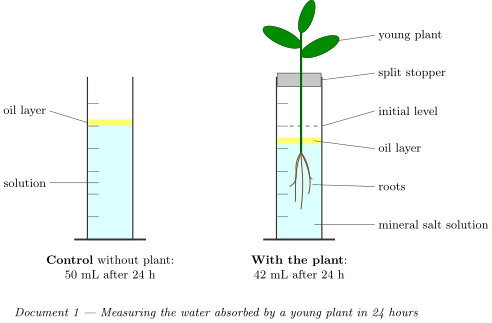
The roots of a young plant are placed in a graduated cylinder containing of a mineral salt solution. A thin layer of oil, poured on the surface, prevents the water from evaporating. An identical cylinder, without a plant, serves as the control. Both cylinders are left in the light for 24 hours.
Proof (Analysis)
In the control cylinder, the level has not changed: the oil did prevent evaporation. In the other, the volume went from 50 to . The plant therefore took mL of water in 24 hours, and it could only do so through its roots, the only part in contact with the solution.
Water is not the only thing that enters. A few mineral ions of the solution are measured at the start and then after four days of culture: mineral salts, once dissolved in water, are indeed present in it as ions, such as the nitrate ion , the potassium ion or the phosphate ion .
{
| Amount of ions in the cylinder (arbitrary units) | nitrate | potassium | phosphate |
|---|---|---|---|
| At the start | 100 | 100 | 100 |
| After four days, with the plant | 38 | 25 | 61 |
| After four days, without plant (control) | 100 | 100 | 100 |
Proof (Analysis)
Without a plant, the amounts of ions do not change. With the plant, they all decrease: the roots have absorbed nitrate, potassium and phosphate ions. They did not absorb them in the same proportions (25 units of potassium remain, but 61 of phosphate): the root does not behave like a simple filter, it takes up each ion according to the needs of the plant.
The roots absorb water from the soil and the mineral ions dissolved in it (nitrate, potassium, phosphate, calcium, magnesium…). This soil solution is the plant's only source of water and mineral salts. The absorption of ions is selective: they are not all taken up in the same proportions.
2.1.2 The root hair zone, place of absorption
A radish seed germinated on damp cotton gives a young root in a few days. Under a magnifying glass, this root does not look the same along its whole length.
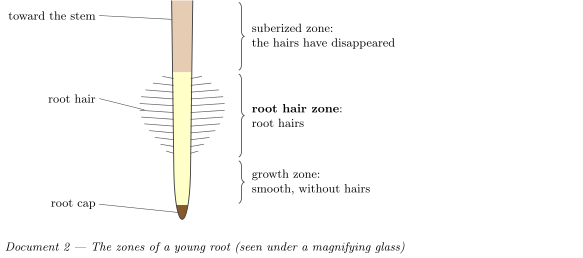
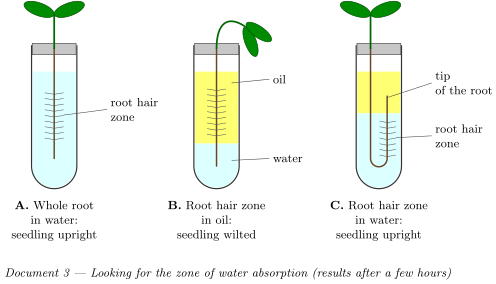
From the tip toward the stem, there follow one another the root cap, which protects the tip; a smooth growth zone; the root hair zone, covered with a fine down of root hairs; then an older, brownish suberized zone, where the hairs have disappeared. To find out which one absorbs water, the roots of three identical seedlings are dipped in tubes containing water topped with oil, a liquid that does not let water through.
Proof (Analysis)
- In A, the whole root is in the water and the seedling stays upright: this is the control, absorption takes place normally.
- In B, the tip of the root dips in the water, but the root hair zone is in the oil: the seedling wilts. The tip (root cap and growth zone) therefore does not absorb enough water for the plant.
- In C, only the root hair zone is in the water: the seedling stays upright, like the control.
Water is therefore absorbed mainly at the root hair zone.
Water and mineral ions are absorbed at the root hair zone of young roots, thanks to the root hairs. This zone always stays at the same distance from the tip: as the root grows longer, new hairs form toward the tip, while the oldest ones, which live only a few days, disappear. The root thus constantly explores new portions of soil.
When a young tomato or lettuce plant is transplanted, it is moved with its clump of soil. Pulled up with bare roots, it would lose most of its very fragile root hairs and would wilt while forming new ones.
2.1.3 The root hair, a specialized cell
Under the microscope, each root hair turns out to be a single cell of the root epidermis, very elongated, which works its way between the soil particles.
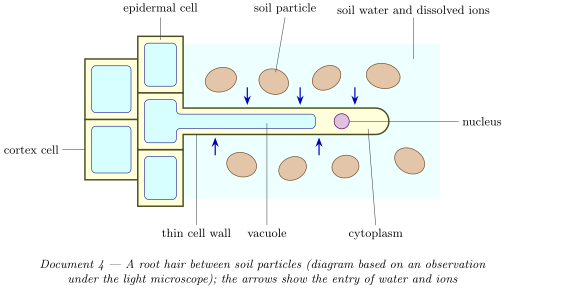
A root hair is a cell of the root epidermis, extended by a long finger-like projection (about one millimeter long). It has:
- a thin, permeable cell wall, with no waterproof coating;
- a large vacuole, which occupies almost the whole volume;
- a cytoplasm reduced to a thin layer, and a nucleus often located toward the tip;
- no chloroplast: the root lives in darkness.
A single hair is tiny, but a plant bears a considerable number of them: on a single rye plant, several billion have been counted, whose total surface area reaches several hundred square meters. Very numerous, very thin and pressed against the soil particles, the root hairs offer water and ions an absorption surface out of all proportion to that of the bare root.
2.1.4 Entry of water into the root hair
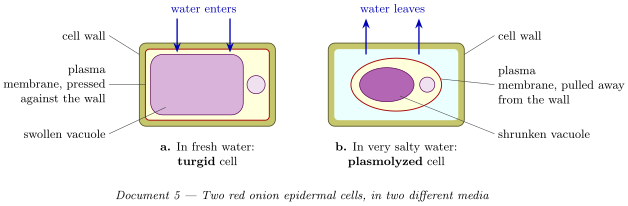
To understand what makes water enter a cell, a convenient material is used: the epidermis of red onion, whose vacuoles are naturally colored purple. Two fragments of this epidermis are mounted between slide and coverslip, one in fresh water, the other in very salty water.
Proof (Analysis)
- In fresh water, the vacuole is swollen and pushes the cytoplasm against the cell wall: the cell has absorbed water. Yet the content of its vacuole, rich in dissolved substances, is more concentrated than the fresh water around it.
- In very salty water, the vacuole is small and darker, and the plasma membrane has pulled away from the cell wall: the cell has lost water. This time, the outside medium is more concentrated than the vacuole.
In both cases, water crossed the membrane, going from the less concentrated medium toward the more concentrated medium.
Osmosis is the movement of water across the membrane of a cell, from the medium less concentrated in dissolved substances toward the medium more concentrated in them. A cell that has absorbed water, swollen, is turgid; a cell that has lost water, whose membrane pulls away from the cell wall, is plasmolyzed.
In the soil, the root hair is in the situation of cell a: its vacuole contains a solution more concentrated than the soil solution, which is very dilute. Soil water therefore enters the root hair by osmosis.