What happens to the products of photosynthesis
Course · Life Sciences (Grade 10, Lebanon), chapter 3 · Lebanon, Grade 10 · the beginning of the chapter, the rest on Adloun
In the Bekaa, it is the leaves of the potato plant that capture light, but it is underground, in the tubers, that starch is harvested. The leaves of the olive tree contain almost no oil: it accumulates in the olives. And in spring, on the young shoots of broad beans or rosebushes, colonies of aphids feed without chewing a single leaf, simply by piercing the stem. The organic matter made in the leaves therefore does not stay where it is. In what form does it leave the leaf, by what route does it circulate, and what happens to it in the rest of the plant?
Curriculum: LB-2
Required skills
- Show, from experimental results, that the products of photosynthesis leave the leaf.
- Define elaborated sap, give its composition and compare it with that of crude sap.
- Interpret experiments (aphid stylet, girdling, labeling) that specify the route and direction of circulation of the elaborated sap.
- Locate the phloem; describe a sieve tube and its companion cell, and relate their structure to the conduction of elaborated sap.
- Present the uses of the synthesized substances: growth and supply of energy.
- Recognize storage organs and identify, with simple tests, the organic substances they store.
This chapter builds on three prior notions: in the light, the chlorophyllic cells of the leaves make carbohydrates by photosynthesis; the water and mineral ions absorbed by the roots form the crude sap; the crude sap rises toward the leaves in the xylem vessels.
3.1 Circulation and composition of the elaborated sap
Problem. The leaves make organic matter, whereas the roots, flowers, fruits and buds do not. How are these organs supplied?
3.1.1 The products of photosynthesis leave the leaf
Starch accumulates during the day in the chloroplasts of the leaves. The starch contained in bean leaves of the same area is measured in the evening, then the next morning, after a night in darkness. Some leaves stayed on the plant; others were detached in the evening, with their petiole dipping in water.
{
| Starch (mg per 100 cm of leaf) | In the evening | The next morning |
|---|---|---|
| Leaf left on the plant | 64 | 7 |
| Leaf detached in the evening | 64 | 52 |
Proof (Analysis)
During the night, the leaf left on the plant loses almost all its starch ( mg), whereas the detached leaf loses only 12 mg of it. The small amount that disappears in the detached leaf was consumed by its own cells. The rest, that is, most of it, could only disappear from the other leaf by leaving it through the petiole: the products of photosynthesis are exported to the rest of the plant.
Starch, insoluble in water, cannot circulate as it is. It is first converted in the leaf into a soluble sugar, sucrose (table sugar).
3.1.2 Collecting and analyzing the elaborated sap
Aphids feed by pushing an extremely fine hollow stylet into the stem. On a section of stem passing through the stylet, its tip is found to always reach the same tissue, the phloem. If the stylet of a feeding aphid is cut, a liquid keeps beading for hours at the end of the stump left in place: it can thus be collected and analyzed.
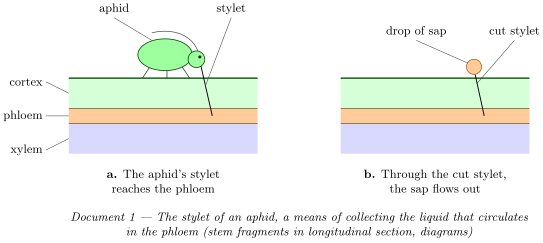
The analysis of this liquid, compared with that of the crude sap taken from the xylem of the same plant, gives the following results.
{
| Dissolved substances (g per liter) | Xylem liquid | Phloem liquid |
|---|---|---|
| Sucrose | 0 | 150 |
| Amino acids | traces | 10 |
| Mineral ions | 1 | 3 |
Proof (Analysis)
The xylem liquid, the crude sap, contains almost nothing but water and mineral ions: it is a very dilute solution. The phloem liquid is completely different: it contains a lot of organic matter, above all sucrose (150 g per liter) and amino acids. It is a concentrated, sugary solution, on which the aphid feeds. These organic substances can only come from the organs that make them: the leaves.
Elaborated sap is the liquid that circulates in the phloem. It is a concentrated solution, rich in organic substances produced by photosynthesis: above all sucrose, along with amino acids. It also contains water and mineral ions.
Amino acids are the “building blocks” of proteins. The plant makes them from the carbohydrates produced by photosynthesis and from the nitrogen of the nitrate ions brought by the crude sap. Mineral ions are therefore not a mere companion of water: they enter into the composition of organic matter.
3.1.3 The direction of circulation of the elaborated sap
Girdling. As early as the 17th century, the Italian scientist Marcello Malpighi removed, all around a branch, a ring of bark a few centimeters high, without cutting into the wood. The phloem, located just under the bark, comes away with it; the xylem, which forms the wood, stays in place.
Exercises of the chapter
- The aphid's meal solved
- Two branches and a ring of bark solved
- Tracking labeled carbon solved
- Sieve tube and vessel solved
- Tests on four storage organs solved
- Germinating wheat grains solved