Hormonal communication
Course · Life Sciences (Grade 10, Lebanon), chapter 5 · Lebanon, Grade 10 · the beginning of the chapter, the rest on Adloun
In a village farmyard, a young rooster that has been castrated never becomes a real rooster: its comb stays small and pale, it does not crow, it does not fight. On the kitchen table, the packet of salt bears the words “iodized salt”: this iodine, added in a tiny quantity, is essential to a small gland of the neck, the thyroid, without which a child does not grow normally. A testis acts on a comb, a gland of the neck acts on the growth of the whole body: how can an organ control, at a distance, other organs to which no nerve links it? By what route does its message travel, and which organs receive it?
Curriculum: LB-2
Required skills
- Use historical experiments (removal, graft, cutting of nerves, injection of extracts) to establish the existence of chemical communication between organs.
- Define a hormone and hormonal communication.
- Locate the thyroid, label a section of this gland and justify that it is an endocrine gland.
- Distinguish an endocrine gland from an exocrine gland.
- Identify, from experimental results, the characteristics of an endocrine gland.
- Identify, from experimental results, the characteristics of the hormonal message: transport by the blood, action on target cells, action at a very low dose, effect linked to the concentration, limited lifetime.
5.1 Chemical communication between organs: the story of a discovery
Problem. How was it discovered that an organ can act on another without going through the nerves?
5.1.1 Berthold's roosters
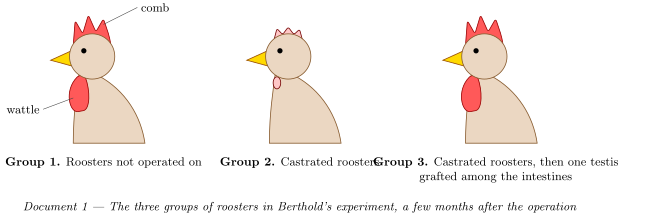
A young rooster that has been castrated, that is, deprived of its testes, becomes a capon. In 1849, the German physiologist Arnold Berthold wondered by what route the testes act on the rest of the body. He operated on young roosters and divided them into several groups, which he observed for several months.
{
| Group 1: not operated on | Group 2: castrated | Group 3: castrated, then grafted | |
|---|---|---|---|
| Comb and wattles | developed, bright red | small, pale | developed, bright red |
| Crowing | rooster's crow | no crowing | rooster's crow |
| Behavior | aggressive, attracted to hens | calm, indifferent to hens | aggressive, attracted to hens |
At the autopsy of the roosters of group 3, Berthold found that the grafted testis had taken: it had surrounded itself with many blood vessels, but no nerve linked it to the rest of the body.
Proof (Analysis)
- Groups 1 and 2. Without testes, the comb, the wattles, the crowing and the behavior of the rooster do not develop: the testes control the appearance of these characteristics.
- Groups 2 and 3. A testis grafted far from its normal place is enough to restore all these characteristics. Yet it no longer has any nervous link with the body: its only link is the blood that flows through it.
Berthold concluded that the testis acts on distant organs through the blood: it must release into it a substance that the blood carries throughout the organism.
5.1.2 The experiment of Bayliss and Starling
The pancreas makes a digestive liquid, pancreatic juice, which it releases into the intestine through a duct. At the end of the 19th century, it was known that this secretion is triggered as soon as the acid contents of the stomach arrive in the intestine, and it was thought that nerves transmitted the information from the intestine to the pancreas. In 1902, two English physiologists, William Bayliss and Ernest Starling, put this idea to the test on an anesthetized dog.
They isolated a portion of intestine, a loop, between two ligatures, then cut all the nerves that go to it: the loop is no longer linked to the rest of the body except by its blood vessels. They then introduced a hydrochloric acid solution into it and collected the pancreatic juice drop by drop.
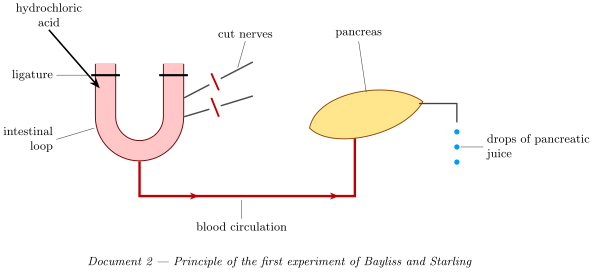
Result. A few moments after the acid is introduced into the denervated loop, the pancreas begins to secrete abundantly.
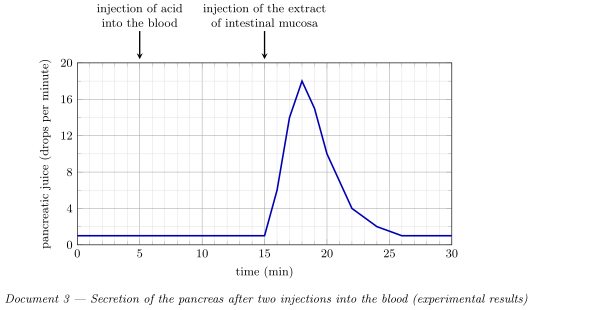
The two researchers then carried out a second experiment. They scraped the mucosa (the inner wall) of a piece of intestine, ground it with a little acid and filtered the whole: they obtained an extract of intestinal mucosa. They injected successively, into a vein of the dog, acid alone, then this extract.
Proof (Analysis)
- First experiment. The loop no longer has nerves, and yet the pancreas responds to the arrival of the acid in the loop. The information therefore did not go through the nerves: it can only have taken the blood, the only link remaining between the loop and the rest of the body.
- Second experiment. Acid injected alone into the blood causes no secretion: it is not the acid itself that, carried by the blood, stimulates the pancreas. The extract of intestinal mucosa, on the other hand, triggers an abundant secretion: it contains an active substance.
Under the action of the acid, the mucosa of the intestine therefore releases into the blood a chemical substance that, carried to the pancreas, triggers its secretion. Bayliss and Starling named it secretin.
5.1.3 The notion of hormone
The testis of the rooster and the mucosa of the dog's intestine act in the same way: they make a substance, release it into the blood, and this substance changes the functioning of an organ located at a distance. In 1905, Starling proposed to call such substances hormones, from a Greek word meaning “I excite”, “I set in motion”.
- A hormone is a chemical substance made by specialized cells, released into the blood and carried by it, that changes the functioning of other cells of the organism, called target cells.
- Hormonal communication is the communication between organs provided by hormones: it is a chemical communication, whose route is the blood.