Productivity of a crop and environmental factors
Course · Life Sciences (Grade 10, Lebanon), chapter 6 · Lebanon, Grade 10 · the beginning of the chapter, the rest on Adloun
In the Bekaa plain, two neighboring wheat fields, sown on the same day with the same variety, do not give the same harvest: one has been irrigated and fertilized, the other has not. On the coast, from Akkar to the south of the country, kilometers of plastic greenhouses shelter tomatoes and cucumbers that are harvested well before the open-field season. What decides the quantity of matter a crop produces? Why does a supply of water or fertilizer increase the harvest in one field and not in another? And how does a greenhouse make it possible to act on the environment of the plant?
Curriculum: LB-2
Required skills
- Define the productivity of a crop and distinguish it from yield; calculate it from measurements of dry matter.
- Identify, from experimental results, the influence of light intensity, carbon dioxide content and temperature on photosynthetic intensity.
- Give other factors of productivity: water, mineral salts, soil, crop enemies.
- Recognize, on a curve or in a table of results, the limiting factor of a production and state the law of the limiting factor.
- Explain how irrigation, fertilization and sheltered crops act on environmental factors, and give their limits.
6.1 The productivity of a crop
Problem. How can what a crop produces be measured, so as to compare two fields or two ways of growing?
6.1.1 From photosynthesis to dry matter
A green plant exposed to light is known to make its organic matter by photosynthesis, from the carbon dioxide of the air, water and the mineral salts of the soil. This organic matter accumulates in the plant, which grows: a crop is a “factory” of organic matter spread over a field.
To measure the matter made, the mass of the fresh plant is a poor indicator: a plant is mostly made of water, and its water content changes from one hour to the next. Dry matter is therefore measured.
Method : : Measuring the dry matter of a crop
- All the plants of a known area of the field, for example , are harvested;
- they are placed in an oven at about , until their mass no longer decreases: all the water has evaporated;
- what remains is weighed: this is the dry matter, made almost entirely of organic matter.
The mass obtained is related to the harvested area: it is expressed in grams per square meter () or in tonnes per hectare (t/ha). One hectare equals , so .
6.1.2 Following a corn crop
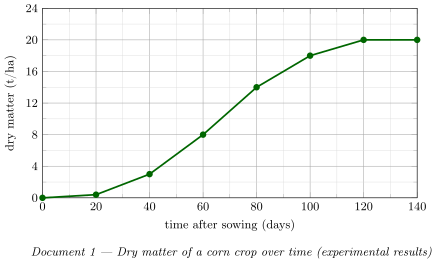
In an irrigated corn field, the dry matter of the crop is measured every twenty days, from sowing to harvest.
Proof (Analysis)
- The dry matter increases from sowing until day 120, then no longer changes: the crop has produced 20 t of dry matter per hectare in all.
- The increase is not steady. It is slow at the beginning (3 t/ha in 40 days), when the plants are small and bear few leaves; it is fast between days 40 and 100, when the foliage covers the whole field; it finally slows down, when the leaves turn yellow and the grain ripens.
- Between days 60 and 100, the crop goes from 8 to 18 t/ha: it produces t of dry matter per hectare in 40 days, that is, t per hectare per day, or per square meter per day.
The productivity of a crop is the mass of dry matter it produces per unit area and per unit time. It is expressed, for example, in grams per square meter per day, or in tonnes per hectare per year.
6.1.3 Productivity and yield
The farmer does not harvest all the matter produced. In the corn field of document 1, the grain represents only 9 of the 20 t of dry matter of each hectare; the stems, the leaves and the roots make up the rest.
The yield of a crop is the mass of product harvested per unit area, for one growing season. It is expressed in tonnes per hectare (t/ha) or in kilograms per square meter.
{
| Productivity | Yield | |
|---|---|---|
| What is weighed | all the dry matter produced by the crop | only the harvested part (grains, tubers, fruits, leaves…) |
| Related to | an area and a duration | an area, for one season |
| Field of document 1 | 25 g per per day between days 60 and 100 | 9 t of grain per hectare |
Productivity and yield vary in the same direction: a crop that makes more organic matter fills its grains, tubers or fruits more. Looking for what increases the harvest is therefore, first of all, looking for what makes the production of organic matter vary.
6.2 Factors linked to photosynthesis
Problem. The dry matter of a crop comes from photosynthesis. Which environmental factors make the intensity of photosynthesis vary?
6.2.1 Measuring photosynthetic intensity
In the light, a leaf absorbs carbon dioxide and releases oxygen: the more active photosynthesis is, the larger these exchanges are. The activity of photosynthesis can therefore be measured by one of these exchanges.
Photosynthetic intensity is the quantity of carbon dioxide absorbed (or of oxygen released) by a plant exposed to light, per unit time and per unit area of leaf (or per unit mass of plant).
To study an environmental factor, a leaf is enclosed in a small transparent chamber through which a stream of air flows. An analyzer measures the carbon dioxide that the air has lost while passing over the leaf. The experimenter can set at will the light intensity (with the lamp), the carbon dioxide content of the air and the temperature.
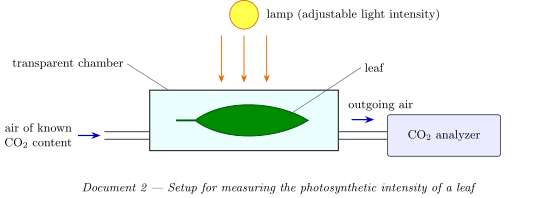
In each series of measurements, only one factor varies; the others are kept constant. The next three documents concern the same tomato leaf.
6.2.2 Light intensity
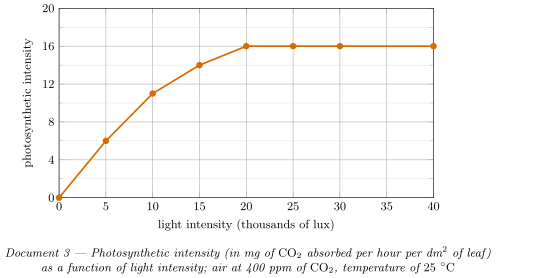
The light intensity received by the leaf is measured in lux. In full summer sun, it is on the order of lux; it is about ten times lower under a heavily overcast sky.
Proof (Analysis)
- In the dark (zero light intensity), photosynthetic intensity is zero: there is no photosynthesis without light.
- From 0 to lux, photosynthetic intensity increases with light intensity: it goes from 0 to 16 mg of per hour per dm.
- Beyond lux, it no longer changes: the curve forms a plateau. Doubling the light intensity from to lux brings nothing.
6.2.3 The carbon dioxide content of the air
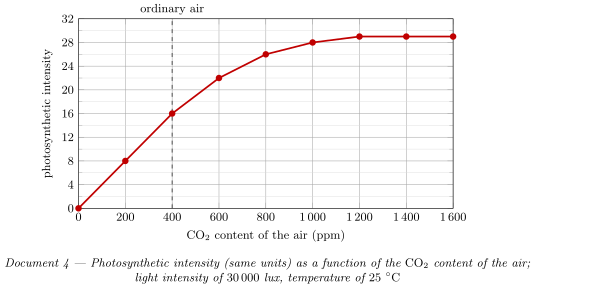
Air contains very little carbon dioxide: about of its volume, that is, 400 ppm (parts per million).
Exercises of the chapter
- The dry matter of a wheat field solved
- Light intensity and the photosynthesis of a lettuce plant solved
- Temperature and the photosynthesis of a tomato plant solved
- Two carbon dioxide contents for a bell pepper plant solved
- Water or nitrogen for a corn field? solved
- The carbon dioxide of a closed greenhouse solved