Pollution of fresh water
Course · Life Sciences (Grade 10, Lebanon), chapter 7 · Lebanon, Grade 10 · the beginning of the chapter, the rest on Adloun
The Litani, the longest river in Lebanon, crosses the Bekaa plain before being held back by the Qaraoun dam. Along its course, it receives the wastewater of towns and villages, discharges from factories and the water that runs off cultivated fields. In the warm season, the water of Lake Qaraoun turns green in places: microscopic algae multiply there in huge numbers. Lower down in the ground, the water of the aquifers, which is pumped for drinking and irrigation, is not safe either. What is polluted water? How can the pollution of a river be measured? Why does a lake that is too “well fed” end up lacking oxygen? And how does a pollutant spread on the surface of the ground reach an aquifer?
Curriculum: LB-2
Required skills
- Give the sources of pollution of fresh water and classify them: chemical, biological, bacteriological, radioactive, thermal pollution.
- Assess the pollution of running water using biochemical indices (dissolved oxygen, biochemical oxygen demand).
- Assess the pollution of running water using a biotic index based on the invertebrates collected.
- Describe the sequence of steps of the eutrophication of a body of water and give its causes.
- Explain the self-purification of infiltration water by the soil.
- Explain the pollution of groundwater by nitrates.
7.1 Good-quality water, polluted water
Problem. What distinguishes polluted water from good-quality water, and where do the pollutants come from?
7.1.1 Two waters compared
The fresh water of springs, rivers, lakes and aquifers is never pure water: it naturally contains dissolved gases, including oxygen , mineral salts and living beings. Water from a mountain stream sampled near its source is compared with water from the same watercourse sampled in the plain, downstream of a town.
{
| Near the source | Downstream of the town | |
|---|---|---|
| Appearance and odor | clear, odorless | cloudy, unpleasant odor |
| Dissolved oxygen (mg per liter) | 10 | 3 |
| Nitrates (mg per liter) | 2 | 30 |
| Bacteria of fecal origin (per 100 mL) | 0 | 20 000 |
| Animals observed | many species, fish | very few species, no fish |
Proof (Analysis)
Between the source and the outskirts of the town, the water has changed in appearance, it has lost a large part of its dissolved oxygen, it has become loaded with nitrates and with bacteria coming from the intestines of human beings and animals, and most animal species have disappeared from it. None of this is natural: it is the discharges of the town that have degraded the quality of the water. This water is no longer drinkable and is no longer suitable for the life of most aquatic animals.
The pollution of water is the degradation of its quality by human activities, which introduce substances, living beings or heat into it. Polluted water becomes dangerous or unfit for its uses (drinking, irrigation, swimming, fishing) and disturbs the life of the living beings that inhabit it. What is introduced into it is a pollutant.
7.1.2 Many sources of pollution
Almost all human activities discharge wastewater or waste, which ends up in a watercourse, a lake or an aquifer.
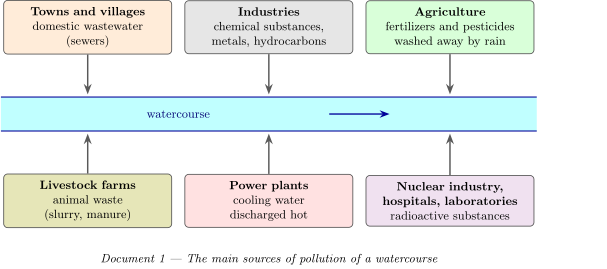
These pollutions are classified according to the nature of what is discharged.
{
| Pollution | Pollutants and origin | Consequences |
|---|---|---|
| chemical | fertilizers (nitrates, phosphates) and pesticides from agriculture; detergents; metals (lead, mercury) and hydrocarbons from industry | poisoning of living beings, water unfit for drinking; nitrates and phosphates make algae proliferate |
| biological | organic matter from wastewater, livestock waste and food industries; living beings that proliferate (algae) | the decomposition of this matter consumes the oxygen of the water: suffocation of animals |
| bacteriological | pathogenic microbes (bacteria, viruses) brought by excrement, in sewage | diseases transmitted by drinking or bathing water (cholera, typhoid, diarrhea) |
| radioactive | radioactive substances discharged by the nuclear industry, some hospitals and laboratories | lasting effects on the cells of living beings (cancers) |
| thermal | hot water discharged by power plants and factories, which use it to cool themselves | warmed water contains less dissolved oxygen; some species disappear |
The sources of pollution of fresh water are many: domestic, agricultural and industrial. According to the nature of the pollutant, a distinction is made between chemical pollution (toxic substances or mineral salts in excess), biological pollution (organic matter and living beings that proliferate), bacteriological pollution (pathogenic microbes), radioactive pollution (radioactive substances) and thermal pollution (heat).
Sewage brings at the same time organic matter (biological pollution), pathogenic microbes (bacteriological pollution) and detergents (chemical pollution). A discharge is therefore often classified in several categories.
7.2 Assessing the pollution of running water
Problem. A river receives a discharge. How can measurements tell whether its water is polluted, and how far downstream?
To give a quality score to running water, two families of indices are available: biochemical indices, which are based on measurements made on the water, and biotic indices, which are based on the living beings collected in the watercourse.
7.2.1 A first biochemical index: dissolved oxygen
Aquatic animals breathe the oxygen dissolved in the water. This oxygen comes from the air, in contact with which the water is stirred, and from aquatic plants, which release it in the light through photosynthesis. Cool, clean, well-mixed water contains 8 to 10 mg per liter. Most fish suffer when this value falls below 5 mg per liter.
Yet all organic matter discharged into water is decomposed there by bacteria. These bacteria respire: the more organic matter they have to decompose, the more they multiply and the more oxygen they consume. A low dissolved oxygen content is therefore the sign of water loaded with organic matter.
7.2.2 A second biochemical index: BOD
To estimate the quantity of organic matter in water, the oxygen that bacteria consume to decompose it is measured.
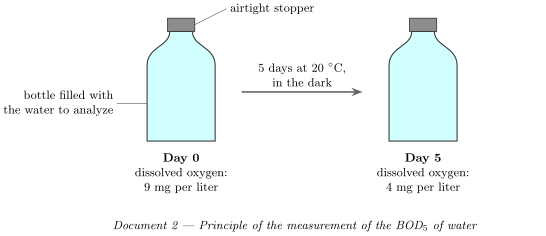
A bottle is completely filled with the water to be analyzed and the dissolved oxygen is measured. The bottle is stoppered, then kept for 5 days at C in the dark, so that no photosynthesis produces oxygen in it. The oxygen is then measured again: the difference between the two measurements is the oxygen consumed by the bacteria. In document 2, it equals mg per liter.
The 5-day biochemical oxygen demand, written BOD, is the mass of oxygen consumed in 5 days, at C and in the dark, by the microorganisms in one liter of water to decompose the organic matter it contains. It is expressed in milligrams of oxygen per liter of water. The higher the BOD, the richer the water is in organic matter.
To interpret the measurements, they are compared with a quality grid. The one that follows is a simplified grid, with four classes.
{
| Water quality | very good | good | fair | poor |
|---|---|---|---|---|
| Dissolved oxygen (mg per liter) | more than 7 | from 5 to 7 | from 3 to less than 5 | less than 3 |
| BOD (mg per liter) | less than 3 | from 3 to less than 5 | from 5 to 10 | more than 10 |