Management and protection of fresh water
Course · Life Sciences (Grade 10, Lebanon), chapter 8 · Lebanon, Grade 10 · the beginning of the chapter, the rest on Adloun
Every winter, rain and snow fall in abundance on Mount Lebanon. In spring, the snow melts, springs gush out at the foot of the limestone slopes and rivers rush down toward the sea. Yet a few months later, wells dry up in the Bekaa, and many boreholes on the coast yield only brackish water. Fresh water falls in winter, but it is needed above all in summer; it seeps in slowly, but it is pumped fast. How does an aquifer fill up? What happens when more is drawn from it than it receives? And how can it be protected from nitrates, or a lake be protected from eutrophication?
Curriculum: LB-2
Required skills
- Describe the path of precipitation water: evaporation, runoff, infiltration.
- Explain the formation and recharge of an unconfined aquifer.
- Explain the consequences of excessive exploitation of water: falling aquifers, dried-up wells, intrusion of salt water into coastal aquifers.
- Propose measures for managing surface water and groundwater resources.
- Explain how to reduce the pollution of aquifers by nitrates.
- Explain how to reduce eutrophication.
8.1 From precipitation to aquifers
Problem. What happens to the water that falls on the ground, and how does part of this water reach an aquifer?
8.1.1 The path of water
Under the effect of the heat of the Sun, the water of the seas evaporates. The water vapor rises, cools and condenses into fine droplets: these are the clouds, which the wind pushes toward the continents. The water then falls back as precipitation, rain or snow.
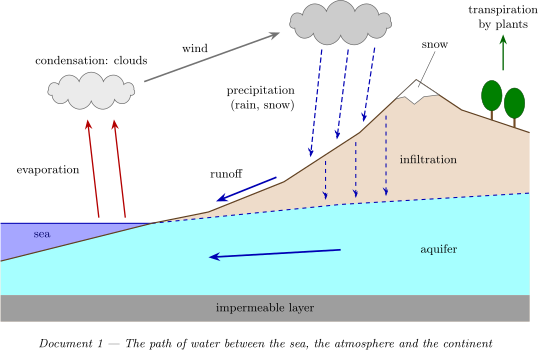
Once on the ground, precipitation water has three fates:
- part of it returns to the atmosphere, through evaporation at the surface of the ground and through transpiration by plants, which release through their leaves the water drawn up by their roots;
- part of it flows over the surface of the ground and joins mountain streams, rivers, then the sea: this is runoff;
- part of it penetrates the ground and moves down to depth: this is infiltration.
The infiltrated water feeds the aquifers, which flow slowly toward springs, rivers and the sea. Water thus travels around an endless loop: the water cycle.
Over a mountain basin, 900 mm of precipitation falls in one year, that is, a layer of water 900 mm thick if all the water stayed in place. Measurements show that 450 mm return to the atmosphere and that 150 mm run off. The water that seeps in is the remainder:
that is, one third of the precipitation. Only this part recharges the aquifers.
8.1.2 Not all rocks let water through
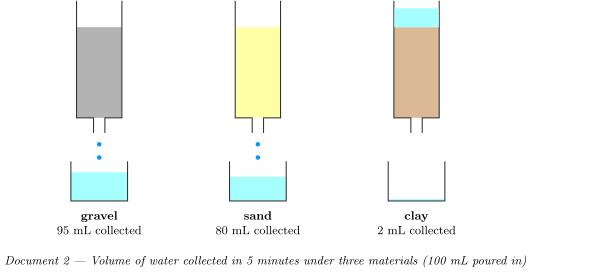
100 mL of water are poured at the top of three identical columns, filled one with gravel, another with sand, the third with clay, and the volume of water collected at the base in 5 minutes is measured.
Proof (Analysis)
Gravel and sand let almost all the water through: the water flows in the spaces that separate the grains. These are permeable rocks. Clay, made of very fine, tightly packed particles, lets almost nothing through: it is an impermeable rock. A compact rock crossed by fissures, like the limestone of the Lebanese mountains, behaves like a permeable rock: the water rushes into it through the fissures.
Infiltration therefore depends first of all on the rock. It also depends on the surface of the ground: it is high under a forest or a meadow, where plants and humus hold the water and let it penetrate; it is low on bare, compacted soil, on a steep slope or during a violent downpour, and almost zero on the concrete and asphalt of towns, where all the water runs off.
8.1.3 The unconfined aquifer
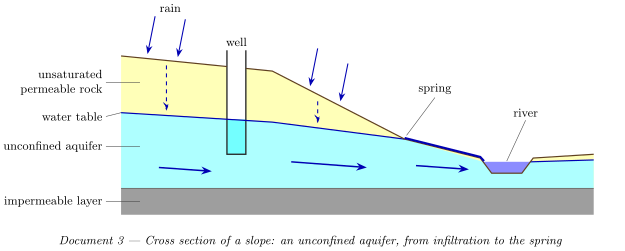
The water that seeps in moves down through the permeable rock until it meets an impermeable layer. It then accumulates above this layer and fills all the spaces in the rock. It does not form an underground lake there: it soaks the rock as water soaks a sponge.
Groundwater is the water that fills the spaces of a permeable rock, above an impermeable layer; the permeable rock that contains it, together with this water, forms an aquifer. The aquifer is said to be unconfined when it is covered only by permeable rock: rainwater reaches it directly by infiltration, and its surface, the water table, rises or falls freely according to the water it receives.
The water of an aquifer is not still: it flows slowly, from a few meters per day to a few meters per year, toward low points. Where the water table meets the surface of the ground, the water comes out: this is a spring. Aquifers thus feed rivers, even long after the last rain.
8.1.4 The recharge of the aquifer
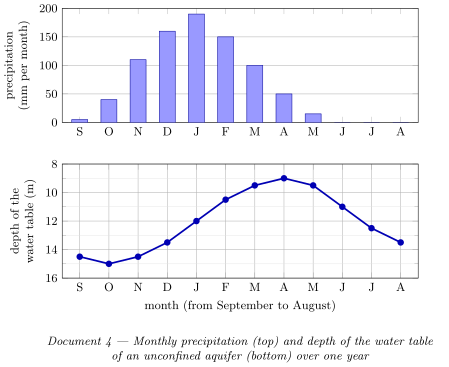
In a region with a Mediterranean climate, the precipitation and the depth of the water in a well, that is, the depth of the water table, are recorded every month for one year.
Proof (Analysis)
Almost all the precipitation falls from October to April; the summer is dry. In October, at the end of the dry season, the water table is at its lowest, at a depth of 15 m. It then rises throughout the rainy season and reaches its highest level, at a depth of 9 m, in April: the infiltrated water has filled the rock over a height of 6 m. From May to September, it no longer rains: the aquifer no longer receives anything, but it continues to flow toward the springs and to be pumped. Its level goes down again.
An unconfined aquifer is fed by the infiltration of part of the precipitation: this is its recharge. Recharge takes place during the rainy season and when the snow melts; during the dry season, the aquifer gradually empties. The level of an aquifer is therefore the result of a balance between what it receives (the recharge) and what it loses (the flow toward the springs and the pumping).
The fissured limestones of Mount Lebanon let a large share of the rain and snowmelt seep in. This water, stored in the rock, comes out all year round through large springs that feed the coastal rivers and those of the Bekaa.
8.2 Excessive exploitation of water
Problem. What happens to an aquifer when too much water is pumped from it?
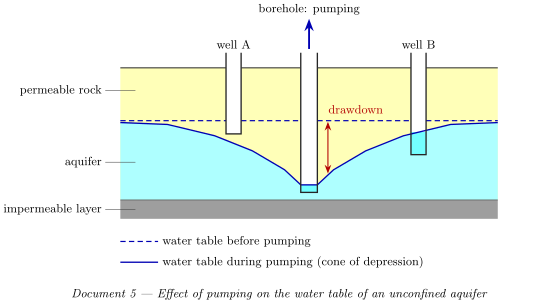
8.2.1 Pumping lowers the aquifer