Human reproductive physiology
Course · Life Sciences (Grade 11 Humanities, Lebanon), chapter 1 · Lebanon, Grade 11 Humanities · the beginning of the chapter, the rest on Adloun
From puberty until about the age of fifty, a woman's body prepares itself, roughly once a month, for a possible pregnancy: a gamete is released by an ovary, the inner wall of the uterus thickens to receive an embryo, then, if no fertilization has taken place, this wall is shed and everything starts again. Menstruation marks the beginning of each of these cycles. Which organs ensure reproduction in men and in women? What happens in the ovary and in the uterus during a cycle? And what regulates this cyclic functioning with such regularity?
Curriculum: LB-1H
Required skills
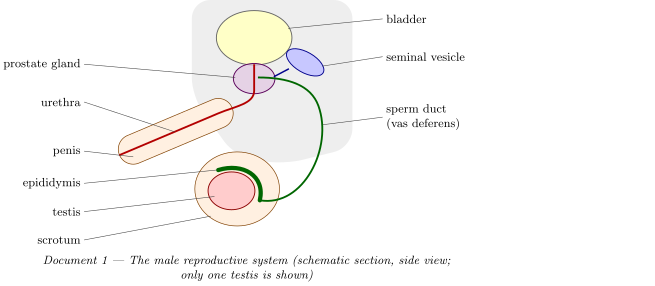
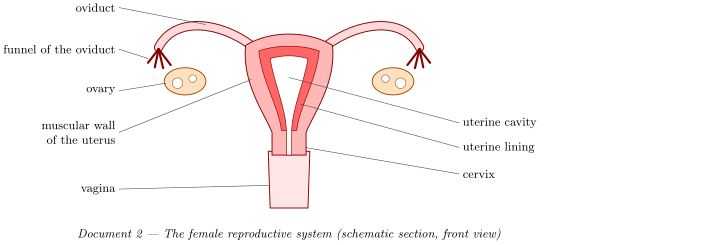
- Label a diagram of the male reproductive system and a diagram of the female reproductive system.
- State the role of each organ: gonads, genital ducts, accessory glands.
- Describe the ovarian cycle: growth of a follicle, ovulation, corpus luteum.
- Describe the uterine cycle: menstruation, thickening then breakdown of the uterine lining.
- Read a graph of hormone secretions during a cycle and locate ovulation on it.
- Explain that the ovary controls the uterine cycle through its hormones (estrogens and progesterone).
- Explain that the pituitary gland controls the ovary through its hormones (FSH and LH).
1.1 The reproductive systems of men and women
Problem. Which organs make up the male reproductive system and the female reproductive system, and what is each of them for?
A reproductive system, or genital system, is the set of organs that ensure reproduction. In men as in women, it always includes:
- two gonads, which produce the reproductive cells, or gametes;
- genital ducts, channels that carry the gametes;
- a copulatory organ.
1.1.1 The male reproductive system
{
| Organ | Role |
|---|---|
| Testes (gonads) | produce the male gametes, the sperm cells (spermatozoa), and a hormone, testosterone |
| Epididymides | the sperm cells stay there and become motile |
| Sperm ducts (vasa deferentia) | carry the sperm cells from the epididymides to the urethra |
| Seminal vesicles and prostate gland | glands that secrete a liquid that nourishes the sperm cells; mixed with the sperm cells, this liquid forms semen |
| Urethra | carries semen to the outside; it is also used for the passage of urine |
| Penis | copulatory organ, through which the urethra runs |
The male reproductive system includes two testes, housed in the scrotum, which produce sperm cells continuously from puberty onward. The sperm cells then follow the genital ducts: epididymis, sperm duct, then urethra. Along the way, the seminal vesicles and the prostate gland add their secretions: the whole forms semen.
1.1.2 The female reproductive system
{
| Organ | Role |
|---|---|
| Ovaries (gonads) | produce the female gametes, the oocytes (often called ova), and two kinds of hormones, estrogens and progesterone |
| Oviducts | their funnel collects the oocyte released by the ovary; the oviduct carries it toward the uterus |
| Uterus | hollow organ with a muscular wall, lined on the inside by the uterine lining; this is where the child develops during pregnancy |
| Cervix | narrow passage between the uterus and the vagina |
| Vagina | copulatory organ; it is also the way out for the child at birth |
The female reproductive system includes two ovaries, which generally release a single oocyte per cycle, from puberty to menopause. The genital ducts are the two oviducts and the uterus, which opens through its cervix into the vagina.
1.1.3 The gonads: gametes and hormones
The testes and the ovaries do not only make gametes. They also release hormones into the blood. Recall that a hormone is a substance secreted by a gland, carried by the blood, and acting at a distance on certain organs, called target organs.
{
| Gonad | Gametes produced | Hormones secreted |
|---|---|---|
| Testis | sperm cells, continuously | testosterone |
| Ovary | oocytes, generally one per cycle | estrogens and progesterone, cyclically |