Fertilization and birth
Course · Life Sciences (Grade 11 Humanities, Lebanon), chapter 2 · Lebanon, Grade 11 Humanities · the beginning of the chapter, the rest on Adloun
In a maternity ward in Beirut, Tripoli or Zahle, a newborn baby gives its first cry. It weighs a little more than three kilograms and its body has trillions of cells. Nine months earlier, it was only a single cell, smaller than a grain of sand, born from the meeting of two gametes. Where and how does this meeting take place? How does the unborn child develop, feed and breathe in its mother's uterus? How does it come into the world, and what does it feed on afterward?
Curriculum: LB-1H
Required skills
- Describe fertilization and locate it in the female reproductive system.
- Describe the path of the fertilized egg to the uterus and define implantation.
- Distinguish the embryo from the fetus and locate the main stages of development on a nine-month timeline.
- Explain the role of the placenta in the exchanges between the mother and the fetus.
- Explain why certain substances consumed by the mother can reach the fetus.
- Explain why menstruation stops at the beginning of pregnancy and the principle of the pregnancy test.
- Describe the stages of childbirth.
- Explain the production of milk and name the benefits of breastfeeding.
2.1 Fertilization
Problem. Where and how do the two gametes meet?
2.1.1 Two very different gametes
{
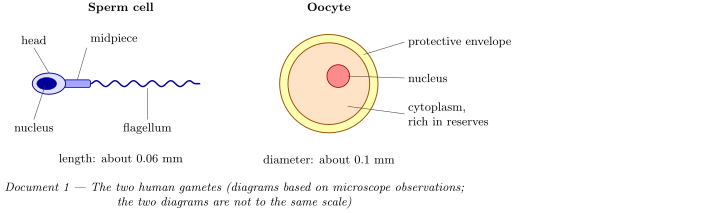
| Sperm cell | Oocyte | |
|---|---|---|
| Place of production | testis | ovary |
| Size | very small (head of about mm) | one of the largest cells of the body ( mm) |
| Mobility | motile thanks to its flagellum | non-motile |
| Reserves | almost none | abundant |
| Number | several tens of millions at each ejaculation | generally only one per cycle |
The sperm cell is a small motile cell, produced in very large numbers: it contributes its nucleus. The oocyte is a large non-motile cell, produced one at a time: it contributes its nucleus and the reserves that will nourish the first cells of the embryo.
2.1.2 The meeting of the gametes in the oviduct
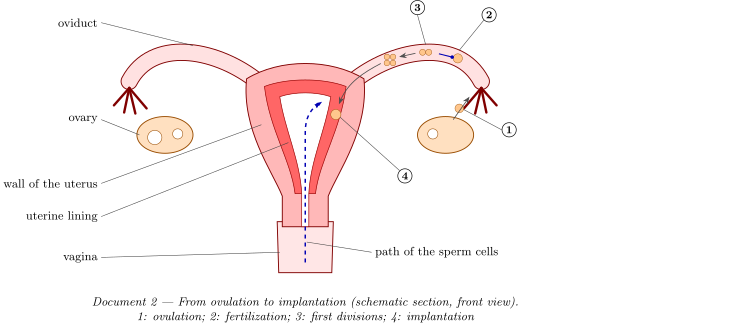
During sexual intercourse, sperm cells are deposited in the vagina. Thanks to their flagellum, some of them pass through the cervix, cross the uterine cavity and move up into the oviducts. Many die on the way: out of several tens of millions of sperm cells, only a few hundred reach the oocyte. If ovulation has just taken place, the meeting occurs in the part of the oviduct closest to the ovary.
2.1.3 A single sperm cell fertilizes the oocyte
Proof (Analysis)
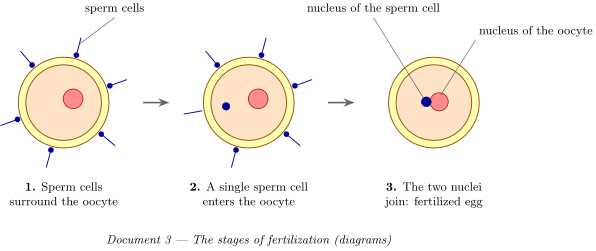
- Several sperm cells reach the oocyte and attach to its envelope.
- A single sperm cell enters the oocyte; its flagellum remains outside. Immediately, the envelope of the oocyte changes: no other sperm cell can enter anymore.
- The nucleus of the sperm cell and the nucleus of the oocyte come together, then fuse into a single nucleus. The cell obtained is the fertilized egg (zygote).
Fertilization is the union of a sperm cell and an oocyte. It takes place in an oviduct and gives a single cell, the fertilized egg (zygote), which is the first cell of a new human being.
After ovulation, the oocyte remains capable of being fertilized for only about one day. Sperm cells, for their part, can survive a few days in the female genital tract. Fertilization is therefore possible only during a few days around ovulation.
2.1.4 From the fertilized egg to implantation
The fertilized egg does not stay in the oviduct. Pushed by the movements of the wall of the oviduct, it slowly moves down toward the uterus (document 2). On the way, it divides: two cells, then four, then eight, and so on. It has become an embryo.
{
| Time after fertilization | Place | What is observed |
|---|---|---|
| a few hours | oviduct | fertilized egg |
| 1 to 2 days | oviduct | embryo of 2, then 4 cells |
| 3 to 4 days | arrival in the uterus | small ball of a few tens of cells |
| 6 to 7 days | uterine lining | the embryo attaches itself in the lining: implantation |