Chromosomes and gene transmission
Course · Life Sciences (Grade 11 Humanities, Lebanon), chapter 3 · Lebanon, Grade 11 Humanities · the beginning of the chapter, the rest on Adloun
“She has her mother's eyes and her father's smile.” Around a cradle, everyone looks for whom the child resembles. The child does indeed resemble both parents, without being a copy of either. Yet the child comes from a single cell, the fertilized egg, born from the union of a sperm cell and an oocyte. What does each parent pass on to the child through their gametes? Why does the child receive as much from the father as from the mother? And what decides, from fertilization onward, whether it will be a girl or a boy?
Curriculum: LB-1H
Required skills
- Explain that chromosomes carry genes.
- Read a human karyotype: number of chromosomes, pairs, sex chromosomes.
- State the number of chromosomes of a body cell, of a gamete and of the fertilized egg.
- Explain the role of meiosis and that of fertilization in maintaining the number of chromosomes.
- Explain that the child receives half of its chromosomes, and therefore of its genes, from each of its parents.
- Explain sex determination using a gamete crossing table.
- Recognize, on a karyotype, an abnormality in the number of chromosomes: trisomy 21.
3.1 Chromosomes carry genes
Problem. Where, in a cell, is what is passed on from parents to children?
3.1.1 Chromosomes in the nucleus of every cell
The human body is made up of trillions of cells. Almost all of them have a nucleus. When a cell divides, small rods that certain stains color strongly appear in its nucleus under the microscope: the chromosomes. Each chromosome is made up of a very long molecule, DNA.
The characteristics that a child gets from its parents, such as its blood group or the color of its eyes, are hereditary characteristics. Each of them depends on a small portion of a chromosome: a gene.
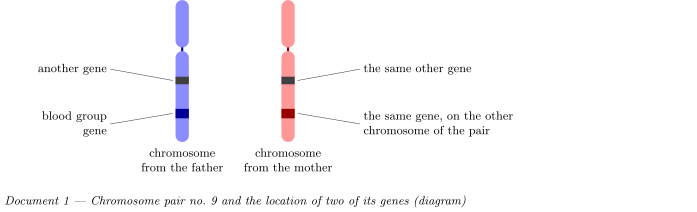
- A chromosome is an element of the nucleus, visible under the microscope when the cell divides.
- A gene is a portion of a chromosome that determines a hereditary characteristic. Each gene occupies a precise location on a precise chromosome.
Each chromosome carries many genes, placed one after another. All the chromosomes of a human cell together carry about 20 000 genes. Passing on one's chromosomes therefore means passing on one's genes.
3.2 The human karyotype
Problem. How many chromosomes does a human cell have, and how are they classified?
3.2.1 Making a karyotype
To study a person's chromosomes, a few of their cells are taken (from a drop of blood, for example). They are made to divide, then burst, and their chromosomes are photographed. The chromosomes are then arranged in pairs, from the largest to the smallest: the document obtained is a karyotype.
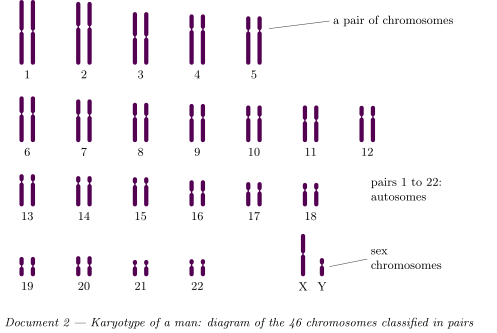
Proof (Analysis)
- 46 chromosomes are counted.
- These chromosomes are arranged two by two: the two chromosomes of the same pair have the same size and the same shape. There are 23 pairs.
- The pairs numbered 1 to 22 are made up of two similar chromosomes.
- The last pair is different: in this man, it is made up of two chromosomes that do not look alike, a large one, called X, and a small one, called Y.
3.2.2 The sex chromosomes
The karyotype of a woman also has 46 chromosomes and differs from that of a man only in the last pair.
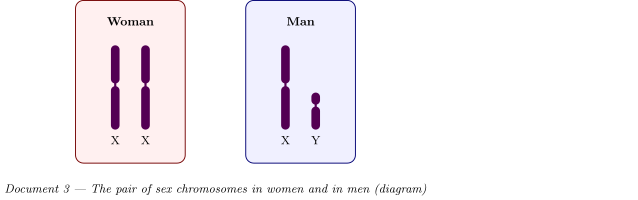
- The karyotype is the set of chromosomes of a cell, classified in pairs according to their size and shape.
- The autosomes are the chromosomes of pairs 1 to 22: they are the same in men and in women.
- The sex chromosomes form the 23rd pair: two X chromosomes in women, one X chromosome and one Y chromosome in men.
Exercises of the chapter
- Reading a karyotype solved
- Cells and their chromosomes solved
- A gene on a chromosome solved
- What if meiosis did not exist? solved
- Girl or boy? solved
- The chromosomes of some animals solved