The defenses of the human body
Course · Life Sciences (Grade 11 Humanities, Lebanon), chapter 4 · Lebanon, Grade 11 Humanities · the beginning of the chapter, the rest on Adloun
The air we breathe, the objects we touch and the food we eat carry billions of microbes. Most are harmless; a few can make us ill. Yet a splinter stuck in a finger most often causes only a little redness that disappears within a few days, and we recover from flu without any medicine against the virus. The body therefore has defenses. How does it distinguish what belongs to it from what is foreign to it? Which organs and which cells defend it? And how are these defenses organized, from the first minute until recovery?
Curriculum: LB-1H
Required skills
- Distinguish self and non-self; explain the rejection of a graft or of an incompatible transfusion.
- Name the organs and cells of the immune system and state their role.
- List the natural barriers of the body.
- Relate the four signs of inflammation to what happens in the infected tissue.
- Describe, in order, the stages of phagocytosis.
- Describe the humoral response: B lymphocytes, plasma cells, antibodies.
- Draw a diagram of an antibody and explain its specificity.
- Describe the cell-mediated response: cytotoxic T lymphocytes.
4.1 Self and non-self
Problem. How does the body recognize what belongs to it and what is foreign to it?
4.1.1 Grafts accepted, grafts rejected
In a person with severe burns, the destroyed skin is replaced by a piece of healthy skin: this is a graft. Experience shows that not all grafts succeed. The following document brings together skin grafts carried out in mice.
{
| Skin graft | Result | |
|---|---|---|
| 1 | The skin of a mouse A is grafted onto the same mouse A | graft accepted: the grafted skin stays in place and becomes covered with hair |
| 2 | The skin of a mouse A is grafted onto a mouse B, of another strain | graft rejected: the grafted skin is destroyed in about twelve days |
| 3 | The skin of a mouse A is grafted onto a mouse A', genetically identical to A | graft accepted |
Document 1 — Three skin grafts in mice
Proof (Analysis)
- Graft 1. The body accepts its own skin.
- Graft 2. The body destroys the skin of another individual: it recognizes it as foreign.
- Graft 3. The skin of another individual is accepted if that individual is genetically identical to the recipient, as two identical twins are. What distinguishes “own” from “foreign” therefore depends on genes.
All the cells of an individual carry on their membrane molecules that are specific to that individual, like an identity card: these are the self markers. They are made according to the genes inherited from both parents; this is why they differ from one person to another, except in identical twins.
- Self is the set of cells and molecules specific to an organism.
- Non-self is everything that is foreign to it: microbes (bacteria, viruses…), cells of another individual, foreign substances.
- An antigen is an element recognized as foreign by the body and that triggers a defense reaction.
4.1.2 Another example: blood groups
Red blood cells also carry markers. Two of them, called A and B, define the four blood groups A, B, AB and O.
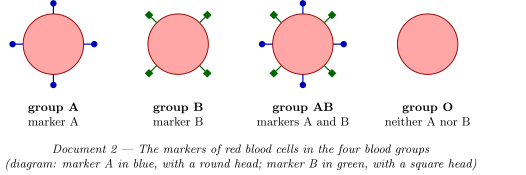
A person's blood also contains, in its liquid part (the plasma), defense molecules, antibodies, directed against the markers that the person does not have. If a person is transfused with red blood cells carrying a marker that is foreign to them, their antibodies attach to it: the red blood cells received clump together, then are destroyed. The transfusion is said to be incompatible; it is dangerous.
{
| Group | Red cell markers | Plasma antibodies | Can receive red cells from |
|---|---|---|---|
| A | A | anti-B | A and O |
| B | B | anti-A | B and O |
| AB | A and B | none | A, B, AB and O |
| O | none | anti-A and anti-B | O |