Disorders of the immune system
Course · Life Sciences (Grade 11 Humanities, Lebanon), chapter 5 · Lebanon, Grade 11 Humanities · the beginning of the chapter, the rest on Adloun
The immune system defends the body against microbes, provided it reacts just as much as it should. Sometimes it reacts too much: every spring, some people sneeze and have watery eyes although they have only breathed in pollen, which is harmless. Sometimes, too, it does not react enough: microbes that are usually harmless then cause serious diseases. What is an allergy? What happens when the defenses are weakened? And how does the AIDS virus manage to disarm the body?
Curriculum: LB-1H
Required skills
- Define an allergy and an allergen; list common allergens.
- Distinguish the first contact with an allergen (sensitization) from the following contacts (allergic reaction).
- Distinguish a congenital immune deficiency from an acquired immune deficiency and give its consequence.
- Explain that HIV destroys T4 lymphocytes and relate this destruction to AIDS.
- Read the curves of the number of T4 lymphocytes and of the viral load during the infection.
- List the modes of transmission of HIV, what does not transmit it and the means of prevention.
5.1 Allergy
Problem. Why does a harmless substance, such as pollen, make some people ill?
5.1.1 An excessive reaction to a harmless substance
{
| Substance involved | Route of entry | Frequent symptoms |
|---|---|---|
| Pollens, house dust mites, animal hair | air breathed in | sneezing, runny nose, red eyes (“hay fever”), breathing difficulty (asthma) |
| Certain foods (peanut, egg, milk, seafood…) | diet | red patches on the skin, itching, swelling of the lips, digestive disorders |
| Wasp or bee venom, certain medicines | sting, treatment | swelling, red patches, sometimes fainting |
Document 1 — Some substances responsible for allergies
These substances are neither microbes nor poisons: most people encounter them without any reaction. In an allergic person, however, the immune system treats them as a dangerous antigen.
An allergy is an excessive reaction of the immune system against a foreign substance that is normally harmless. This substance is an allergen.
5.1.2 Two stages: sensitization, then the reaction
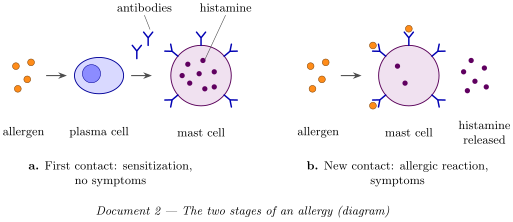
A person is never ill the first time they encounter the allergen. The following document shows why. It involves cells present in the skin and the mucous membranes, the mast cells, filled with small granules of a substance called histamine.
Proof (Analysis)
- First contact. The allergen is recognized as an antigen. Plasma cells make particular antibodies, which attach to the mast cells. The person feels nothing, but is now sensitized.
- Following contacts. The allergen attaches to the antibodies carried by the mast cells. These immediately release their histamine, which dilates the blood vessels and irritates the tissues: the symptoms appear within a few minutes.
Exercises of the chapter
- Hay fever in spring solved
- Two wasp stings solved
- An infant without defenses solved
- HIV in culture solved
- Ten years of infection without treatment solved
- Transmits, does not transmit solved