From gene to protein
Course · Life Sciences (Grade 11, Lebanon), chapter 2 · Lebanon, Grade 11 · the beginning of the chapter, the rest on Adloun
The keratin of a hair, the hemoglobin that colors the blood, the insulin that regulates the sugar level, the enzymes that digest a meal: these substances with such different roles all belong to the same family of molecules, the proteins. A cell makes thousands of kinds of them, each one following a precise order of assembly. Yet genetic information is enclosed in the nucleus, in the form of DNA, whereas proteins are made in the cytoplasm. How does the information carried by a gene control the construction of a protein, and what becomes of this protein once it is built?
Curriculum: LB-1S
Required skills
- Give various roles of proteins and write the general formula of an amino acid.
- Draw a diagram of the formation of a peptide bond and relate the sequence of a protein to its shape.
- Define a gene and show that its nucleotide sequence determines an amino acid sequence.
- Compare RNA with DNA; describe transcription and write the messenger RNA transcribed from a DNA strand.
- Use the table of the genetic code to translate a messenger RNA; state the properties of the code.
- Describe the steps of translation at the level of a ribosome and the role of transfer RNAs.
- Describe the path of a secreted protein, from the endoplasmic reticulum to exocytosis.
2.1 Proteins, assemblies of amino acids
Problem. After water, proteins are the most abundant constituents of a cell. What are they made of, and what distinguishes one protein from another?
2.1.1 Molecules with very varied roles
{
| Role | Example of a protein | What it does |
|---|---|---|
| Structure | keratin, collagen | make up hair, nails, skin, tendons |
| Transport | hemoglobin | carries oxygen in the blood |
| Catalysis | amylase (an enzyme) | speeds up the digestion of starch |
| Communication | insulin (a hormone) | passes a message between organs |
| Movement | actin, myosin | bring about the contraction of muscles |
| Defense | antibodies | neutralize microbes |
Proteins are therefore the main “tools” and “materials” of the cell: they are essential organic constituents of all living things.
2.1.2 Amino acids
When heated for a long time in the presence of an acid, or attacked by digestive enzymes, a protein breaks down: this is hydrolysis. Whatever the protein, the same type of small molecules is always collected, the amino acids. Living things use only twenty kinds of them to build all their proteins.
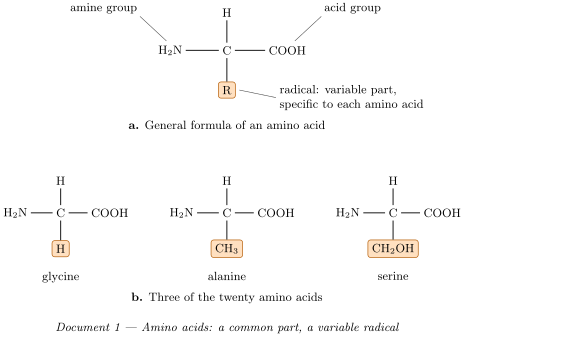
An amino acid is an organic molecule that carries, on the same carbon atom, an amine group , an acid group , a hydrogen atom and a radical written R. The radical differs from one amino acid to another: it is the radical that gives each of the twenty amino acids its properties.
2.1.3 The peptide bond
In a protein, the amino acids are attached to one another in a chain. Document 2 shows how two amino acids bond.
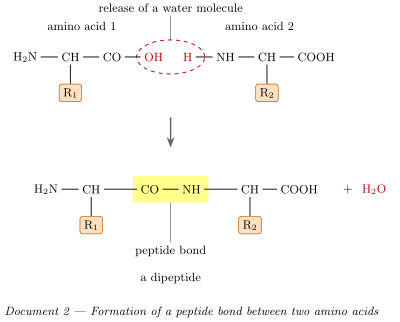
- The peptide bond is the bond that forms between the acid group of one amino acid and the amine group of the next amino acid; its formation releases a water molecule.
- Two amino acids bonded in this way form a dipeptide, three a tripeptide. A long chain of amino acids is a polypeptide chain or polypeptide. A chain of amino acids has peptide bonds.
- A protein is made of one or more polypeptide chains, which most often contain from a hundred to several thousand amino acids.
2.1.4 From sequence to shape
Two proteins differ by the number of their amino acids, by their nature and above all by the order in which they follow one another: this is the sequence of the protein. With twenty amino acids, the number of possible sequences is immense: a chain of only three amino acids can already be written in ways.
A polypeptide chain does not stay stretched out. Depending on the nature and position of their radicals, some amino acids attract each other and others repel each other: the chain folds up on itself and takes a precise three-dimensional shape.
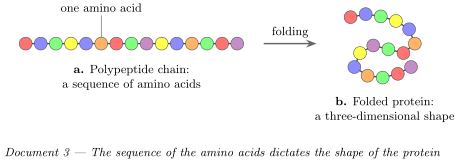
The sequence of the amino acids of a polypeptide chain determines the way it folds, and therefore the three-dimensional shape of the protein. This shape in turn determines the function of the protein. Changing a single amino acid can be enough to change the shape of a protein and prevent it from fulfilling its role.
2.2 The gene, a unit of structure and information
Problem. DNA carries genetic information in the form of a nucleotide sequence; a protein is a sequence of amino acids. What link joins these two sequences?
2.2.1 One gene, one segment of DNA
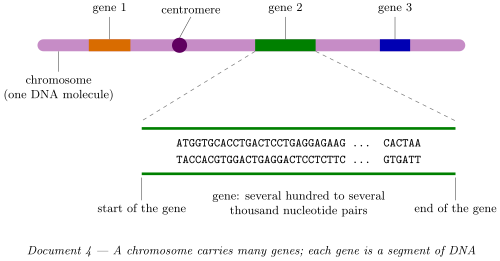
A human cell makes thousands of different proteins, but has only 46 DNA molecules in the G phase. Each DNA molecule therefore carries the information needed to make many proteins. The portion of a DNA molecule that governs the production of a given polypeptide chain is called a gene. Each gene occupies a fixed location on a given chromosome: the gene that controls the beta chain of hemoglobin, for example, is found on chromosome 11 of the human species.
2.2.2 The sequence of the gene and the sequence of the protein
The hemoglobin of red blood cells comprises two kinds of polypeptide chains; one of them, the beta chain, has 146 amino acids. In people affected by a hereditary disease, sickle cell anemia, this chain is abnormal: the hemoglobin forms long fibers that deform the red blood cells. The start of the gene and the start of the chain were compared in a healthy person and in a sick person (the table shows only one strand of the gene, from the fourth nucleotide on, and designates the amino acids by their abbreviation).
{
| Position | 1 | 2 | 3 | 4 | 5 | 6 | 7 | 8 | |
|---|---|---|---|---|---|---|---|---|---|
| Healthy person | gene | GTG | CAC | CTG | ACT | CCT | GAG | GAG | AAG |
| beta chain | Val | His | Leu | Thr | Pro | Glu | Glu | Lys | |
| Sick person | gene | GTG | CAC | CTG | ACT | CCT | GTG | GAG | AAG |
| beta chain | Val | His | Leu | Thr | Pro | Val | Glu | Lys |
Proof (Analysis)
The two genes differ by only one nucleotide, at position 6: A in the healthy person, T in the sick person. The two chains differ by only one amino acid, also located at position 6: glutamic acid (Glu) is replaced by valine (Val). The rest of the 146 amino acids is identical. A change in the nucleotide sequence of the gene is therefore expressed as a change, at the same place, in the amino acid sequence of the protein. Note also that each amino acid corresponds to a group of three nucleotides of the gene.
A gene is a segment of DNA, located at a precise place on a chromosome, whose nucleotide sequence determines the amino acid sequence of a polypeptide chain. The gene is both a unit of structure (a fragment of the DNA molecule) and a unit of information (the “plan” of a polypeptide chain).
Exercises of the chapter
- A small peptide to analyze solved
- Two almost twin hormones solved
- Three versions of the same gene solved
- Transcribing, then translating solved
- A ribosome at work solved
- Khorana's artificial RNAs solved