Enzymes, biological catalysts
Course · Life Sciences (Grade 11, Lebanon), chapter 3 · Lebanon, Grade 11 · the beginning of the chapter, the rest on Adloun
A mouthful of bread chewed for a long time ends up tasting sweet: in less than a minute, at body temperature, part of its starch has been converted into a sugar. In the laboratory, a chemist who wants to obtain the same result must boil the starch for an hour in acid. The whole functioning of a cell relies on thousands of chemical reactions of this kind, which take place quickly, without heating and without acid. Which substances make these reactions possible? What does their efficiency depend on? And how do they act?
Curriculum: LB-1S
Required skills
- Show, from experimental results, that an enzyme is a catalyst: it speeds up a reaction, acts in very small quantities and is recovered intact at the end of the reaction.
- Justify the protein nature of enzymes.
- Read an initial reaction rate on a curve.
- Describe and explain the influence of temperature and pH on the activity of an enzyme.
- Describe qualitatively the influence of substrate concentration on the initial rate.
- Define the substrate specificity and the specificity of action of an enzyme.
- Explain the mode of action of an enzyme using the active site and the enzyme-substrate complex.
3.1 Enzymes, protein biocatalysts
Problem. Starch is a very large molecule, made of thousands of glucose molecules attached to one another. How does the body manage to break it down quickly at 37 °C?
3.1.1 A reaction speeded up by saliva
Recall two tests: iodine solution, orange-yellow, turns blue-black in the presence of starch; Fehling's solution, blue, gives a brick-red precipitate when heated in the presence of certain sugars, such as glucose or maltose (a sugar made of two glucose units), but not in the presence of starch.
Three tubes containing the same volume of a starch solution (starch paste) are prepared and placed in a water bath at 37 °C:
- tube A: starch paste and water;
- tube B: starch paste and a few drops of a solution of amylase, a substance extracted from saliva;
- tube C: starch paste and the same amylase solution, previously brought to a boil.
Every two minutes, a drop is taken from each tube and placed on a drop of iodine solution.
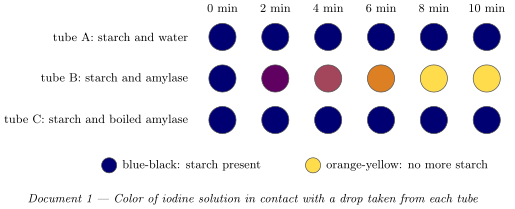
After ten minutes, the Fehling's solution test is negative for tubes A and C, positive for tube B.
Proof (Analysis)
- In tube A, starch is still present after ten minutes, and no sugar has appeared: at 37 °C, starch alone in water is not converted to any detectable extent.
- In tube B, the starch disappeared in six to eight minutes and a sugar appeared, maltose. The starch was broken down by reaction with water: this is a hydrolysis. Since tubes A and B differ only by the amylase, it is the amylase that made the reaction fast.
- In tube C, the boiled amylase has no effect: boiling made it lose its power.
3.1.2 Three characteristics of a catalyst
Other observations complete this result.
- A few drops of a very dilute amylase solution are enough to convert a quantity of starch thousands of times larger.
- If, once the reaction is over, starch paste is added again to tube B, this starch is hydrolyzed in turn, and this can be repeated several times: the amylase is still present and still active. It has therefore not been consumed by the reaction.
- Amylase does not create a new reaction: the hydrolysis of starch is possible without it, but it is then so slow that it cannot be detected, unless the starch is strongly heated in an acid medium.
- A catalyst is a substance that speeds up a chemical reaction, acts in very small quantities and is recovered intact at the end of the reaction.
- An enzyme is a catalyst made by a living thing: it is a biocatalyst. It acts under the conditions of life, at moderate temperature.
- The substance converted thanks to the enzyme is its substrate; the substances formed are the products of the reaction.
In the previous experiment, amylase is the enzyme, starch the substrate and maltose the product:
The name of an enzyme generally ends with the suffix -ase and often recalls its substrate: amylase acts on starch, sucrase on sucrose, proteases on proteins, lipases on lipids.
3.1.3 Enzymes are proteins
{
| Observation on an amylase solution | What it indicates |
|---|---|
| It gives a violet color with the biuret reagent | it contains a protein |
| Treated with a protease, an enzyme that breaks down proteins, it loses its catalytic power | the catalyst is itself a protein |
| Brought to a boil, it loses its catalytic power | like proteins, it is altered by heat |
Enzymes are proteins. Like any protein, an enzyme is a chain of amino acids folded into a precise three-dimensional shape; it is made by the cell from the information of a gene. A cell has thousands of different enzymes: almost each of its chemical reactions has its own.
3.2 Reaction rate and optimum conditions
Problem. An enzyme speeds up a reaction: how can this rate be measured, and on which conditions of the medium does it depend?
3.2.1 Measuring a reaction rate
Hydrogen peroxide is a toxic product that forms in cells. A very widespread enzyme, catalase, breaks it down into water and oxygen:
An oxygen probe connected to a computer is placed in a closed chamber containing hydrogen peroxide. At time , a small quantity of catalase is injected, then the oxygen concentration is recorded.
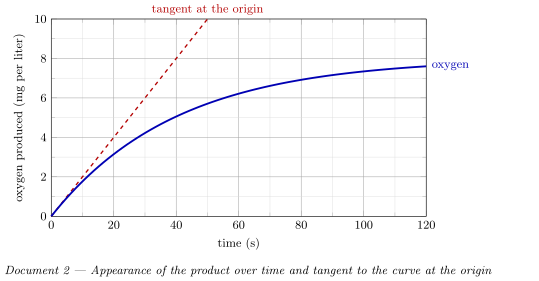
Proof (Analysis)
The oxygen concentration increases quickly at first, then more and more slowly, and tends toward a constant value: the reaction slows down as the hydrogen peroxide runs out, then stops when there is none left. The reaction rate is therefore not the same at every moment. To compare experiments with one another, the rate at the very beginning, when the substrate is still abundant, is used: the initial rate.