Energy expenditure of organisms
Course · Life Sciences (Grade 11, Lebanon), chapter 4 · Lebanon, Grade 11 · the beginning of the chapter, the rest on Adloun
In a closed classroom, in winter, the temperature gradually rises without anyone having turned on the heating: each student, even when motionless, constantly gives off heat to the surrounding air. If that same student runs up the school stairs, his breathing speeds up, his heart beats faster, he feels hot. The body therefore expends energy at every moment, and it expends more or less of it depending on what it is doing. How can this expenditure be measured? What does it depend on? And is there a minimum expenditure, below which a living organism cannot go?
Curriculum: LB-1S
Required skills
- Describe the principle of direct calorimetry and that of indirect calorimetry.
- Calculate an energy expenditure from an oxygen consumption and the thermal equivalent of oxygen.
- Calculate a respiratory quotient and relate it to the nature of the nutrients oxidized.
- Express an energy expenditure in a suitable unit: kJ, kJ per hour, kJ per hour per square meter of body surface area.
- Describe, from documents, the variations in energy expenditure according to activity, outside temperature, age, sex and physiological state.
- Define basal metabolism, state the conditions for measuring it and explain why it is an irreducible expenditure.
4.1 Evaluating energy expenditure
Problem. Energy cannot be seen or weighed. Through what measurements can the quantity of energy an organism expends be known?
4.1.1 In what forms does the body expend energy?
A living organism uses energy for three kinds of tasks:
- mechanical work: contraction of the muscles that move the body, heartbeats, breathing movements;
- chemical work: production of the molecules of its cells, for example protein synthesis;
- the production of heat, which keeps the temperature of the human body close to 37 °C even though the air is almost always colder.
In a subject at rest, who moves no object, all the energy expended ends up leaving the body as heat: the blood set in motion by the heart rubs against the walls of the vessels and warms up there, and the molecules made are sooner or later broken down. Measuring the heat given off by a subject at rest therefore amounts to measuring his energy expenditure.
The energy expenditure of an organism is the quantity of energy it uses over a given time. Energy is measured in joules (J); the kilojoule is mainly used: . An old unit is still used on food labels, the kilocalorie: .
4.1.2 Direct calorimetry: measuring heat
The first idea is to measure directly the heat that the body gives off to its surroundings: this is direct calorimetry. The subject spends several hours in a calorimetric chamber, a room whose insulating walls let no heat in or out. A stream of cold water runs through a pipe that winds through the chamber: this water carries away the heat produced by the subject, and it comes out warmer than it went in.
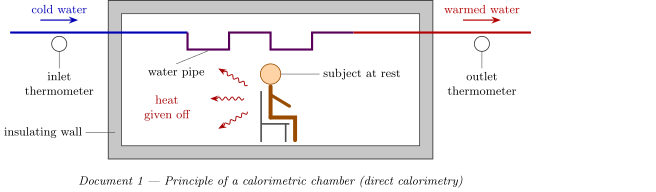
It takes kJ to raise the temperature of 1 kg of water by 1 °C. Knowing the mass of water that has passed through the chamber and its rise in temperature, the heat carried away is calculated:
In one hour, 40 kg of water pass through the chamber; the water enters at °C and comes out at °C. Its rise in temperature is °C, so
The subject gave off 418 kJ in one hour: his energy expenditure is 418 kJ per hour.
At the end of the 18th century, Lavoisier and Laplace carried out the first measurement of this kind. They shut a guinea pig in a chamber surrounded by ice: the animal's heat melted the ice, and the mass of water collected measured this heat. Having also measured the carbon dioxide released by the animal, they compared respiration to a slow combustion, which consumes oxygen and gives off heat.
Direct calorimetry is precise, but it requires a heavy installation and a long stay by the subject: it cannot be used for a runner or a swimmer. A second, simpler method has replaced it almost everywhere.
4.1.3 Indirect calorimetry: measuring the oxygen consumed
The energy that the body expends comes from the oxidation of nutrients by oxygen, in its cells. For glucose, the overall equation of this oxidation is written:
The more energy an organism expends, the more nutrients it oxidizes, and the more oxygen it consumes. Instead of measuring heat, the volume of oxygen consumed can therefore be measured: this is indirect calorimetry. The classic apparatus is the spirometer.
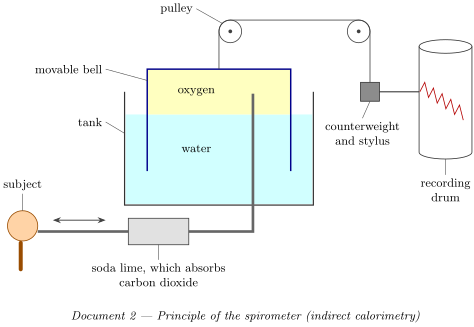
The subject breathes, through a mouthpiece, the oxygen contained in a bell floating on water. The air he breathes out returns to the bell after passing through soda lime, which retains carbon dioxide. The volume of gas in the bell rises and falls with each breathing movement; but, from one breath to the next, it gradually decreases, by the volume of oxygen that the body has consumed. A stylus connected to the bell records these variations.
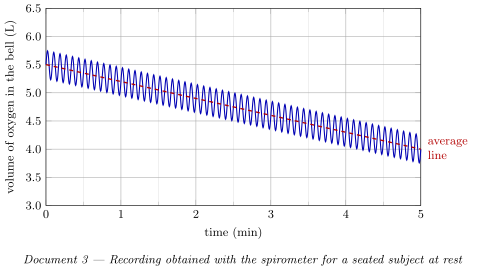
Proof (Analysis)
- The rapid oscillations reflect the breathing movements: the volume of the bell decreases with each inhalation and rises again with each exhalation.
- The average line goes down: in 5 min, the volume of oxygen in the bell goes from L to L. The subject consumed L of oxygen in 5 min, that is, L per minute.
This volume of oxygen remains to be converted into energy. Measurements made by burning nutrients in oxygen have established, for each kind of nutrient, the energy released per liter of oxygen consumed and the ratio between the volumes of gas exchanged.
{
| Carbohydrates | Lipids | Proteins | |
|---|---|---|---|
| Energy released per liter of oxygen consumed (kJ) | 21 | about 19 | |
| Volume of released divided by the volume of consumed | 1 | about |