The energy of cell functioning
Course · Life Sciences (Grade 11, Lebanon), chapter 5 · Lebanon, Grade 11 · the beginning of the chapter, the rest on Adloun
An organism at rest consumes oxygen and expends energy at every moment. But an organism is made of cells: it is in them that the oxygen brought by the blood disappears, and it is in them that the nutrients resulting from digestion are used. On what does a cell expend energy? Where does it get it from? In which part of the cell is this energy released, and in what form can the cell use it?
Curriculum: LB-1S
Required skills
- List the activities of a cell that consume energy and the nutrients that supply it with energy.
- Demonstrate, from experimental results, the gas exchanges of cellular respiration.
- Write the overall equation of the oxidation of glucose by cellular respiration.
- Label the ultrastructure of a mitochondrion and justify its role as the site of cellular oxidations.
- Explain that part of the energy of metabolites is conserved in the form of ATP, the rest being dissipated as heat.
- Present ATP as the intermediary between the reactions that release energy and the activities that consume it.
5.1 Cells expend energy
Problem. The energy expenditure of an organism is the sum of those of its cells. Which activities of a cell require energy, and which substances supply it?
5.1.1 The energy expenditure of a cell
Every living cell, even one in an organ at rest, constantly carries out tasks that do not happen by themselves.
{
| Activity of the cell | Examples |
|---|---|
| Syntheses | assembly of amino acids into proteins, replication of DNA before a division, production of reserves |
| Movements | contraction of a muscle fiber, beating of the flagellum of a sperm cell, movement of the chromosomes during mitosis |
| Exchanges with the surroundings | entry or exit of certain substances across the plasma membrane, secretion by exocytosis |
| Production of heat | maintenance of body temperature |
A cell deprived of energy immediately stops making its molecules, contracting or dividing: it soon dies.
5.1.2 Nutrients, sources of energy for the cell
The cells of an animal or of a fungus do not capture the energy of light. Their only source of energy is the organic matter they receive from their surroundings: nutrients. In humans, these come from the digestion of food and are brought to the cells by the blood: glucose, fatty acids and amino acids. They are organic molecules, rich in chemical energy: when they are burned, they give off heat.
- The metabolism of a cell is the set of chemical reactions that take place in it. Each one is catalyzed by an enzyme.
- An energy metabolite is an organic molecule that the cell breaks down to obtain energy from it. Glucose is the main one.
5.2 Cellular respiration
Problem. How does a cell obtain energy from a metabolite such as glucose?
5.2.1 The gas exchanges of a cell suspension
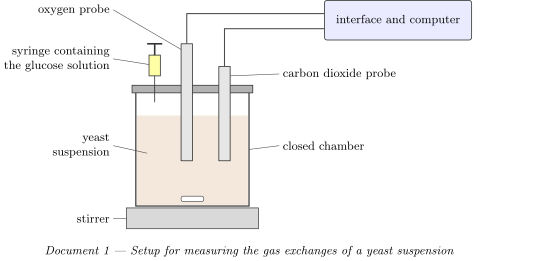
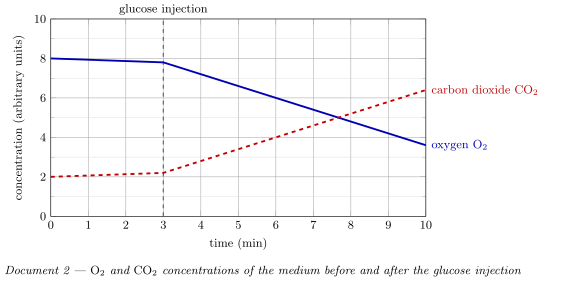
Baker's yeast is a fungus made of a single cell, easy to grow. A suspension of yeast cells, deprived of food since the day before, is placed in a closed chamber, stirred and kept at 25 °C. Two probes continuously measure the oxygen and carbon dioxide concentrations of the medium. After three minutes, a little glucose solution is injected into the chamber.
Proof (Analysis)
- Before the injection, the two concentrations hardly vary: deprived of nutrients, the yeast cells exchange very little gas with their surroundings.
- As soon as the glucose is added, the concentration decreases steadily, from to units in seven minutes, while the concentration increases by the same amount, from to units.
In the presence of glucose, the yeast cells absorb oxygen and release carbon dioxide. An assay shows at the same time that the glucose disappears from the medium, and a sensitive thermometer shows that the suspension warms up slightly: the glucose is consumed, and energy is released.
The same result is obtained with animal or plant cells: all living cells that have oxygen available carry out these exchanges.
5.2.2 The overall balance of cellular respiration
Experiments in which the fate of the atoms of glucose is followed show that the carbon of glucose is found entirely in the carbon dioxide released, and that the oxygen absorbed is used to form water. Glucose, an organic molecule, is thus entirely transformed into mineral matter: it is oxidized by oxygen.
Cellular respiration is the complete oxidation of an organic metabolite by oxygen, inside the cell. It produces carbon dioxide and water, and it releases the chemical energy of the metabolite. For glucose, its overall equation is written: