Energy metabolism in humans
Course · Life Sciences (Grade 11, Lebanon), chapter 6 · Lebanon, Grade 11 · the beginning of the chapter, the rest on Adloun
We eat three or four meals a day, yet our heart beats, our brain works and our muscles contract at every hour, including during the night, long after the last meal. A long-distance runner runs for two hours without eating; a sprinter produces, in ten seconds, an effort so violent that breathing has no time to adjust to it. In what form do foods reach the cells? Where does the body set aside what it does not spend at once? How does the blood stay supplied with glucose between meals? And how does a muscle find, at every moment, the energy for its contraction?
Curriculum: LB-1S
Required skills
- List the energy metabolites of the human body and state their origin.
- Name the energy reserves of the body and the organs that store them.
- Define glycemia and give its normal value.
- Show, from experimental results, that the liver stores glucose in the form of glycogen and releases glucose into the blood.
- Describe the washed-liver experiment and draw its conclusion.
- Label the diagram of a muscle fiber and relate its organization to its function.
- Compare respiration and lactic fermentation in the muscle fiber.
- Present the three pathways that restore ATP and relate them to the duration and intensity of an effort.
6.1 Nature and origin of energy metabolites
Problem. Cells draw their energy from metabolites that they oxidize. What are these metabolites in humans, and where do they come from?
6.1.1 From foods to nutrients
Foods contain three kinds of energy-rich organic molecules: carbohydrates (such as the starch of bread, rice or bulgur), lipids (such as the triglycerides of olive oil) and proteins (such as those of meat, eggs or lentils). These are large molecules, unable to cross the wall of the intestine. In the digestive tract, digestive enzymes cut them by hydrolysis into small molecules, the nutrients, which pass into the blood in the small intestine.
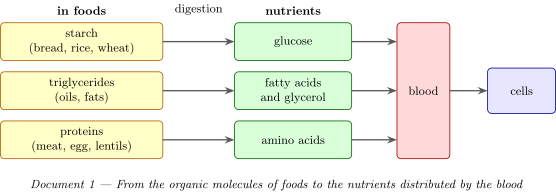
The energy metabolites of the human body are varied:
- glucose, which comes from the digestion of carbohydrates;
- fatty acids and glycerol, which come from the digestion of lipids;
- amino acids, which come from the digestion of proteins.
They all come from food. Absorbed by the small intestine, they are carried by the blood to all the cells.
6.1.2 Metabolites used unequally
In the mitochondria of cells, these metabolites are oxidized by cellular respiration, and part of their energy is conserved in the form of ATP. Yet they do not all play the same role.
- Glucose can be used by all cells; brain cells, in particular, depend almost entirely on it.
- Fatty acids are very rich in energy: the oxidation of one gram of lipids releases about 38 kJ, compared with 17 kJ for one gram of carbohydrates. Muscle at rest or during prolonged effort, the heart and the liver oxidize a lot of them.
- Amino acids serve first of all to build the body's proteins. Only a small proportion of them is oxidized, except during prolonged fasting.
6.2 Energy reserves and their storage organs
Problem. Meals are spaced out, while cells consume metabolites without interruption. Where does the body store the metabolites it does not use at once?
6.2.1 Glycogen and triglycerides
After a meal, the intestine releases into the blood far more nutrients than the cells oxidize. The surplus does not stay in the blood: it is stored in certain organs, in the form of large molecules.
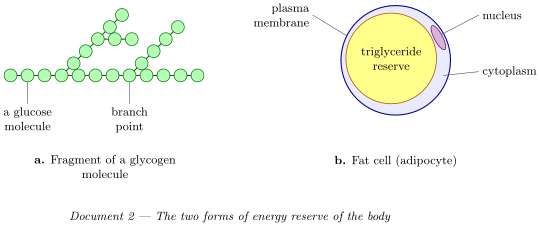
- Glycogen is a very large branched molecule, made of thousands of glucose molecules attached to one another. It is the storage form of glucose in animals, as starch is in plants. Iodine solution stains it mahogany brown.
- A triglyceride is a lipid made of one glycerol and three fatty acids. It is the storage form of fatty acids.
The table gives an order of magnitude of the reserves of a 70 kg adult, and the energy they represent (17 kJ per gram of glycogen, 38 kJ per gram of triglycerides).
{
| Reserve | Storage organ | Mass | Energy (kJ) |
|---|---|---|---|
| Glycogen | liver | 100 g | |
| Glycogen | muscles | 400 g | |
| Triglycerides | adipose tissue | 12 kg |
Proof (Analysis)
- The glycogen reserves are modest: kJ, less than the expenditure of a single day, close to kJ for an adult man.
- The triglyceride reserves are more than 50 times larger (): they would cover the expenditure of several weeks. For the same mass, a lipid contains more than twice as much energy as a carbohydrate, and it is stored without water: it is a compact reserve.
- The liver and the muscles store glucose in the form of glycogen: it is a small reserve, quickly mobilized.
- Adipose tissue, located mainly under the skin and around the organs, is made of fat cells that store triglycerides: it is the body's large energy reserve.
Between meals, these reserves are broken down and give back metabolites: glucose from glycogen, fatty acids and glycerol from triglycerides.
6.3 The liver, the organ that regulates glycemia
Problem. Glucose enters the blood only at mealtimes, but the cells take it up continuously. How does the glucose concentration of the blood vary over the day, and which organ controls it?
6.3.1 Glycemia, an almost constant quantity
Glycemia is the glucose concentration of the blood. In a healthy person who has not eaten, it is close to 1 g per liter of blood (between and ).
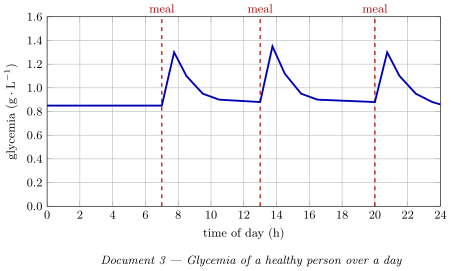
The glycemia of a healthy person is measured throughout a day that includes three meals.
Proof (Analysis)
- After each meal, glycemia rises: it reaches to in less than an hour. But this rise is limited and brief: within two to three hours, glycemia is back to , although the meal supplied tens of grams of glucose.
- Far from meals, and even at the end of the night, after ten hours without eating, glycemia does not fall below , although the cells have not stopped taking up glucose.
Glycemia therefore varies very little around 1 g per liter. There must be a mechanism that removes glucose from the blood after meals and supplies it with glucose between meals.
This constancy is vital. If glycemia falls below , the brain, which consumes almost nothing but glucose, stops working normally: faintness, loss of consciousness, coma. A glycemia that stays too high damages the blood vessels in the long run.
6.3.2 The liver retains or releases glucose
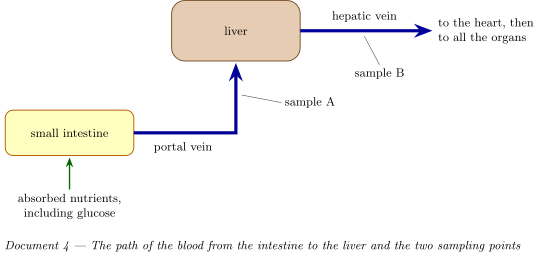
The blood coming from the intestine, loaded with the absorbed nutrients, does not go directly to the heart: the hepatic portal vein first takes it to the liver. It leaves the liver through the hepatic veins. Glucose is measured in the blood of these two vessels, in an animal, after a meal rich in carbohydrates and then after a day of fasting.
{
| Glycemia () | A: portal vein | B: hepatic vein |
|---|---|---|
| After a meal rich in carbohydrates | ||
| After a day of fasting |