Diversity of nutritional habits
Course · Life Sciences (Grade 11, Lebanon), chapter 7 · Lebanon, Grade 11 · the beginning of the chapter, the rest on Adloun
In Beirut, a festive meal begins with a mezze: tabbouleh, hummus, vine leaves, labneh drizzled with olive oil. In Tokyo, rice, fish and a soybean soup will be served; in Mexico City, corn tortillas and beans. The plates do not look alike, and those of our great-grandparents did not look any more like ours. Yet all human beings have a body built in the same way. Why do people not eat the same thing everywhere, nor at all times? What do foods as different as bread, milk and oil have in common? How can it be shown by experiment? And how can we know what a food really supplies to the body?
Curriculum: LB-1S
Required skills
- Show, from documents, that nutritional habits vary according to regions and over time, and list the factors of this diversity.
- List the constituents of foods and distinguish organic constituents from mineral constituents.
- Distinguish a simple food from a compound food.
- Describe the tests that detect water, starch, reducing sugars, proteins, lipids and mineral salts, and interpret their results.
- Read a food composition table.
- Calculate the energy value of a food from its composition.
7.1 Nutritional behavior
Problem. All human beings need to feed themselves, but they do not feed themselves in the same way. How does diet vary from one region to another and from one period to another?
7.1.1 Habits that vary according to regions
In each region of the world, the traditional diet rests on a staple food, eaten at almost every meal, to which other foods are added in smaller quantities.
{
| Region | Staple food | Foods that often go with it |
|---|---|---|
| Around the Mediterranean, Middle East | wheat (bread, bulgur, semolina) | legumes, vegetables, fruits, olive oil, dairy products |
| East and Southeast Asia | rice | vegetables, soybeans, fish |
| Central America | corn | beans, chili peppers, squash |
| Tropical Africa | millet, sorghum, cassava, yam | vegetables in sauce, peanuts, dried fish |
| Arctic regions (traditional way of life) | fish, seal and reindeer meat | very few plants |
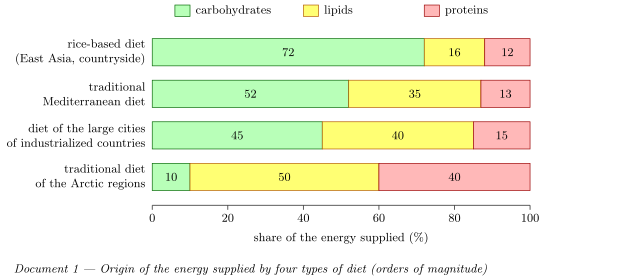
These diets can be compared by looking at which constituents the energy they supply comes from. Document 1 gives orders of magnitude for four types of diet.
Proof (Analysis)
- Where rice is the staple food, carbohydrates supply nearly three quarters of the energy (72%), and lipids very little (16%).
- The traditional Mediterranean diet still draws more than half of its energy from carbohydrates (52%), supplied by wheat and legumes; lipids, supplied mainly by olive oil, hold a large place in it (35%).
- In the large cities of industrialized countries, the share of lipids reaches 40% and that of carbohydrates falls to 45%.
- In the Arctic regions, where almost nothing grows, the traditional diet is made of animals: carbohydrates supply only 10% of the energy, lipids and proteins share the rest.
Healthy populations therefore live on very different diets. In all four cases, however, the same three energy sources are found: carbohydrates, lipids and proteins.
Several factors explain this diversity.
- The environment. Climate and soil decide what can be grown, raised or fished: the olive tree and wheat around the Mediterranean, rice in the hot, wet plains, fish along the coasts.
- Culture. Recipes, tastes and the way meals are taken are passed down from generation to generation. Traditions and religions recommend certain foods, rule out others, and set periods of fasting or feasting.
- Standard of living. Meat, fish and fruits cost more than cereals: their place on the plate depends on the family's resources.
- Way of life. The time available for cooking, work, life in the city or in the countryside, and advertising also steer choices.
Lebanese cuisine belongs to the Mediterranean family. Wheat is everywhere in it: bread, the bulgur of tabbouleh and kibbeh, the flatbread of man'oushe. Legumes (the chickpeas of hummus, the lentils of mujaddara, fava beans) are often combined with a cereal. Fresh vegetables and fruits are abundant, olive oil is the main fat, dairy products (labneh, yogurt, cheeses) are eaten every day; meat and fish come in more modest quantities. This diet makes use of what the mountains, the Bekaa plain and the coast produce.
7.1.2 Habits that change over time
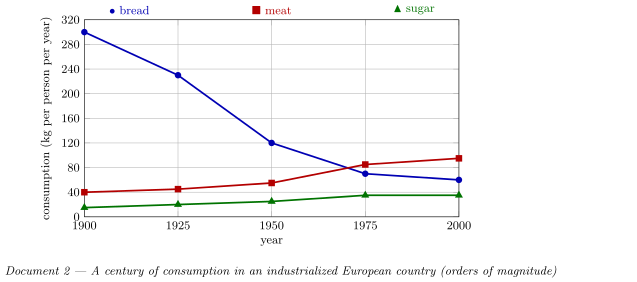
The first human beings lived by hunting, fishing and gathering. About ten thousand years ago, agriculture and animal husbandry, which appeared in particular in the Near East, made cereals the basis of the diet. Much closer to us, industry, transport and trade have once again transformed meals. Document 2 traces, in broad outline, a century of consumption in an industrialized European country.
Proof (Analysis)
- Bread consumption collapses: it is divided by 5 in a century (). Bread, the staple food in 1900, is now only an accompaniment.
- Meat consumption more than doubles (), and so does sugar consumption ().
In a century, starch-rich foods of plant origin have given ground to foods of animal origin, fats and sweet products. To this is added a change that the graph does not show: a growing share of foods is prepared by industry (ready meals, cookies, sugary drinks) and no longer at home.
This change is not specific to Europe. In the countries around the Mediterranean, including Lebanon, the traditional diet is also declining, especially in the cities and among young people: meals eaten out, fast food, sugary drinks and processed products take up a growing place, while daily life becomes less active.
Nutritional habits are diverse: they vary according to regions, with the environment, culture, standard of living and way of life, and they change over time, with techniques and ways of life. Despite this diversity, all diets supply the body with the same categories of constituents.
7.2 Foods, mixtures of the same constituents
Problem. A piece of bread, a glass of milk and a spoonful of oil have neither the same appearance nor the same taste. What are they made of?
7.2.1 Six categories of constituents
The chemical analysis of foods, whatever their origin, always leads to the same list of constituents.
- Water, present in almost all foods.
- Carbohydrates: the sweet-tasting sugars, such as the glucose and fructose of fruits, the sucrose of table sugar, the lactose of milk; the starch of cereals, legumes and potatoes, a large molecule made of very many glucose units; the cellulose of plant cell walls, the main dietary fiber.
- Lipids, or fats: oils, butter, fats.
- Proteins (protides): proteins proper, long chains of amino acids, and the amino acids themselves.
- Mineral salts: salts of calcium, sodium, potassium, iron, chlorides, phosphates…
- Vitamins, present in tiny quantities.
Carbohydrates, lipids, proteins and vitamins are organic constituents: their molecules contain carbon and come from living things. Water and mineral salts are mineral constituents.
7.2.2 The same constituents, in different proportions
A composition table gives the mass of each constituent in 100 g of food. Here is an extract (orders of magnitude; vitamins, whose mass is counted in milligrams, are not included).
Exercises of the chapter
- Three plates, three regions solved
- A century of changes solved
- Reading a composition table solved
- Five white powders solved
- The constituents of milk solved
- The energy of a breakfast solved