Principles of a well-balanced diet
Course · Life Sciences (Grade 11, Lebanon), chapter 8 · Lebanon, Grade 11 · the beginning of the chapter, the rest on Adloun
An infant doubles its mass in a few months; an adult keeps the same mass for years, although he swallows several hundred kilograms of food every year. A sailor deprived of fresh fruit used to fall ill, even though he ate his fill. Eating well therefore does not consist only in eating enough. How much energy must the diet supply every day? Which constituents does the body require, since it cannot make them? And how can the meals of a day be put together with the foods available?
Curriculum: LB-1S
Required skills
- Draw up the energy balance of an organism and predict its consequences on body mass.
- Relate energy needs to age, sex, activity and physiological state.
- Distinguish the energy role and the building role of foods.
- Show, from experimental results, that certain amino acids and certain fatty acids are essential.
- Define a vitamin; state the role and the sources of some vitamins and some minerals.
- Classify foods into food groups.
- State the rules of a balanced food ration, calculate a ration and assess it.
8.1 A diet sufficient in quantity
Problem. The body spends energy all the time, and it is the diet that supplies it. How much energy must foods supply every day?
8.1.1 The energy balance
An organism spends energy at every moment, even at complete rest: this is its basal metabolism, to which are added the expenditures linked to physical activity, to fighting the cold, to digestion and, depending on the case, to growth. All this energy comes from the oxidation of nutrients, and therefore from foods. Two quantities expressed in kilojoules can then be compared over a day:
- the energy intake, or inputs: the energy of the carbohydrates, lipids and proteins consumed;
- the energy expenditure, or outputs.
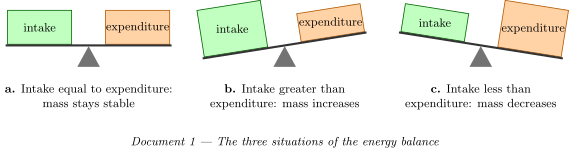
Three adults whose activity does not change are followed for a month. Their intake is assessed from what they eat, and their expenditure by indirect calorimetry.
{
| Subject 1 | Subject 2 | Subject 3 | |
|---|---|---|---|
| Intake (kJ per day) | |||
| Expenditure (kJ per day) | |||
| Change in mass in a month (kg) | 0 |
Proof (Analysis)
- Subject 1 eats exactly what he spends: his mass does not change.
- Subject 2 receives each day kJ more than he spends, that is, kJ in a month. This energy is not lost: the excess nutrients are stored, mainly in the form of triglycerides in adipose tissue. As one gram of lipids contains 38 kJ, the surplus corresponds to g of lipids: the mass increases by kg.
- Subject 3 receives kJ less than he spends. He makes up the difference by drawing on his reserves: his mass decreases by as much.
The energy balance is the difference between energy intake and energy expenditure.
- If it is zero, the reserves and body mass stay stable.
- If it is positive, the surplus is stored, mainly in the form of lipids: mass increases.
- If it is negative, the body draws on its reserves: mass decreases.
In the adult, a diet sufficient in quantity supplies as much energy as the body spends. In the child and the adolescent, it must supply more: the balance is slightly positive, because growth requires new matter.
8.1.2 Needs that vary from one person to another
A person's energy need is the energy intake that balances his expenditure, growth included. It therefore varies as the expenditure does.
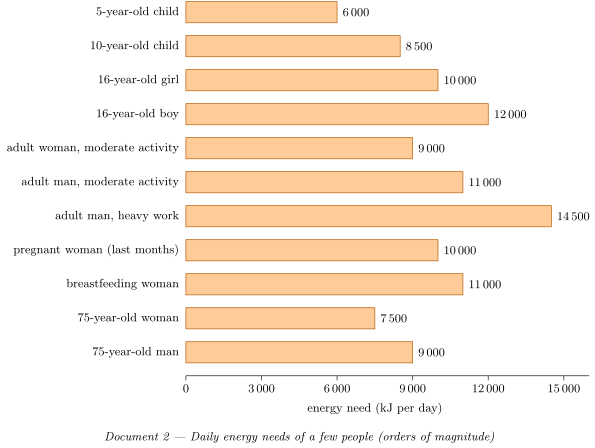
Proof (Analysis)
- Age. The need increases during childhood, peaks in adolescence, when growth is fast, then decreases in the elderly.
- Sex. For comparable age and activity, the need is on average higher in males: body mass and its proportion of muscle are greater.
- Activity. Heavy work raises the need of an adult man from to kJ per day, that is, nearly a third more.
- Physiological state. Pregnancy and breastfeeding increase a woman's need: energy is needed to build the tissues of the fetus, then to make milk.
The energy need depends on age, sex, physical activity, climate and physiological state (growth, pregnancy, breastfeeding). There is therefore no quantity of food valid for everyone: the ration must be adapted to each person.
8.2 Qualitative needs: energy foods and building foods
Problem. Are two rations that supply the same energy equally good? Can one's needs be covered with any foods, provided there is enough of them?
8.2.1 Two major roles
The analysis of foods has shown that they are made of the same constituents: water, carbohydrates, lipids, proteins, mineral salts, vitamins. In the body, these constituents fulfill different roles.
- Energy foods supply mainly the energy needed for the functioning of the cells. They are rich in carbohydrates (bread, rice, pasta, bulgur, potatoes, sugar) or in lipids (oils, butter, oily nuts).
- Building foods supply mainly the matter with which the body builds itself, grows and renews itself. They are rich in proteins (meats, fish, eggs, dairy products, legumes) and in certain minerals, such as the calcium of bones.
This distinction is not absolute: proteins can be oxidized and supply energy, and lipids enter into the construction of the membranes of all cells. Water, finally, is the body's first material: it represents about 60% of the mass of an adult.
8.2.2 Not all proteins are equal
The body's proteins are constantly destroyed and remade; in the child, new ones are made as well. The amino acids needed come from the digestion of dietary proteins. At the beginning of the 20th century, the biochemists Osborne and Mendel fed young rats on diets that all supplied enough energy, lipids, carbohydrates, minerals and vitamins, but whose only protein source differed. Document 3 presents results of the type they obtained.
{
| Group | Only protein source of the diet |
|---|---|
| A | casein, a milk protein |
| B | zein, a corn protein |
| C | zein with an added amino acid, tryptophan |
| D | zein with two added amino acids, tryptophan and lysine |
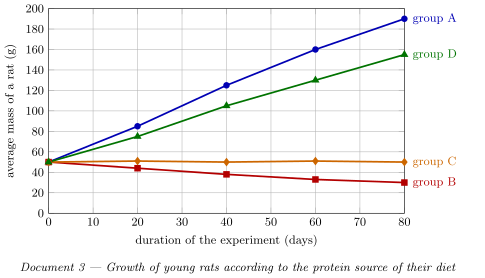
Proof (Analysis)
- With casein (group A), the rats grow normally: their mass goes from 50 to 190 g in 80 days.
- With zein alone (group B), they lose weight, from 50 to 30 g, although their diet supplies as much protein and energy. Zein allows neither growth nor even maintenance of the body.
- With zein and tryptophan (group C), the mass stays at 50 g, but the rats do not grow.
- With zein, tryptophan and lysine (group D), growth resumes: 155 g at 80 days.
Chemical analysis shows that zein contains almost no tryptophan or lysine, whereas casein contains all twenty amino acids. The rat is therefore unable to make these two amino acids: it must find them in its food.
Exercises of the chapter
- Three energy balances solved
- A school day, a sports day solved
- Gliadin and lysine solved
- A day's calcium solved
- Vitamin C, from harvest to plate solved
- Cereals and legumes solved