Diseases with a nutritional component
Course · Life Sciences (Grade 11, Lebanon), chapter 9 · Lebanon, Grade 11 · the beginning of the chapter, the rest on Adloun
In the 18th century, the crews of the great sailing ships feared storms less than scurvy, which killed more sailors than shipwrecks did. Even today, children stop growing for lack of sufficient food, while, sometimes in the same countries, adults see their arteries gradually become blocked. Lacking a constituent or receiving too much of it: in both cases, the diet departs from the needs of the body, and health suffers. Which diseases appear when a constituent is lacking? Which are promoted by excesses? And how can they be prevented?
Curriculum: LB-1S
Required skills
- Distinguish a deficiency disease from a disease caused by dietary excess.
- Describe the features of marasmus and kwashiorkor, and relate them to their cause.
- Relate scurvy, rickets, iron-deficiency anemia and goiter to the deficiency that causes them.
- Describe atherosclerosis and its consequences; specify the role of cholesterol.
- Define arterial hypertension and name what promotes it.
- Calculate a body mass index and interpret it; relate obesity to the energy balance.
- Name the risk factors of these diseases and suggest prevention measures.
9.1 Dietary deficiency diseases
Problem. A balanced diet covers all the needs of the body. What happens when energy, proteins, a vitamin or a mineral are lacking over a long period?
A dietary deficiency is the prolonged shortage, in the diet, of a constituent needed by the body. The deficiency can be global, when the diet does not supply enough energy, or specific, when it lacks a particular constituent: proteins, a vitamin, a mineral.
9.1.1 Energy and protein deficiencies
They strike mainly young children, whose needs, relative to their mass, are the highest. They occur in situations of extreme poverty, drought, war or population displacement. Two main forms are distinguished.
{
| Marasmus | Kwashiorkor | |
|---|---|---|
| Cause | diet insufficient in quantity: global lack of energy and proteins | diet roughly sufficient in energy, but very poor in proteins |
| Circumstances | infant, often under one year: breastfeeding stopped too early, overdiluted milk, famine | child of one to three years, after weaning: breast milk is replaced by cereal or cassava porridges |
| Signs | extreme thinness; disappearance of the fat under the skin, muscle wasting; wrinkled skin, wizened face; no edema; the child stays alert and is hungry | edema (swelling of the feet, legs, face); swollen belly; peeling skin, discolored and brittle hair; the child is sad, without appetite, apathetic |
| Growth | stopped | stopped |
The word kwashiorkor comes from a language of Ghana: it refers to the disease of the child who is weaned when a newborn takes its place at the breast. It alone states the cause of the illness: with breast milk, the child loses its source of proteins.
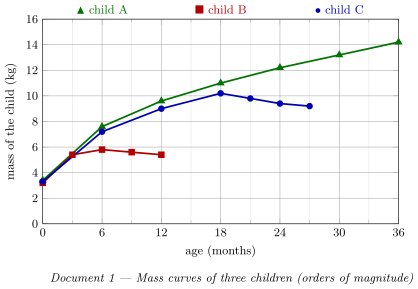
Child A is well fed. Child B, deprived of breast milk at three months, then receives a very diluted milk. Child C is weaned at eighteen months and fed cereal porridges from then on.
Proof (Analysis)
- The mass of child A increases steadily: it is almost multiplied by three in a year, then continues to increase more slowly.
- That of child B stops increasing from three months, then decreases: at one year, this child weighs kg, compared with kg for child A. The diet does not supply enough energy: the child draws on fat reserves, then on muscles. This is marasmus.
- Child C grows almost normally as long as breastfed. The mass falls from weaning, but moderately: the water of the edema partly masks the weight loss. The diet provides energy, but too few proteins: this is kwashiorkor.
The edema of kwashiorkor can be explained: for lack of amino acids, the liver no longer makes enough blood proteins; yet these proteins hold water in the vessels. Water then escapes into the tissues, which swell. In both diseases, the body resists infections poorly, and these worsen its condition further.
9.1.2 A vitamin C deficiency: scurvy
During long sea voyages, sailors lived on hard biscuits and salted meat. After a few weeks, many were seized with great fatigue; their gums swelled and bled, their teeth loosened, blood spots appeared under the skin, their wounds no longer healed: this was scurvy, often fatal. In 1747, aboard a ship, the Scottish physician James Lind chose twelve sailors with scurvy, at the same stage of the disease. He gave them the same food, and added a different supplement to the ration of each group of two men.
{
| Group | Daily supplement | Condition of the patients after six days |
|---|---|---|
| 1 | cider | very slight improvement |
| 2 | diluted solution of an acid | no change |
| 3 | vinegar | no change |
| 4 | seawater | no change |
| 5 | two oranges and a lemon | rapid recovery: one of the two sailors returns to duty |
| 6 | mixture of garlic, mustard seeds and spices | no change |
Exercises of the chapter
- Marasmus or kwashiorkor? solved
- James Lind's experiment solved
- Rats, light and cod liver oil solved
- A valley and its salt solved
- Fats, cholesterol and arteries solved
- Body mass index and the energy balance solved