Meiosis, fertilization and genetic recombination
Course · Life Sciences (Grade 12 Life Sciences, Lebanon), chapter 2 · Lebanon, Grade 12 Life Sciences · the beginning of the chapter, the rest on Adloun
Two brown-eyed parents can have a blue-eyed child; a brother and a sister born of the same parents are never identical, unless they are identical twins. Yet each child received its chromosomes from these two parents alone, through one spermatozoon and one oocyte. Meiosis, which makes the gametes, and fertilization, which unites them, do more than keep the chromosome number constant: at each generation they deal the hereditary information of the parents out again, like a pack of cards that is shuffled before each game. How is a hereditary trait passed on, and how do meiosis and fertilization create new combinations?
Curriculum: LB-SV
Required skills
- Define gene, locus, allele, genotype, phenotype, homozygous, heterozygous, dominant, recessive, codominant, pure line.
- Write genotypes, phenotypes and gametes with the conventional notation.
- Analyze a monohybrid cross: determine dominance, write the genotypes, build a Punnett square, predict proportions.
- Use a test cross to determine the genotype of an individual.
- Analyze a dihybrid cross and decide whether two genes are independent or linked.
- Explain interchromosomal recombination by the behavior of the chromosomes at anaphase I.
- Explain intrachromosomal recombination by crossing-over at prophase I; calculate a percentage of recombinants.
- Show that fertilization amplifies the genetic diversity created by meiosis.
2.1 Hereditary traits and genes
Problem. A trait such as the color of a flower or a blood group is passed on from parents to offspring. What, in the chromosomes, determines a hereditary trait, and why can the same trait take several forms?
2.1.1 From the trait to the gene
In the previous school year, a gene was defined as a fragment of a DNA molecule whose nucleotide sequence governs the synthesis of a protein. The proteins of an organism build its traits.
A hereditary trait is a characteristic that is passed on from generation to generation: the shape of the seeds of the pea, the color of the body of the fruit fly, the blood group in humans. Each trait studied in this chapter is governed by one gene, which occupies a fixed place on a given chromosome. Since a diploid cell has two homologous chromosomes of each pair, it has two copies of each gene, one received from the father, the other from the mother (Document 1).
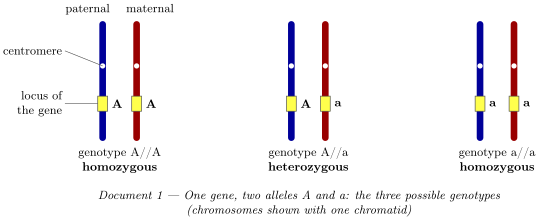
- A gene is a fragment of DNA that determines a hereditary trait. Its fixed position on a chromosome is its locus (plural: loci).
- The alleles of a gene are its different versions; they differ by their nucleotide sequence and occupy the same locus on homologous chromosomes. A diploid individual has two alleles of each gene.
- An individual is homozygous for a gene if its two alleles are identical, heterozygous if they are different.
- The genotype of an individual is the set of alleles it has for the gene or genes studied.
- The phenotype is the trait as it appears: what is observed or measured.
2.1.2 From the allele to the phenotype: the wrinkled pea
How can a difference between two alleles change the look of a seed? The answer is known for the trait that made Mendel famous, the shape of the seeds of the pea (Document 2).
{
| Allele R | Allele r | |
|---|---|---|
| Sequence of the gene | normal | interrupted by an inserted fragment of DNA of about 800 nucleotide pairs |
| Protein | a functional enzyme, which builds the branches of the molecules of starch | no functional enzyme |
| In the growing seed | much starch, little sugar | less starch, more sugar; the sugar draws in more water and the seed swells |
| When the seed dries | it loses little water and stays round | it loses much water, its coat collapses: it is wrinkled |
Document 2 — The two alleles of the gene that governs the shape of the seeds of the pea (results established between 1988 and 1990)}
Proof (Analysis)
- The two alleles are two versions of the same fragment of DNA, at the same locus: they differ by their nucleotide sequence.
- The chain of causes runs from the gene to the trait: the sequence of the allele determines a protein (here an enzyme), the enzyme determines a chemical composition (starch or sugar), and this composition determines the visible phenotype (round or wrinkled).
- A plant R//r has one functional allele. It makes the enzyme, its seeds store starch normally and they are round, like those of a plant R//R. This is what the dominance of R means here: one functional copy of the gene is enough. The allele r shows itself only when no functional copy is present, in the plants r//r.
2.1.3 Dominance, recessivity, codominance
A heterozygote has two different alleles. Its phenotype shows how they are expressed together:
- if the heterozygote has the same phenotype as one of the two homozygotes, the allele that is expressed is dominant; the other, masked, is recessive. A recessive allele is expressed only in the homozygous state;
- if the heterozygote shows a phenotype different from those of the two homozygotes — an intermediate phenotype, or both phenotypes at once — the two alleles are codominant: both are expressed.
Method : : Writing genotypes, phenotypes and gametes
- Alleles. A dominant allele is written with a capital letter and the recessive allele of the same gene with the same letter in lower case: R and r. Two codominant alleles are written with two different capital letters: R and W.
- Genotype. The two alleles are written on either side of a double bar that stands for the two homologous chromosomes: R//R, R//r, r//r.
- Phenotype. It is written between square brackets: [R], [r].
- Gametes. A gamete has a single allele of each gene; it is written with a single bar: R or r. Its proportion is written beside it: a heterozygote R//r forms R and r.
- Two genes. If they are on two different pairs of chromosomes: A//a\; B//b. If they are on the same pair: AB//ab, the alleles carried by the same chromosome being written on the same side of the bar.
A pure line is a set of individuals that, crossed with one another, always give offspring identical to themselves for the trait studied, generation after generation. The individuals of a pure line are homozygous for the gene concerned: they form only one kind of gamete.
2.2 Transmission of allelic genes
Problem. How are the two alleles of one gene passed on from parents to offspring, and in what proportions do the phenotypes appear?
2.2.1 Mendel's experiment
Between 1856 and 1863, in the garden of his monastery, Gregor Mendel crossed varieties of the garden pea that differed by one clear-cut trait. The pea normally fertilizes itself; to cross two plants, the anthers of a flower are removed before they are ripe and its pistil is dusted with the pollen of another plant. A cross that concerns a single trait is a monohybrid cross. Document 3 gives one of the results published by Mendel in 1866.
{
| Generation | Cross and result |
|---|---|
| Parents (P) | pure line with round seeds pure line with wrinkled seeds |
| First generation (F) | all the seeds are round, whichever variety provided the pollen |
| Second generation (F), obtained by letting the F plants fertilize themselves | 7,324 seeds: 5,474 round and 1,850 wrinkled |
Document 3 — A monohybrid cross of Mendel: the shape of the seeds of the pea}
Proof (Analysis)
- F. All the seeds are round: the generation is uniform, and the wrinkled phenotype has disappeared. The allele “round”, expressed in the F hybrids, is dominant (R); the allele “wrinkled” is recessive (r).
- F. The wrinkled phenotype reappears: the F plants therefore carried the allele r without showing it. They were heterozygous, R//r. The proportions are round and wrinkled, that is, very nearly and .
2.2.2 The chromosomal interpretation
Mendel knew nothing about chromosomes. His results are explained by the behavior of the homologous chromosomes at meiosis (Document 4): the two alleles of a heterozygote are carried by the two chromosomes of a pair; at anaphase I these chromosomes separate, so that each gamete receives one allele only.
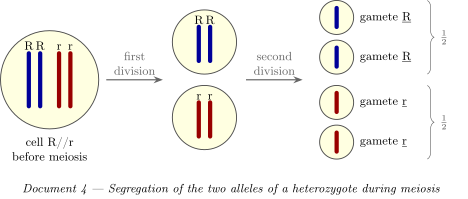
The cross of two individuals of pure lines that differ by one trait gives a first generation F in which all the individuals have the same genotype and the same phenotype: the F generation is uniform.
The two alleles of a gene separate when the gametes are formed: each gamete contains only one allele of each gene. A heterozygote A//a therefore forms two kinds of gametes in equal proportions, A and a. This law is also called the law of the purity of the gametes.
The cross of Document 3 can now be written in full. The parents, of pure lines, are R//R and r//r; they form the gametes R and r; all the F individuals are R//r, with the phenotype [R]. Each F plant forms R and r, and the gametes meet at random. All the possible encounters are shown in a table with two entries, the Punnett square (also called gamete crossing table):
{
| gametes of F | R | r |
|---|---|---|
| R | R//R \; [R] | R//r \; [R] |
| r | R//r \; [R] | r//r \; [r] |
Proof (Interpretation)
The F generation comprises three genotypes, R//R, R//r and r//r, and two phenotypes: [R] and [r]. The predicted proportions, 75% and 25%, agree with those observed by Mendel (74.7% and 25.3%): the hypothesis of one gene with two alleles, one dominant, is validated.
2.2.3 Is the result general? Mendel's seven traits
One cross proves little. Mendel repeated the experiment with seven traits of the pea, each time starting from two pure lines and letting the F plants fertilize themselves (Document 5).
{
| Trait | Phenotype of the F | F: numbers counted | Ratio | |
|---|---|---|---|---|
| like the F | other phenotype | |||
| Shape of the seeds | round | 5,474 round | 1,850 wrinkled | 2.96 to 1 |
| Color of the seeds | yellow | 6,022 yellow | 2,001 green | 3.01 to 1 |
| Color of the flowers | violet | 705 violet | 224 white | 3.15 to 1 |
| Shape of the pods | inflated | 882 inflated | 299 constricted | 2.95 to 1 |
| Color of the pods | green | 428 green | 152 yellow | 2.82 to 1 |
| Position of the flowers | along the stem | 651 along the stem | 207 at the tip | 3.14 to 1 |
| Length of the stem | tall | 787 tall | 277 dwarf | 2.84 to 1 |
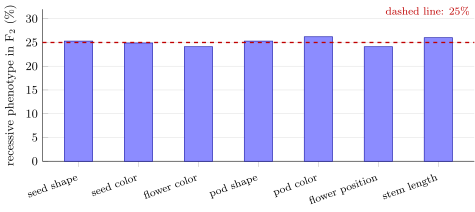
Document 5 — The seven monohybrid crosses of Mendel: numbers counted in F and share of the recessive phenotype}
Exercises of the chapter
- The coat color of mice solved
- Red, white and pink flowers solved
- Two traits of the guinea pig solved
- A test cross in the fruit fly solved
- Two linked genes in the tomato solved
- Three test crosses to compare solved