Genetic polymorphism
Course · Life Sciences (Grade 12 Life Sciences, Lebanon), chapter 3 · Lebanon, Grade 12 Life Sciences · the beginning of the chapter, the rest on Adloun
All human beings have the same genes, at the same loci of the same 23 pairs of chromosomes. Yet no two of them, identical twins apart, look exactly alike: blood groups, hair color, sensitivity to a disease differ from one person to the next. Meiosis and fertilization shuffle the alleles at each generation, but they create none. Where do the different alleles of a gene come from? How many versions of a gene can a population hold, and how can they be detected in an individual, to the point of identifying a person from a trace of blood?
Curriculum: LB-SV
Required skills
- Define a mutation; distinguish spontaneous and induced mutations, somatic and germ-line mutations.
- Interpret experimental results that show the effect of a mutagen.
- Compare two nucleotide sequences, identify a substitution, an insertion or a deletion, and determine its effect on the protein with the genetic code.
- Explain how mutations give rise to the multiple alleles of a gene.
- Calculate allele frequencies in a sample and decide whether a gene is polymorphic.
- Interpret an electrophoresis of proteins or of DNA fragments obtained with a restriction enzyme.
- Explain why each individual has its own genetic identity and read a DNA profile (identification, paternity).
3.1 Mutation and the environment
Problem. DNA replication copies the genetic information faithfully, and yet new versions of genes appear. How does a change arise in a DNA sequence, and can the environment make such changes more frequent?
3.1.1 Rare and spontaneous changes
A strain of yeast that makes a red pigment forms red colonies on a culture dish. Each colony is a clone: it comes from a single cell by successive mitoses. Among many thousands of red colonies, a few white colonies are sometimes found, although nothing has been done to the culture. Transferred to a new dish, the cells of a white colony give only white colonies.
Proof (Analysis)
The white trait appears suddenly, in very few cells, and it is passed on to all the descendants of the cell: it is hereditary. The genetic information of that cell has therefore changed. Such a change is a mutation; since it arose without any outside intervention, it is spontaneous. It is also rare.
3.1.2 An experiment with ultraviolet rays
Suspensions of the same red yeast are exposed to ultraviolet (UV) rays for increasing durations, then spread on culture dishes. For each duration, the surviving colonies are counted, and the white ones among them (Document 1; illustrative data).
{
| Duration of exposure to UV (s) | 0 | 15 | 30 | 45 | 60 |
|---|---|---|---|---|---|
| Surviving colonies (out of 100,000 cells spread) | 98,000 | 81,000 | 52,000 | 23,000 | 6,000 |
| White colonies among the survivors | 2 | 49 | 104 | 115 | 54 |
| White colonies per 10,000 survivors | 0.2 | 6 | 20 | 50 | 90 |
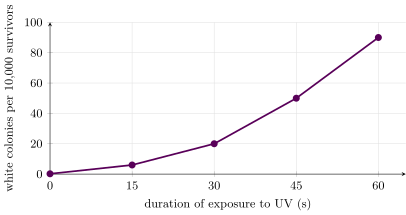
Document 1 — Effect of ultraviolet rays on a culture of yeast}
Proof (Analysis)
- Without UV, 2 white colonies are found among 98,000: mutations occur spontaneously, at a very low frequency (0.2 per 10,000).
- The longer the exposure, the fewer the survivors (98,000 without UV, 6,000 after 60 s): UV rays kill cells.
- Among the survivors, the frequency of white mutants rises with the duration, from 0.2 to 90 per 10,000, that is, 450 times more after 60 s. UV rays increase the frequency of mutations: they are a mutagen.
The white mutants are only one kind among others: UV rays do not “aim” at the gene of the pigment. They damage DNA at random.
- A mutation is a change in the nucleotide sequence of DNA. It is sudden, rare, random, and passed on to the cells that derive from the mutated cell.
- A mutation is spontaneous when it arises without any known outside cause, for example from an error during DNA replication; it is induced when it is caused by an agent of the environment.
- A mutagen (mutagenic agent) is an agent that increases the frequency of mutations: ultraviolet rays, X-rays and radioactivity, certain chemical substances such as those of tobacco smoke.
3.1.3 Damage, repair and consequences
Ultraviolet rays are absorbed by the bases of DNA. They cause two neighboring thymines of the same strand to bind to each other, which distorts the molecule and disturbs its replication. The cell is not defenseless: enzymes constantly inspect the DNA, cut out the damaged segment and rebuild it using the other strand as a template. A mutation remains only when a lesion escapes this repair. In a rare hereditary disease, xeroderma pigmentosum, the repair enzymes do not work: the skin of the patients, exposed to sunlight, develops many cancers.
- A somatic mutation affects a cell of the body. It is passed on by mitosis to the cells that derive from it (a clone of mutated cells, which may be the origin of a cancer), but not to the offspring.
- A germ-line mutation affects a germ cell, and therefore gametes. It can be passed on to the offspring: all the cells of the child will carry it. Only germ-line mutations are hereditary.
3.2 Mutation and multiple alleles
Problem. A mutation changes the sequence of a gene. What kinds of changes exist, what do they do to the protein, and how do they produce the different alleles of a gene?
3.2.1 The genetic code, a tool for reading sequences
In the previous school year, the expression of a gene was studied: one strand of the gene is transcribed into messenger RNA (mRNA), and the mRNA is translated into a chain of amino acids, codon by codon (three nucleotides), from the start codon AUG to a stop codon, according to the genetic code.