Human genetics, predictions and prenatal diagnosis
Course · Life Sciences (Grade 12 Life Sciences, Lebanon), chapter 4 · Lebanon, Grade 12 Life Sciences · the beginning of the chapter, the rest on Adloun
A couple in good health has a first child with a severe hereditary disease. What is the risk for the next child? Mendel could cross his peas as he wished and count thousands of seeds. Nothing of the kind is possible in the human species: unions are not chosen by the geneticist, children are few, and a generation lasts a quarter of a century. Human genetics works differently: it reads the history of families, examines chromosomes, and today analyzes the DNA of a child before its birth.
Curriculum: LB-SV
Required skills
- Read a pedigree and use its conventions.
- Determine, with justification, whether the allele responsible for a disease is dominant or recessive, and whether the gene is carried by an autosome or by a sex chromosome.
- Write the genotypes of the members of a family and calculate the risk for a child to be born affected.
- Explain the particular transmission of the traits linked to the X chromosome.
- Interpret an abnormal karyotype (trisomy 21, Turner syndrome, Klinefelter syndrome) and explain its origin by a diagram of meiosis.
- Describe the techniques of prenatal diagnosis and interpret their results (fetal karyotype, electrophoresis of DNA).
- Discuss the bioethical questions raised by prenatal diagnosis.
4.1 Inheritance of genetic traits
Problem. Without experimental crosses, how can the mode of inheritance of a human trait be established?
4.1.1 The pedigree, a tool of human genetics
A pedigree is a diagram that shows, over several generations, the members of a family, their kinship and their phenotype for a given trait. Document 1 is the pedigree of a family in which two persons have cystic fibrosis, a disease in which a thick mucus obstructs the bronchi and the ducts of the pancreas.
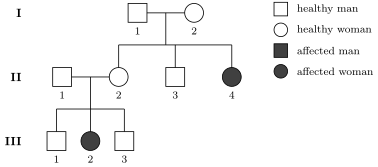
Document 1 — Pedigree of a family affected by cystic fibrosis}
Method : : Conventions of a pedigree
- A square stands for a man, a circle for a woman; a filled symbol indicates an affected person.
- A horizontal line joins the two members of a couple; a double line indicates a consanguineous union, between relatives.
- A vertical line leads from the couple to its children, placed from left to right in order of birth.
- Each generation is numbered with a Roman numeral (I, II, III) and each person with an Arabic numeral within its generation: II-4 is the fourth person of generation II.
- A diamond with a question mark stands for a child to be born (fetus).
4.1.2 Dominant or recessive?
Proof (Analysis)
The parents I-1 and I-2 are healthy, and their daughter II-4 is affected. II-4 received one allele of the gene from each parent. If the allele of the disease were dominant, at least one of her parents would carry it and would be affected: this is not the case. The allele of the disease is recessive; it is written m, and the normal allele, dominant, N. The parents carry m without expressing it: they are heterozygous. The couple II-1 and II-2 leads to the same conclusion.
4.1.3 Autosomal or sex-linked?
A gene is autosomal when it is carried by one of the 22 pairs of autosomes, and sex-linked when it is carried by a sex chromosome (case studied further on). The two hypotheses are tested in turn.
Proof (Analysis)
- Hypothesis: the gene is carried by the Y chromosome. Only men would be affected. Now II-4 and III-2 are women: the hypothesis is rejected.
- Hypothesis: the gene is carried by the X chromosome (in its part that has no equivalent on Y). The affected daughter II-4, of recessive phenotype, would have the genotype ; she would have received one from her father. Her father I-1, who has a single X chromosome, would be and affected. Now I-1 is healthy: the hypothesis is rejected.
- The gene is therefore autosomal. Genotypes: II-4 and III-2 are m//m; their parents I-1, I-2, II-1 and II-2, healthy but each having passed on m, are N//m.
Method : : Analyzing a pedigree
- Dominant or recessive. Look for two parents of the same phenotype who have a child of a different phenotype: the phenotype of the child is recessive, and the parents are heterozygous. State the symbols chosen.
- Location of the gene. Test each hypothesis (Y, X, autosome) and reject those that contradict a fact of the pedigree; name the individuals used.
- Genotypes. Start with the individuals of recessive phenotype, whose genotype is certain; then deduce those of their parents and children. When two genotypes remain possible, give both.
- Risk. Calculate the probability asked for from the gametes of the two parents (Punnett square).
4.2 Autosomal diseases
Problem. How are the diseases due to an autosomal gene passed on, and how can the risk for a child to be born be calculated?
4.2.1 Autosomal recessive diseases
In these diseases, only the homozygotes m//m are affected. The heterozygotes N//m are healthy: they are carriers, who can pass the allele on without knowing it. Affected children are usually born of two healthy parents, and both sexes are affected equally.
{
| Disease | Gene | Consequence in homozygotes |
|---|---|---|
| Cystic fibrosis | chromosome 7 | abnormal membrane protein; thick mucus that obstructs the bronchi and the pancreatic ducts; about 1 newborn in 3,000 in populations of northern European descent |
| Sickle cell anemia | -globin, chromosome 11 | hemoglobin S; sickle-shaped red blood cells, anemia, obstruction of small vessels |
| Phenylketonuria | chromosome 12 | an enzyme that transforms phenylalanine is missing; this amino acid builds up and damages the brain unless a diet low in phenylalanine is followed from birth; about 1 newborn in 12,000 |
| Albinism | (several genes) | no synthesis of melanin: very pale skin, hair and eyes |
Document 2 — Some autosomal recessive diseases}
4.2.2 Calculating a risk
In the family of Document 1, the couple II-1 and II-2, both N//m, expects a fourth child. Each parent forms of gametes N and of gametes m:
| N | m | |
|---|---|---|
| N | N//N healthy | N//m healthy carrier |
| m | N//m healthy carrier | m//m affected |
The risk is at each birth, whatever the phenotypes of the children already born: the gametes that meet at one fertilization do not depend on those of the previous ones.
II-3, healthy brother of an affected woman, wishes to have children. His parents are both N//m. He is healthy: he is not m//m. Among the three remaining boxes of the square, equally likely, two are N//m: the probability that II-3 is a carrier is (and not ).
His partner has no known case in her family. In her population, 1 person in 25 is a carrier. A child is affected only if the father is a carrier, the mother is a carrier, and both pass on m:
Method : : Calculating the risk for a child to be born
- Determine the genotype of each parent. If it is certain, its probability is 1; otherwise, calculate the probability that the parent carries the allele (from its own parents, or from the frequency of carriers in the population).
- For an autosomal recessive disease, two carrier parents have a risk of .
- Multiply: risk P(father carrier) P(mother carrier) .
4.2.3 Consanguinity
Two relatives, cousins for example, have common ancestors. If one of these ancestors carried a rare recessive allele, both may have inherited it; their children then have a real chance of receiving it twice. In the general population, on the contrary, a carrier seldom meets another carrier of the same rare allele.
Document 3 shows a family in which a girl has a rare autosomal recessive disease. Her parents, III-2 and III-3, are first cousins.
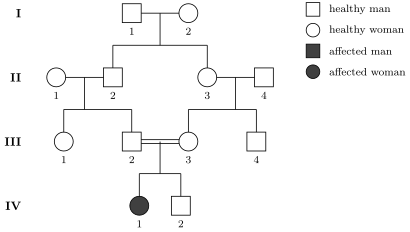
Document 3 — A consanguineous union (double line) and a rare recessive disease}
Proof (Analysis)
- IV-1 is affected and her parents are healthy: the allele of the disease is recessive, IV-1 is m//m and both III-2 and III-3 are N//m.
- The disease is rare: it would be surprising if two different copies of the allele m had entered the same family by chance. Now III-2 and III-3 have two grandparents in common, I-1 and I-2, since II-2 and II-3 are brother and sister. The simplest explanation is that one of these two ancestors carried m and passed it on to both II-2 and II-3, who passed it on to III-2 and III-3.
- The two alleles m of IV-1 are thus two copies of the same allele of an ancestor, which have come down by two paths and met again.
Suppose that I-1 is a carrier, N//m, and I-2 is N//N, and consider the risk before any child is born.
- II-2 has received m from I-1 with a probability of ; if he carries it, he passes it on to III-2 with a probability of : the probability that III-2 is a carrier is . The same holds for III-3.
- Union between the cousins. Risk for a child: .
- Union of III-2 with an unrelated woman, in a population where 1 person in 100 is a carrier: .
In this example the risk is 25 times higher for the consanguineous union. The rarer the allele in the population, the larger the difference.
A consanguineous union increases the probability that a child is homozygous for a rare recessive allele inherited from a common ancestor. It does not create the allele: it brings together two copies of it. In a pedigree, a rare recessive disease often appears among the children of a consanguineous couple.
4.2.4 Autosomal dominant diseases
Document 4 is the pedigree of a family affected by Huntington's disease, a degeneration of nerve cells whose first signs usually appear between the ages of 30 and 50. The gene is located on chromosome 4. The disease is rare: the persons who enter the family by marriage (II-1, II-5) do not carry the allele.
Exercises of the chapter
- Albinism in a family solved
- Phenylketonuria: evaluating a risk before a birth solved
- Polydactyly solved
- Duchenne muscular dystrophy solved
- Color blindness in boys and in girls solved
- An unexpected karyotype solved