Biotechnology and immunology
Course · Life Sciences (Grade 12 Sociology and Economics, Literature and Humanities, Lebanon), chapter 5 · Lebanon, Grade 12 Sociology and Economics, Literature and Humanities · the beginning of the chapter, the rest on Adloun
Until 1982, people with diabetes injected insulin extracted from the pancreas of pigs and cattle. Since then, most of the insulin used in the world is human insulin made by bacteria or yeasts into which the human gene has been transferred. The vaccine against hepatitis B is made by yeasts, and a pregnancy test bought in a pharmacy contains antibodies produced in the laboratory. How can a bacterium make a human protein? How are these vaccines and these antibodies produced, and what are they used for?
Curriculum: LB-SE
Required skills
- Recall the notions of gene, DNA, RNA and gene expression.
- Find the sequence of amino acids coded by a short DNA sequence, using the genetic code.
- Explain the principles of genetic engineering: restriction enzymes, ligase, vector (plasmid), recombinant DNA, transgenic cell, cloning and selection.
- Explain the production of substances of medical interest by genetic engineering: insulin, growth hormone, recombinant vaccine.
- Explain the production of monoclonal antibodies and their use in a pregnancy test and against cancers.
5.1 Principles of biotechnology
Problem. How can a gene be taken from one organism and made to work in another?
5.1.1 Gene, DNA and gene expression
- DNA is a double helix made of two strands of nucleotides. There are four nucleotides, designated by their bases: A, T, G, C. The two strands are complementary: A faces T, G faces C.
- A gene is a segment of DNA that carries the information to make a protein. This information is the sequence of its nucleotides.
- RNA is made of a single strand of nucleotides; it contains U (uracil) instead of T.
- Gene expression takes place in two steps: the transcription of the gene into a messenger RNA (mRNA), in the nucleus; then the translation of the mRNA into a protein, in the cytoplasm, at the ribosomes. Each group of three nucleotides of the mRNA (a codon) corresponds to one amino acid.
- The genetic code (the correspondence between codons and amino acids) is universal: it is the same in bacteria, plants, animals and humans.
Proof (Analysis)
Since the genetic code is the same in all living beings, a cell of a bacterium can “read” a human gene and make the corresponding human protein, provided that the gene is introduced into it in a form it can use. This is the basis of genetic engineering.

{
| Codons | Amino acid | Codons | Amino acid | Codons | Amino acid |
|---|---|---|---|---|---|
| AUG | Met (start) | UUU, UUC | Phe | GUU, GUC | Val |
| AAU, AAC | Asn | CAA, CAG | Gln | CAU | His |
| UGC | Cys | GGC, GGG | Gly | AAA | Lys |
| GAA | Glu | CCC | Pro | UAA, UAG, UGA | stop (end) |
Document 2 — An extract of the genetic code (after the standard code table of the NCBI). Met, Phe, Val… are the abbreviations of amino acids.
Method : : Finding the protein coded by a DNA sequence
- Transcription: write the messenger RNA, complementary to the transcribed strand of DNA (A U, T A, G C, C G). The mRNA has the same sequence as the coding strand, with U instead of T.
- Cut the mRNA into codons of three nucleotides, starting from the codon AUG.
- Translation: replace each codon by its amino acid using the genetic code, until a stop codon.
The B chain of human insulin begins with the amino acids Phe – Val – Asn – Gln – His. A researcher writes a short gene whose transcribed strand is:
TAC AAA CAA TTG GTT GTA- Messenger RNA:
AUG UUU GUU AAC CAA CAU. - Codons and amino acids: AUG = Met (start), UUU = Phe, GUU = Val, AAC = Asn, CAA = Gln, CAU = His.
- Protein: Met – Phe – Val – Asn – Gln – His: after the starting Met, this is indeed the beginning of the B chain.
A bacterium, which uses the same genetic code, reads this sequence in the same way: this is what makes it possible to have human proteins made by bacteria.
5.1.2 The tools of genetic engineering
Proof (Analysis)
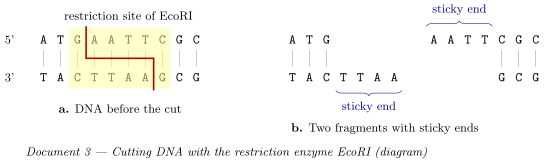
The enzyme EcoRI recognizes the sequence GAATTC (read on each strand in the same direction) and cuts each strand between G and A. The two cuts are shifted: each fragment ends with a short single-stranded sequence (AATT), called a sticky end. Two fragments cut by the same enzyme have complementary sticky ends: they can pair again, even if they come from two different organisms.
- A restriction enzyme cuts DNA at a precise sequence of a few nucleotides, the restriction site; many of them leave sticky ends.
- Ligase is an enzyme that joins (“glues”) two DNA fragments.
- A vector carries a gene into a host cell. The most used vector is the plasmid, a small circular DNA molecule of bacteria, separate from the chromosome.
- Recombinant DNA is a DNA molecule made by joining DNA from two different origins.
- A transgenic cell (or organism) contains a gene from another species: a transgene.
Many different restriction enzymes have been found in bacteria; each one recognizes its own sequence. Its name recalls the bacterium it comes from.
{
| Enzyme | Bacterium of origin | Site (/ = cut) | Ends obtained |
|---|---|---|---|
| EcoRI | Escherichia coli | G/AATTC | sticky (AATT) |
| BamHI | Bacillus amyloliquefaciens | G/GATCC | sticky (GATC) |
| HindIII | Haemophilus influenzae | A/AGCTT | sticky (AGCT) |
| SmaI | Serratia marcescens | CCC/GGG | blunt (no single strand) |
Document 4 — Four restriction enzymes and their sites (after Promega and New England Biolabs)
Proof (Analysis)
- Each site is a short sequence of six nucleotides; it reads the same on the two strands in the same direction (GAATTC is complementary to CTTAAG, which read backward gives GAATTC again).
- EcoRI, BamHI and HindIII cut the two strands at shifted places and leave sticky ends; SmaI cuts the two strands at the same place and leaves blunt ends, which do not pair spontaneously.
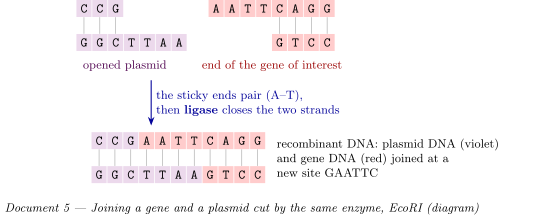
- The sticky ends of BamHI (GATC) and of EcoRI (AATT) are not complementary: to join a gene and a plasmid, both must be cut by the same enzyme.
Method : : Finding the restriction sites in a DNA sequence
- Write the recognition sequence of the enzyme (for EcoRI: GAATTC).
- Read the strand from left to right and underline each occurrence of this sequence.
- Count the sites: a linear double-stranded DNA cut at sites gives fragments; a circular DNA (plasmid) cut at sites gives fragments.
- Check that the enzyme does not cut inside the gene to be transferred.
Example. In TTGAATTCAGCTGAATTCGA, GAATTC appears twice: EcoRI cuts this linear DNA into 3 fragments, the middle one (AATTCAGCTG on the upper strand) being bordered by two sticky ends.
5.1.3 The steps of genetic engineering
Proof (Analysis)
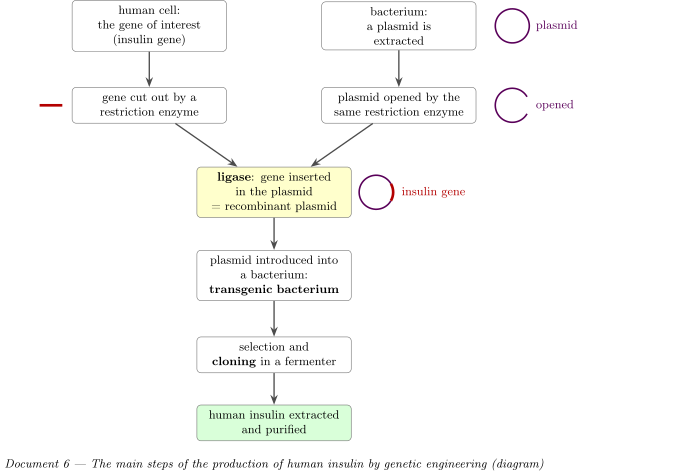
- The gene of interest is obtained from a human cell. (In practice, a copy of the gene is prepared from its messenger RNA or synthesized in the laboratory, in a form the bacterium can use.)
- The gene and the plasmid are cut by the same restriction enzyme: they have complementary sticky ends.
- Ligase joins the gene and the plasmid: a recombinant plasmid is obtained.
- The recombinant plasmid is introduced into bacteria, which become transgenic.
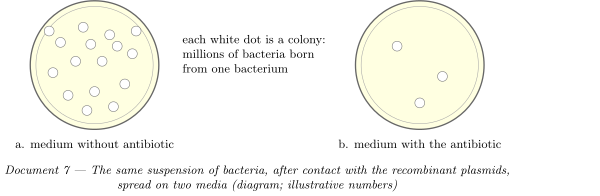
- Only some bacteria have received the plasmid. The plasmid also carries a gene of resistance to an antibiotic: on a medium containing this antibiotic, only the bacteria that have the plasmid survive. This is selection.
- The selected bacteria multiply in large tanks (fermenters) and give a clone: millions of identical bacteria, all carrying the gene. They make the human protein, which is then extracted and purified.
Proof (Analysis)
On the medium without antibiotic, 16 colonies grow: all the bacteria survive, whether they have received the plasmid or not. On the medium with the antibiotic, only 3 colonies grow: they come from the rare bacteria that have received the plasmid carrying the gene of resistance (and the gene of interest). Each of these colonies is a clone that can be multiplied.
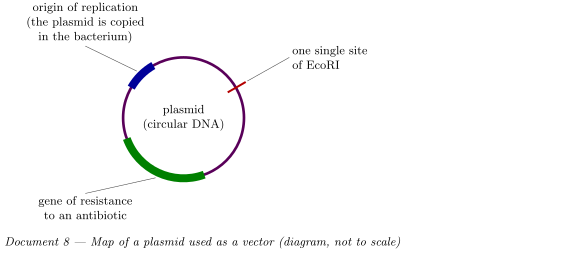
Method : : Checking that a plasmid can serve as a vector
- It must be copied in the host bacterium (it has an origin of replication), so that all the descendants of the bacterium receive it.
- It must carry a marker gene (for example a gene of resistance to an antibiotic) that is not cut by the enzyme: it allows the selection of the bacteria that have received the plasmid.
- It must have one single site for the enzyme used: cut once, the circle is simply opened, and the gene can be inserted at this place. Cut at two sites, it would lose a fragment.
Genetic engineering transfers a gene of interest from one organism into another. The gene and a vector (plasmid) are cut by the same restriction enzyme, then joined by ligase: this gives recombinant DNA. Introduced into a host cell (bacterium, yeast), it makes this cell transgenic. After selection and cloning, the host cells make the protein coded by the transgene. This is possible because the genetic code is universal.
5.1.4 A short history
{
| Date | Event |
|---|---|
| 1960s--1970s | Werner Arber, Hamilton Smith and Daniel Nathans discover the restriction enzymes of bacteria and use them to cut DNA at precise sites; they receive the Nobel Prize in Physiology or Medicine in 1978. |
| 1973 | Stanley Cohen and Herbert Boyer join, in the laboratory, a plasmid fragment carrying a gene of resistance to one antibiotic with another plasmid carrying a gene of resistance to another antibiotic. Introduced into E. coli, the recombinant plasmid gives bacteria resistant to the two antibiotics: the first recombinant DNA working in a living cell. |
| 1974 | The same team introduces into E. coli a gene of the African clawed frog (Xenopus): the bacteria copy the frog DNA and transcribe it. It is the first animal gene cloned in a bacterium. |
| 1978 | Human insulin is made for the first time by bacteria, in the laboratory (section 5.2). |
Document 9 — The beginnings of genetic engineering (after the Nobel Foundation, The Scientist and the US National Human Genome Research Institute)
Exercises of the chapter
- A firefly gene in a plant solved
- The right enzyme solved
- Insulin made by bacteria solved
- Growth hormone: two eras solved
- Vaccinating against hepatitis B solved
- Reading pregnancy tests solved