Biotechnology and the environment
Course · Life Sciences (Grade 12 Sociology and Economics, Literature and Humanities, Lebanon), chapter 6 · Lebanon, Grade 12 Sociology and Economics, Literature and Humanities · the beginning of the chapter, the rest on Adloun
Every year, caterpillars and other insects destroy part of the harvests, and farmers spray insecticides that also kill useful insects and pollute soils and water. Oil spills and industrial waste contaminate the sea and the land. Can biotechnology help? By transferring genes into plants and bacteria, it is possible to obtain plants that defend themselves against insects and bacteria that degrade pollutants. How are these genes transferred, what are the benefits for the environment, and what are the risks?
Curriculum: LB-SE
Required skills
- Explain the transfer of a gene into a plant with the bacterium Agrobacterium tumefaciens and its Ti plasmid.
- Explain how a transgenic plant resistant to insects (Bt plant) can reduce the use of insecticides.
- Explain how bacteria can be used to degrade pollutants.
- Point out, from documents, the contribution of biotechnology to the improvement of the environment, and discuss its benefits and risks.
- Calculate a percentage of change from data, and build a nuanced argument supported by documents.
6.1 The transfer of genes
Problem. How can a useful gene be transferred into a plant, and how can it help protect the environment?
6.1.1 A natural genetic engineer: Agrobacterium tumefaciens
Agrobacterium tumefaciens is a bacterium of the soil. When it infects a wounded plant, it causes a tumor, the crown gall. Researchers discovered why: the bacterium carries a plasmid, the Ti plasmid, and transfers a segment of it, the T-DNA, into the cells of the plant, where this segment is integrated into the plant's own DNA. The genes of the T-DNA then make the plant cells multiply and form the tumor.
{
| Date | Event |
|---|---|
| 1907 | Erwin Smith and Charles Townsend, in the United States, show that the crown gall, a tumor of many plants, is caused by a bacterium of the soil, today called Agrobacterium tumefaciens. |
| 1977 | Researchers show that the bacterium inserts a precise segment of its own DNA into the genome of the plant cell: the tumor cells contain bacterial genes. |
| 1983 | Four laboratories publish, the same year, the first plant cells made transgenic by using Agrobacterium: the tumor genes have been replaced by other genes. |
Document 1 — From a disease of plants to a tool of biotechnology (after reviews published in PMC and PeerJ)
Proof (Analysis)
For seventy years, the crown gall was studied as a disease. When it was understood that the tumor is due to the transfer of bacterial genes into the plant, researchers realized that the bacterium could transfer any gene placed in its T-DNA. A natural phenomenon became a tool: this is often how biotechnology progresses.
Proof (Analysis)
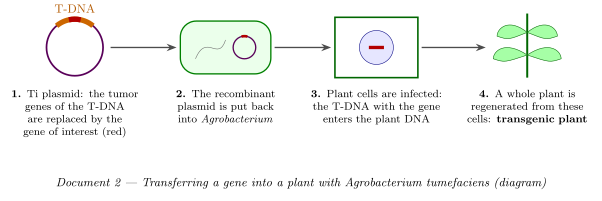
The bacterium naturally transfers the T-DNA of its Ti plasmid into the DNA of the plant cell. Researchers use this ability: they remove the genes that cause the tumor from the T-DNA and insert in their place the gene of interest. The bacterium then transfers this gene into the plant cells, without causing a tumor. From a transformed cell, a whole plant is regenerated: all its cells carry the gene, and its seeds transmit it to the next generation.
Gene transfer is the introduction of a gene of one species into the DNA of another species. A transgenic plant is a plant that carries in its cells a gene of another species. The bacterium Agrobacterium tumefaciens, whose Ti plasmid carries a segment (T-DNA) that integrates into the plant DNA, is used as a vector to transfer genes into plants.
6.1.2 Plants that resist insects: Bt plants
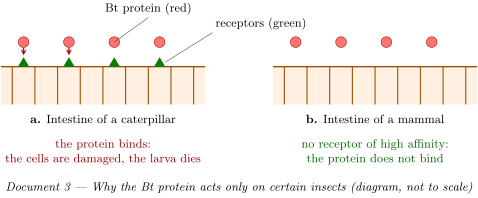
The soil bacterium Bacillus thuringiensis (Bt) makes proteins that are toxic to the larvae of certain insects (such as caterpillars). These proteins bind to specific receptors of the intestine of the larvae, which die. The intestine of mammals does not carry these receptors. Preparations of this bacterium have been sprayed as a biological insecticide since the 1960s.
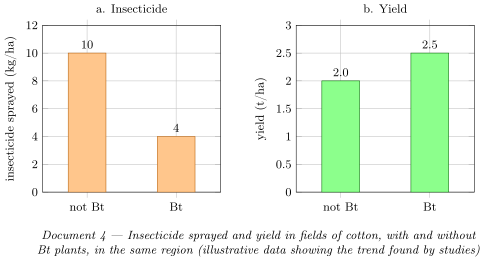
The gene of one of these toxic proteins has been transferred into plants such as maize and cotton: these Bt plants make the protein themselves, in their leaves and stems, and the caterpillars that eat them die.
Exercises of the chapter
- From a tumor to a tool solved
- Bt cotton in the field solved
- Specific to caterpillars solved
- When insects resist solved
- A transgene on the move? solved
- The oil-eating bacterium solved