Plane representation of solids
Course · Mathematics (Grade 10, Lebanon), chapter 20 · Lebanon, Grade 10 · the beginning of the chapter, the rest on Adloun
How can we represent on a sheet of paper, which has only two dimensions, an object in space that has three? This problem, central in geometry as well as in architecture, technical drawing or computer graphics, cannot be solved without accepting that a plane figure alters certain quantities of the real object: in the drawing, right angles become acute or obtuse and segments of the same length appear unequal. In order nevertheless to reason rigorously on a plane figure, we adopt a precise system of drawing rules called cavalier perspective, completed by visibility conventions distinguishing the visible edges from the hidden edges.
This chapter presents the principle of cavalier perspective — frontal plane in true size, receding lines characterized by a receding angle and a reduction ratio — and clearly distinguishes the geometric properties that it preserves (collinearity, parallelism, midpoint, ratios of lengths along the same direction) from those that it does not preserve (lengths outside a frontal plane, angles, orthogonality). It then presents the drawing conventions and their application to the common solids of space (cube, rectangular prism, right prism, tetrahedron, pyramid, right circular cylinder and cone), as well as their nets and the calculation of their areas and volumes.
Curriculum: LB-2
Required skills
- Know and apply the rules of cavalier perspective (frontal plane, receding lines, receding angle , reduction ratio ).
- Identify on a representation in cavalier perspective the properties that are preserved (collinearity, parallelism, midpoint of a segment, ratio of two parallel segments) and those that are not (orthogonality, angles and lengths outside a frontal plane).
- Calculate the drawn length of a segment carried by a receding line from its real length and the reduction ratio, and conversely.
- Respect the drawing conventions (solid lines for visible lines, dashed lines for hidden lines) when representing common solids and drawing on their faces.
- Represent in cavalier perspective and recognize the common solids: cube, rectangular prism, right prism, tetrahedron, regular pyramid, right circular cylinder and cone.
- Construct the net of a common solid and calculate its lateral surface area, its total surface area and its volume using the theorems of plane geometry in the faces.
20.1 Representation in cavalier perspective
20.1.1 Principle of cavalier perspective
When we observe a solid in space, we choose a reference plane parallel to the drawing sheet: any plane parallel to this sheet is called a frontal plane. The figures contained in a frontal plane are drawn without any distortion, whereas the lines perpendicular to the frontal plane, which express depth, are represented by oblique lines parallel to one another.
In cavalier perspective, we fix a reference plane called the frontal plane (the plane of the sheet and all the planes parallel to it) and we adopt the following rules:
- every figure located in a frontal plane is represented in true size (its lengths and its angles are preserved, to which a common scale may be applied);
- every line perpendicular to the frontal plane is called a receding line; all the receding lines are represented in the drawing by parallel lines making the same angle (with ) with the horizontal lines of the frontal plane, called the receding angle;
- on every receding line, the length in the drawing of a segment of real length is multiplied by a constant real number , called the reduction ratio:
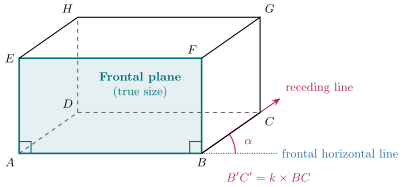
In common practice, we most often choose a receding angle equal to , or , and a reduction ratio equal to , or . These choices give the eye a natural impression of depth while making constructions with a ruler and a protractor (or on a grid) easier.
20.1.2 Preserved properties and non-preserved properties
To read a drawing in cavalier perspective correctly, it is essential to know which properties observed on the sheet correspond to properties that are true in space, and which ones may be misleading.
The representation in cavalier perspective preserves:
- the collinearity of points: three collinear points in space are represented by three collinear points;
- the parallelism of lines: two parallel lines in space are represented by two parallel lines in the drawing;
- the midpoint of a segment: the midpoint of a segment in space is represented by the midpoint of the drawn segment ;
- the equality and the ratios of collinear vectors: if two segments and are parallel (or carried by the same line), the ratio of their lengths is preserved in the drawing:
In particular, a parallelogram in space (notably a rectangle, a rhombus or a square) is always represented by a parallelogram in the drawing.
Exercises of the chapter
- Calculating lengths, angles and an area on a rectangular prism in cavalier perspective solved
- Constructions without a graduated ruler by the preserved properties, and visibility in a cube solved
- Right prism with an isosceles triangular base: perspective, net, areas and volume solved
- Regular pyramid with a hexagonal base: apothem, lateral edge, area and volume solved
- From the net to the right circular cone: radius, height, apex angle and volume solved
- Cube truncated at a corner: representation, area of the cut face and distance from a vertex to the plane solved