Graphical solution of equations and inequalities
Course · Mathematics (Grade 10, Lebanon), chapter 19 · Lebanon, Grade 10 · the beginning of the chapter, the rest on Adloun
Every equation or inequality involving one or two real functions has a direct geometric translation in a coordinate system of the plane: looking for when two expressions take the same value amounts to looking for where their representative curves meet, and comparing two expressions amounts to determining which of the two curves is located above the other. This double reading, algebraic and graphical, makes it possible to visualize the solutions of a problem, to predict their number and to check the results obtained by calculation.
Curriculum: LB-2
Required skills
- Compare two functions and on a set and interpret geometrically the inequality by the relative position of the curves and .
- Study the relative position of two curves and by studying the sign of the difference .
- Recognize whether two functions and are equal by checking the equality of their domains of definition () and the equality for every .
- Solve graphically the equations and ; discuss graphically the number of solutions of the equation according to the values of the real number .
- Use the curve of a usual function (, , ) and a line to solve an equation or an inequality graphically.
- Read graphically the sign of a function from the position of relative to the -axis and draw up its sign table; solve graphically the inequalities , , and .
Throughout the chapter, the plane is equipped with an orthogonal coordinate system , and , denote the respective representative curves of the functions and .
19.1 Comparison of two functions
19.1.1 Definition and geometric interpretation
Let and be two functions defined on the same set (with ).
- We say that is less than or equal to on , and we write on , when:
- We say that is strictly less than on , and we write on , when, for every , .
- We say that is greater than or equal to on , and we write on , when, for every , .
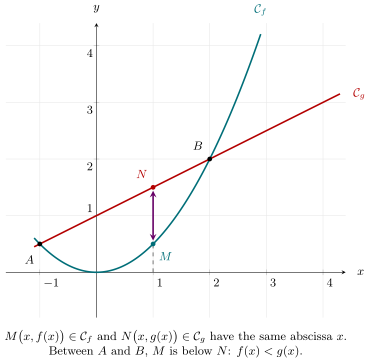
Let and be two functions defined on a set . For every real number , let be the point of with abscissa and the point of with the same abscissa .
- Saying that on is equivalent to saying that the curve is located below the curve on (or has points in common with it).
- Saying that on is equivalent to saying that the curve is located strictly below the curve on (every point of with abscissa is located strictly lower than the point of with the same abscissa).
- Saying that on is equivalent to saying that the curve is located above the curve on .
19.1.2 Algebraic study of the relative position of two curves
Method : Studying the relative position of and
To compare two functions and and determine the relative position of their curves and on a set :
- we form the difference for , then we factor it (or reduce it to a common denominator);
- we draw up the sign table of on ;
- we conclude on each interval:
- where , we have : is below ;
- where , we have : is above ;
- where , we have : the curves and meet at the point with abscissa .
Let and be the functions defined on by and . For every real number :
We draw up the sign table of the product :
We deduce that:
- on , : the parabola is strictly above the line ;
- on , : the parabola is strictly below the line ;
- at and at , : and meet at the points and .
19.2 Equality of two functions
Two real functions and are said to be equal, and we write , when the following two conditions are both satisfied:
- they have the same domain of definition: ;
- for every real number , they give the same image: .
Graphically, two functions are equal if and only if their representative curves and coincide exactly.
Two algebraic expressions, one of which is obtained by simplifying the other, do not necessarily define the same function: a simplification by a factor that may vanish or the removal of a radical may change the domain of definition. We must therefore always determine and before any simplification. When but for every of a subset , we only say that and coincide on , but .
Exercises of the chapter
- Equality or mere coincidence of two functions: role of the domain of definition solved
- Complete reading on a curve, sign table and discussion according to solved
- Solving second-degree equations and inequalities by means of the parabola solved
- Irrational equations and inequalities by means of the half-parabola solved
- Equations, inequalities and discussion with the absolute value function solved
- Relative position of a hyperbola and a line by the sign of the difference solved