Study of functions
Course · Mathematics (Grade 10, Lebanon), chapter 18 · Lebanon, Grade 10 · the beginning of the chapter, the rest on Adloun
After laying down the general notions of domain of definition, representative curve, direction of variation, extremum and parity, we study in this chapter the four main families of reference functions: linear and affine functions, the absolute value function, the square function and the square root function. These functions are the elementary building blocks of analysis: their variations, their signs and the shape of their curves are used to solve equations and inequalities, to bound algebraic expressions and to study more elaborate functions.
Curriculum: LB-2
Required skills
- Recognize a linear function, an affine function and a constant function; calculate its rate of change, determine its direction of variation, study its sign and draw its representative line.
- Determine the expression of an affine function from two numbers and their images, or from two points of its representative line.
- Study the absolute value function (parity, variations, minimum, curve); write without absolute value bars and represent a piecewise affine function, in particular of the form .
- Study the square function (parity, proof of the direction of variation by the rate of change, minimum, parabola); solve the equations and inequalities , , and bound knowing bounds for .
- Study the square root function on (domain of definition, proof that it is strictly increasing by the rate of change, representative curve).
- Compare , and for and interpret this comparison graphically by the relative positions of their curves on and on .
Throughout the chapter, the plane is equipped with an orthogonal coordinate system , orthonormal when this is specified, and denotes the representative curve of a function .
18.1 Linear functions – Affine functions
18.1.1 Definition and special cases
Let and be two fixed real numbers. The function defined on by
is called an affine function.
- When , the function is called a linear function with coefficient ; it expresses a situation of proportionality.
- When , the function is called a constant function; with every real number , it associates the same real number .
- The function is affine with and .
- The function is linear (hence affine) with and .
- The function is affine with and .
- On the other hand, the functions and are not affine functions.
18.1.2 Rate of change and characterization
Let be an affine function defined on . For all distinct real numbers and , the rate of change of between and is constant and equal to :
Thus, the increments are proportional to the increments , with proportionality coefficient : for all real numbers and , .
Proof
Let and be two distinct real numbers (, so ). We calculate the difference of the images:
Dividing by , we obtain:
The rate of change depends neither on nor on : it is constant and equal to .
For every real number , we have : when the variable increases by one unit, the image varies by . Moreover, taking , we obtain .
Method : Determining an affine function from two images
To determine the expression of an affine function knowing the images and of two distinct real numbers and :
- we calculate the coefficient by means of the rate of change:
- we replace by its value in the equality , which gives .
Let us determine the affine function such that and .
- The coefficient equals:
- We then know that . Now , so , that is, and .
The function sought is defined on by . We check that .
18.1.3 Direction of variation and study of the sign
Let be an affine function defined on .
- If , then is strictly increasing on .
- If , then is strictly decreasing on .
- If , then is constant on .
Proof
For all distinct real numbers and , the rate of change of between and is equal to .
- If , then for all : the function is strictly increasing on .
- If , then for all : the function is strictly decreasing on .
- If , then for every real number : the function is constant on .
These results are summarized in the following tables of variations:
Let and be two real numbers with . The expression vanishes for a unique value of , called the root or zero of , equal to .
- For , has the sign of .
- For , has the sign of (sign opposite to that of ).
Proof
Since , we can factor out : for every real number ,
For , we have , so the product has the same sign as . For , we have , so the product has the sign opposite to that of , that is, the sign of . For , we have .
18.1.4 Graphical representation
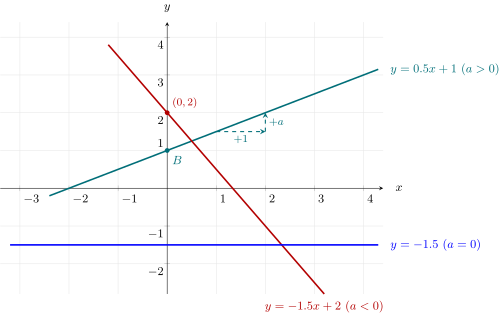
In a coordinate system , the representative curve of an affine function is the line with equation :
- the real number is the slope of the line ; the vector is a direction vector of ;
- the real number is the -intercept: the line meets the -axis at the point ;
- if (linear function), the line passes through the origin ;
- if (constant function), the line is parallel to the -axis .
18.2 Absolute value function
18.2.1 Study of the function
The absolute value function is the function defined on which, with every real number , associates its absolute value :
Exercises of the chapter
- Determining two affine functions, intersection of lines and sign of a product solved
- Complete study and representation of a piecewise affine function solved
- Equations, inequalities and bounds with the square function solved
- Study of a second-degree function from its canonical form solved
- Study of a function with a square root and conjugate quantity solved
- Comparison of , and and subadditive inequality of the square root solved