General notions on functions
Course · Mathematics (Grade 10, Lebanon), chapter 17 · Lebanon, Grade 10 · the beginning of the chapter, the rest on Adloun
The study of a physical, geometric or economic phenomenon very often leads to expressing a quantity as depending on a variable quantity : the temperature of a fluid as a function of time, the area of a figure as a function of the position of a moving point, or the production cost as a function of the quantity manufactured. The mathematical notion of real function provides the universal language for describing, representing graphically and analyzing these laws of correspondence.
This chapter introduces the fundamental concepts attached to every real function of one real variable: the determination of its domain of definition, the calculation and the graphical reading of images and preimages on its representative curve, the study of its direction of variation by means of the rate of change, the search for its extrema on an interval, and finally the use of its parity to bring out the symmetries of its curve and to reduce its domain of study.
Curriculum: LB-2
Required skills
- Determine the domain of definition of a real function (polynomial, rational, irrational) and calculate algebraically the image of a real number or the possible preimages of a real number.
- Construct and use the representative curve of a function in a coordinate system: read images and preimages, determine the points of intersection of with the coordinate axes.
- Calculate the rate of change of a function between two distinct real numbers, study its sign on an interval to prove the monotonicity of , and draw up the table of variations.
- Recognize and prove that a function has a maximum or a minimum on an interval by studying the sign of , by bounding or from the table of variations.
- Study the parity of a function (domain of definition symmetric about , comparison of and ), deduce the symmetry of about or about the origin , as well as the direction of variation on two symmetric intervals.
Throughout the chapter, the plane is equipped with a coordinate system , orthogonal or orthonormal when this is specified.
17.1 Real functions
17.1.1 Notion of function, image and preimages
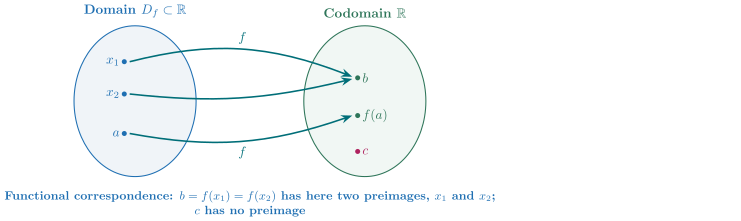
Let be a nonempty subset of (most often an interval or a union of intervals). Defining a real function on the set means associating with each real number of a unique real number, denoted . We write:
- The set , denoted , is called the domain of definition (or domain) of the function , and is called the variable.
- For a given real number , the unique real number is called the image of under the function .
- For a given real number , any real number such that is called a preimage of under .
By the very definition of a function, every element of has exactly one image . On the other hand, a real number may have a single preimage, several preimages, or no preimage in : the preimages of under are exactly the solutions in of the equation .
17.1.2 Determining the domain of definition
When a function is given only by its algebraic expression without explicit mention of its starting domain, its domain of definition is the set of all the real numbers for which the expression can be calculated (that is, is defined in ).
Let , and be polynomial expressions in .
- Polynomial function: every polynomial function is defined on the whole of : .
- Rational function (quotient): the function is defined if and only if its denominator does not vanish:
- Irrational function (square root): the function is defined if and only if the radicand is nonnegative:
- Quotient with a radical in the denominator: the function is defined if and only if is strictly positive:
- Let . The function is defined if and only if . So:
- Let . The expression exists if and only if . So . The image of is . Let us look for the preimages of under :
The real number has as its only preimage. On the other hand, has no preimage under because a square root is always nonnegative.
- Let . We need simultaneously and , that is, and . Hence .
Two real functions and are said to be equal, and we write , if and only if:
- they have the same domain of definition: ;
- for every , they associate the same image: .
The functions and are not equal: indeed, whereas . On the other hand, for every , we have : we say that and coincide on .
17.2 Graphical representation of a function
Let be a real function defined on . In the plane equipped with a coordinate system , the representative curve (or graph) of the function , denoted , is the set of points with coordinates as ranges over :
The relation is called the equation of the curve in the coordinate system .
Method : Graphical readings and intersections with the axes
Let be the representative curve of a function in a coordinate system .
- Reading the image of a real number : we locate on the -axis , we draw the parallel to the axis with equation up to its unique point of intersection with , then we read the ordinate on the axis .
- Reading the preimages of a real number : we locate on the -axis , we draw the horizontal line with equation parallel to , and we read the abscissas of all its points of intersection with .
- Intersection of with the -axis : the line has equation .
- If , meets at a unique point .
- If , does not meet the -axis.
- Intersection of with the -axis : the line has equation . The points of intersection of with are the points with coordinates where is a solution in of the equation (that is, the preimages of ).
Exercises of the chapter
- Determining domains of definition and equality of two functions solved
- Three forms of a function, images, preimages and intersections with the axes solved
- Graphical readings and algebraic check on a cubic curve solved
- Rate of change and proof of the direction of variation solved
- Algebraic proof of a maximum and a minimum on solved
- Parity, reduction of the domain of study and symmetry of the table of variations solved