Linear inequalities in one unknown
Course · Mathematics (Grade 10, Lebanon), chapter 16 · Lebanon, Grade 10 · the beginning of the chapter, the rest on Adloun
In many scientific or economic situations, we are not looking for a single value that achieves an exact equality, but for the set of all the values of a quantity that respect a threshold, a maximum budget, a tolerance margin or an existence condition. The problem then translates into an inequality or a system of inequalities.
This chapter first establishes the rule for studying the sign of the first-degree binomial and the solution of linear inequalities in one unknown. It then deals with systems of linear inequalities, whose solution rests on the intersection of intervals represented on the graduated line. Finally, it shows how to solve product inequalities and quotient inequalities by means of sign tables including the excluded values, as well as inequalities with absolute values interpreted in terms of distance on the real axis.
Curriculum: LB-2
Required skills
- Transform an inequality into an equivalent inequality using the rules of compatibility of the order with addition and multiplication.
- Study the sign of the binomial according to the sign of , draw up its sign table and solve any first-degree inequality, writing the solution set in the form of an interval.
- Solve a system of linear inequalities in one unknown or a double inequality by determining the intersection of the solution intervals by means of graduated lines.
- Factor or reduce to a common denominator in order to bring a polynomial or rational inequality back to the study of the sign of a product or of a quotient in a sign table with excluded values.
- Solve algebraically and geometrically inequalities with absolute value of the type and , and express an interval by means of an absolute value.
16.1 First-degree inequality in one unknown
16.1.1 Inequalities and transformations that preserve equivalence
An inequality in one real unknown is an inequality of the form , , or , where and are two expressions depending on .
- The domain of validity of the inequality is the set of real numbers for which and both exist.
- A real number is a solution of the inequality if the numerical inequality obtained by replacing by is true.
- Solving the inequality consists in determining the set of all its solutions, which is written in the form of an interval or of a union of intervals.
- Two inequalities with the same domain of validity are equivalent if they have the same solution set .
On a common domain of validity , we obtain an equivalent inequality when:
- we add to (or subtract from) both sides the same expression defined on :
- we multiply (or divide) both sides by the same strictly positive real number , keeping the direction of the inequality:
- we multiply (or divide) both sides by the same strictly negative real number , reversing the direction of the inequality:
These rules remain fully valid when is replaced by , or .
16.1.2 Sign of the binomial and solution of the linear inequality
Let and be two real numbers with . The expression is called a first-degree binomial. Any inequality that reduces, after moving the terms to one side and combining like terms, to one of the forms , , or is called a linear (or first-degree) inequality in one unknown.
Let and be two real numbers such that . The binomial vanishes for the unique value , called the root of the binomial. Factoring out , we have for every real number :
Consequently:
- for (to the right of the root), has the sign of ;
- for (to the left of the root), has the sign opposite to that of (sign of ).
This result is summarized by the universal sign table of the first-degree binomial:
Proof
Since , for every real number , the equality shows that is the product of by the difference .
- If , then . The product therefore has the same sign as the factor : strictly positive if , strictly negative if .
- If , then . The product then has the sign opposite to that of : strictly negative if , strictly positive if .
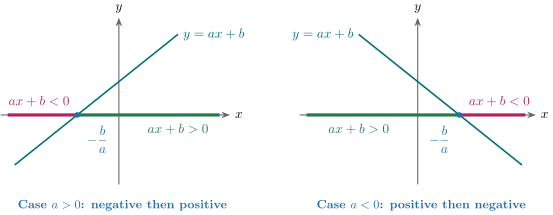
Let and . The solution set of the inequality is obtained by reading the sign table of (or by isolating ):
| Inequality | Solutions if | Solutions if |
|---|---|---|
| [6pt] | ||
| [6pt] | ||
| [6pt] |
Exercises of the chapter
- Fractional linear inequalities, singular cases and discussion according to a parameter solved
- Systems of linear inequalities, graduated lines and double inequalities solved
- Factoring and sign tables of product inequalities solved
- Rational inequalities, reduction to a common denominator and excluded values solved
- Inequalities with absolute values, center and radius of an interval solved
- Comparison of two absolute values and sum of absolute values solved