First-degree equations in one unknown
Course · Mathematics (Grade 10, Lebanon), chapter 15 · Lebanon, Grade 10 · the beginning of the chapter, the rest on Adloun
Determining the value of an unknown quantity from the relations it satisfies is one of the founding problems of algebra. Whether we want to calculate the equilibrium position of a point on a segment, to share a resource fairly or to determine the instant at which two moving objects meet, the modeling most often leads to an equation in which the unknown appears to the first degree, or to a more elaborate equation that reduces to it.
This chapter first presents the complete solution of the linear equation and the method for setting up the equation of a problem. It then shows how to reduce polynomial or rational equations to the first degree by means of factoring, the zero-product rule and reduction to a common denominator, taking the excluded values into account. Finally, it studies equations involving absolute values or square roots, where mastery of the positivity conditions and of the splitting of the real line into intervals is essential to discard extraneous solutions.
Curriculum: LB-2
Required skills
- Determine the domain of validity of an equation in one unknown and transform an equation into an equivalent equation.
- Solve in a first-degree equation by discussing according to whether the coefficient is zero, and translate a concrete problem into an equation.
- Factor an algebraic expression using a common factor or the special products in order to solve a product equation or an equation of the form .
- Determine the excluded values and solve a quotient equation or a rational equation that reduces to the first degree after reduction to a common denominator.
- Solve algebraically and geometrically equations with absolute values of the type , , , as well as equations involving several absolute values by means of a sign table.
- Solve irrational equations of the type , and when they reduce to the first degree, while checking the positivity condition.
15.1 First-degree equation in one unknown
15.1.1 Equations, domain of validity and equivalence
An equation in one real unknown is an equality of the form , where and are two expressions depending on , called respectively the left-hand side and the right-hand side of the equation.
- The domain of validity (or domain of definition) of the equation, denoted , is the set of real numbers for which the two expressions and are both defined.
- A real number is a solution (or root) of the equation if the numerical equality is true.
- Solving the equation in consists in determining the set of all its solutions belonging to .
Two equations with the same domain of validity are said to be equivalent if they have exactly the same solution set . They are then linked by the equivalence symbol .
On a common domain of validity , we obtain an equation equivalent to when:
- we add to (or subtract from) both sides the same expression defined for every :
- we multiply (or divide) both sides by the same nonzero real number :
Multiplying both sides of an equation by an expression that may vanish, or squaring both sides, does not preserve equivalence in general: these operations may introduce extraneous solutions. Conversely, dividing both sides by an expression depending on without checking that it does not vanish may cause solutions to be lost.
15.1.2 Solving the equation
A first-degree equation in one real unknown is any equation which, after expanding, combining like terms and moving all the terms to the same side, can be written in the canonical form:
where and are two given real numbers. When , we say that the equation is genuinely of the first degree.
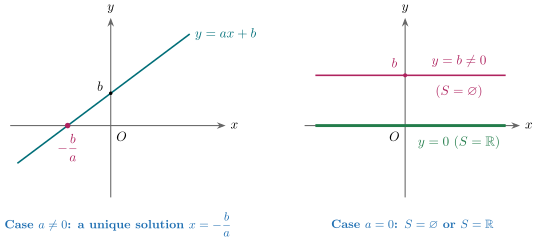
Let and be two real numbers, and consider the equation with unknown .
- First case: . The equation has a unique real solution:
- Second case: and . The equation reads , that is, , which is false for every real number . The equation is said to be impossible and has no solution:
- Third case: and . The equation reads , an equality that is true for every real number . The equation is said to be indeterminate (it is an identity on ):
Proof
The domain of validity of is . Subtracting from both sides, we obtain the equivalent equation .
- If , we can divide both sides by the nonzero real number , which gives the equivalence . The unique solution is therefore .
- If , for every real number , the left-hand side equals . The equation is therefore equivalent to , that is, . If , this condition is satisfied by no real number , hence . If , the equality holds whatever , hence .
Let us solve in the following three equations:
- . Multiplying both sides by the common denominator :
The solution set is .
- . Expanding the left-hand side:
This equality is impossible: .
- . We obtain , hence .
15.1.3 Setting up the equation of a problem
Method : Solving a problem by setting up an equation
To solve a concrete problem leading to a first-degree equation:
- Choice of the unknown: clearly identify the quantity sought, denote it , specifying its unit and the set of values it can take according to the constraints of the statement (positivity, geometric bounds).
- Setting up the equation: express in terms of the various quantities mentioned in the statement and translate the relation linking them into an equation.
- Algebraic solution: solve the equation obtained by successive equivalences.
- Check and conclusion: check that the solution found satisfies the constraints of the problem and write a complete answer sentence with the units.
Exercises of the chapter
- Fractional linear equations, singular cases and discussion according to a parameter solved
- Algebraic factoring, special products and product equations solved
- Quotient equations, reduction to a common denominator and rejection of excluded values solved
- Absolute values, geometric interpretation on the real axis and sign condition solved
- Sum of absolute values and solution by splitting into intervals solved
- Irrational equations that reduce to the first degree solved