Analytic form of the scalar product
Course · Mathematics (Grade 10, Lebanon), chapter 14 · Lebanon, Grade 10 · the beginning of the chapter, the rest on Adloun
In an arbitrary coordinate system, coordinates already make it possible to express the collinearity of points and the parallelism of lines. On the other hand, as soon as we need to measure lengths, calculate angles or characterize perpendicularity, the coordinate system must be chosen orthonormal. In such a coordinate system, the scalar product of two vectors takes a remarkably simple algebraic expression in terms of their coordinates. This analytic tool then unifies metric geometry and algebraic calculation: determining the equation of an altitude or of a perpendicular bisector, checking whether two lines are perpendicular or calculating the distance from a point to a line all come down to elementary operations on coordinates.
Curriculum: LB-2
Required skills
- Calculate the scalar product of two vectors, the norm of a vector and the distance between two points using their coordinates in an orthonormal coordinate system.
- Determine the cosine and a measure of the geometric angle formed by two nonzero vectors from their coordinates.
- Characterize analytically the orthogonality of two vectors by the relation .
- Determine a normal vector to a line with a given Cartesian equation and establish a Cartesian equation of a line knowing a point and a normal vector.
- Recognize and establish the perpendicularity of two lines from their Cartesian equations () or from their slopes ().
- Determine an equation of an altitude or of a perpendicular bisector in a triangle, the coordinates of the orthogonal projection of a point onto a line and the distance from a point to a line.
14.1 Analytic expression
Throughout the rest of this chapter, the plane is equipped with an orthonormal coordinate system . By definition of an orthonormal basis , the vectors and are unit vectors and orthogonal:
In terms of the scalar product, these three conditions translate into:
14.1.1 Scalar product in coordinates
In an orthonormal coordinate system , let and be two vectors of the plane. The scalar product of the vectors and is given by:
Proof
By definition of coordinates in the basis , we have and . Using the bilinearity of the scalar product, we expand:
Since the basis is orthonormal, we have , and . There therefore remains:
The formula is valid only in an orthonormal basis. If the axes of the coordinate system are not perpendicular or if the units of length differ on the two axes, the terms , and are no longer equal to and .
In an orthonormal coordinate system , consider the vectors and , as well as the points , and .
- The scalar product of and is:
- To calculate , we first determine the coordinates of the two vectors:
We deduce:
14.1.2 Norm of a vector and distance between two points
In an orthonormal coordinate system :
- For every vector , the norm of is given by:
- For all points and , the distance is given by:
Proof
- Applying the analytic expression of the scalar product to the pair , we obtain the scalar square:
The norm being a nonnegative real number, we deduce .
- The vector has coordinates . Since , the previous formula immediately gives .
14.1.3 Calculating angles using coordinates
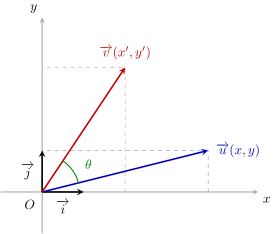
Combining the trigonometric definition and the analytic expression of the scalar product, we obtain a direct formula for the cosine of the geometric angle of two nonzero vectors.
Let and be two nonzero vectors in an orthonormal coordinate system, and let be the measure of their geometric angle. Then:
Exercises of the chapter
- Scalar product, lengths, nature of a triangle and calculation of angles solved
- Orthogonality with a real parameter and calculation of a remarkable angle solved
- Normal vector, equations of perpendiculars and a family of lines solved
- Altitudes, perpendicular bisectors, orthocenter, circumscribed circle and Euler line solved
- Orthogonal projection, distance to a line and reflection in a line solved
- Altitude and area of a triangle, and angle bisectors of two intersecting lines solved