Scalar product
Course · Mathematics (Grade 10, Lebanon), chapter 13 · Lebanon, Grade 10 · the beginning of the chapter, the rest on Adloun
In physics, the work of a constant force during a straight-line displacement depends not only on the magnitude of the force and on the length of the displacement, but also on the inclination of the force with respect to the path: only the component of projected onto the direction of motion does positive or negative work. In geometry, this operation, which associates a real number with two vectors, is called the scalar product.
This chapter introduces the scalar product of two vectors through its trigonometric expression and through orthogonal projection, then establishes its rules of computation — symmetry, bilinearity, scalar square and special products. These tools make it possible to prove, in a unified way, the classical metric theorems of the plane: the Al-Kashi theorem, the median theorem, the characterization of the circle by a diameter, and the metric relations in a right triangle.
Curriculum: LB-2
Required skills
- Calculate the scalar product of two vectors using the definition or by orthogonal projection ().
- Determine the sign of a scalar product according to the nature of the angle (acute, right, obtuse) and characterize the orthogonality of two vectors by .
- Use symmetry, bilinearity, the scalar square and the vector special products to expand or transform expressions and to calculate scalar products from norms.
- Apply the Al-Kashi theorem to calculate a length or an angle in any triangle.
- Apply the median theorem to calculate the length of a median or to determine sets of points, and characterize the circle with diameter by .
- Prove and use the metric relations in a right triangle.
13.1 Scalar product of two vectors
13.1.1 Definition by the cosine
Let and be two vectors of the plane. The scalar product of and is the real number, denoted , defined by:
- if and :
where denotes the angle of the vectors and ;
- if or :
Since the cosine function is even (), the real number does not depend on the chosen orientation: if we represent the two vectors from the same initial point by setting and (with and ), then:
where is the geometric angle of the triangle at . The result of a scalar product is always a real number (a scalar), never a vector.
Let be an equilateral triangle with side . The sides from have length and form an angle (i.e. ). We therefore have:
If is the point such that , the angle measures (), hence .
13.1.2 Expression by orthogonal projection
Let , and be three points of the plane such that , and let be the orthogonal projection of onto the line . Then:
where and denote the algebraic measures on the axis . In other words:
- if and have the same sense, then ;
- if and have opposite senses, then ;
- if , then .
Proof
If , then and both sides are zero. Assume and distinguish three cases according to the measure of the geometric angle :
- First case: (acute angle). The point belongs to the ray , so and are collinear and have the same sense, which gives . In the triangle , right-angled at (or degenerate if ), we have , hence:
- Second case: (right angle). The orthogonal projection of onto is , so , and , hence .
- Third case: (obtuse angle). The point belongs to the ray opposite to with endpoint , so and have opposite senses and . In the triangle , right-angled at , the acute angle measures , so that , that is, . We then obtain:
In all cases, since is collinear with , we indeed have .
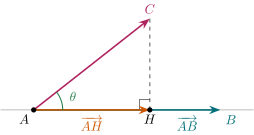
{ Case of an acute angle (): and have the same sense, so .}
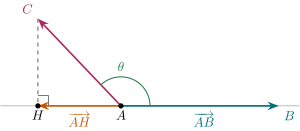
{ Case of an obtuse angle (): and have opposite senses, so .}
Let , , and be four points of the plane such that . If and denote the respective orthogonal projections of and onto the line , then:
Proof
Let be the point such that and its orthogonal projection onto . Orthogonal projection preserves the equality of vectors, so and . By the previous theorem, . Finally, since the vectors and are collinear, .
Exercises of the chapter
- Calculating scalar products by orthogonal projection and cosine solved
- Scalar square, special products and polarization formulas solved
- Two isosceles right triangles constructed on the sides of a triangle solved
- Complete solution of a triangle with Al-Kashi and the median theorem solved
- Metric relations in a right triangle and projections of the foot of the altitude solved
- Level lines and sets of points solved