The straight line in the plane
Course · Mathematics (Grade 10, Lebanon), chapter 12 · Lebanon, Grade 10 · the beginning of the chapter, the rest on Adloun
We draw the straight profile of an irrigation canal on a plan drawn on grid paper; we check whether two plot boundaries are parallel or whether they end up crossing, and we calculate the coordinates of their meeting point. As soon as the plane is equipped with a coordinate system, each line translates into a first-degree equation linking the abscissa and the ordinate of its points.
This chapter establishes the link between the geometry of lines and algebraic computation. Starting from the notion of direction vector and the collinearity condition, it shows that every line of the plane has a Cartesian equation of the form , then introduces the slope-intercept equation and the slope of a line that is not parallel to the -axis. It then studies the relative positions of two lines — parallelism and intersection — before characterizing the line drawn through a given point parallel to a fixed direction.
Curriculum: LB-2
Required skills
- Determine a direction vector of a line and characterize the membership of a point in the line through with direction vector by .
- Write a Cartesian equation of a line defined by a point and a direction vector, or by two distinct points; read a direction vector from the Cartesian equation.
- Go from a Cartesian equation to the slope-intercept equation of a line not parallel to the -axis; calculate and interpret the slope and the -intercept .
- Recognize and write the equations of lines parallel to the coordinate axes ( and ).
- Study the relative position of two lines (strictly parallel, coincident, intersecting) using the determinant or the slopes, and calculate the coordinates of their point of intersection when they intersect.
- Write an equation of the line through a given point parallel to a given line, and apply it to the study of parallelograms and trapezoids.
Throughout the chapter, the plane is equipped with a coordinate system .
12.1 Cartesian equations of a line
12.1.1 Direction vector and vector characterization
Let be a line of the plane. A direction vector of is any nonzero vector that has the same direction as , that is, such that there exist two distinct points and of satisfying .
A line has infinitely many direction vectors: if is a direction vector of , then a nonzero vector is also a direction vector of if and only if it is collinear with , that is, if there exists a nonzero real number such that . In particular, if and are two distinct points of , the vector is a direction vector of .
Let be a point of the plane and a nonzero vector. There exists a unique line through with direction vector . A point belongs to if and only if the vectors and are collinear:
Proof
By definition, a point belongs to the line through directed by if and only if has the direction of (or if , in which case ), that is, if and only if the vectors and are collinear. In the coordinate system , the collinearity condition for two vectors is expressed by the vanishing of their determinant:
which gives exactly the stated equivalence.
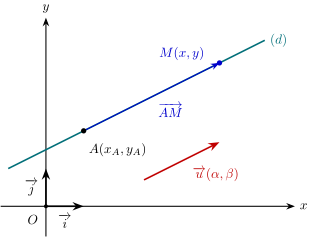
{ A point belongs to the line through directed by if and only if and are collinear, that is, .}
12.1.2 Cartesian equation
In the plane equipped with a coordinate system :
- Every line has an equation of the form
called a Cartesian equation of .
- Conversely, for all real numbers , , such that , the set of points of the plane satisfying is a line of which the vector is a direction vector.
Proof
1. Let be a line of the plane. It is determined by a point and a nonzero direction vector , where . By the previous characterization:
Setting , and , we obtain the equation . Since , the pair is different from .
2. Conversely, consider the set of points such that , with . Let us first show that contains at least one point :
- if , the point satisfies ;
- if , then necessarily , and the point satisfies .
Since , we have . For every point of the plane:
Let . Since , the vector is nonzero, and we recognize the determinant:
Thus : the set is the line through with direction vector .
A line has infinitely many Cartesian equations: if is a Cartesian equation of , then for every nonzero real number , the equation is equivalent to the first one and represents the same line . For example, and are two Cartesian equations of the same line.
Method : Determining a Cartesian equation of a line
- With a point and a direction vector :
- First way: we write , that is, , and expand.
- Second way: since , we set and , which gives an equation of the form ; then we calculate by expressing that the coordinates of satisfy the equation.
- With two distinct points and : we calculate the coordinates of the direction vector and apply the previous method with the point and the vector .
Exercises of the chapter
- Cartesian equation, slope-intercept equation, slope and intersections with the axes solved
- Graphical reading and identification of the equations of three lines solved
- Relative positions of two lines and computation of their point of intersection solved
- Family of lines depending on a real parameter and fixed point solved
- Parallels through the vertices of a triangle and associated parallelogram solved
- Medians, midline and centroid of a triangle solved