Bases and coordinate systems
Course · Mathematics (Grade 10, Lebanon), chapter 11 · Lebanon, Grade 10 · the beginning of the chapter, the rest on Adloun
Associating with each point of the plane a pair of real numbers and with each vector its components makes it possible to transform a geometry problem into a systematic algebraic calculation. This is the founding idea of analytic geometry: once a coordinate system has been chosen on a line or in the plane, the equality of vectors, collinearity of vectors, collinearity of points, parallelism of lines or the search for a midpoint come down to simple operations on coordinates.
This chapter begins with locating points on an axis and the notion of algebraic measure , then introduces the bases and the coordinate systems of the plane (arbitrary, orthogonal, orthonormal). It then establishes the rules of calculation on the coordinates of vectors and the collinearity criterion by the determinant, before applying them to the classical geometric configurations and to the change of origin of a coordinate system.
Curriculum: LB-2
Required skills
- Locate a point on an axis , calculate the algebraic measure , the distance and the abscissa of the midpoint of a segment, and use Chasles' relation .
- Recognize a basis and a coordinate system of the plane (arbitrary, orthogonal, orthonormal); decompose a vector in a basis and read the coordinates of a point or of a vector.
- Calculate the coordinates of , of and of the vector .
- Calculate the determinant of two vectors and use it to study their collinearity, the collinearity of three points or the parallelism of two lines.
- Calculate the coordinates of the midpoint of a segment, of the centroid of a triangle and of the fourth vertex of a parallelogram; carry out a change of origin of a coordinate system.
11.1 Lines and axes
11.1.1 Coordinate system of a line and abscissa of a point
Let be a line of the plane, a point of and a nonzero vector having the direction of (and chosen with norm to fix the unit of length).
- The pair is called a coordinate system of the line . The point is its origin and its unit vector. A line equipped with a coordinate system is called an axis.
- For every point of the axis , the vectors and are collinear: there therefore exists a unique real number such that:
This real number is called the abscissa of the point in the coordinate system , and we write .
In particular, the origin has abscissa () and the unit point such that has abscissa . The points with positive abscissa are located on the ray (positive sense of the axis), whereas the points with negative abscissa are located on the opposite ray.
11.1.2 Algebraic measure on an axis
Let and be two points of an axis equipped with the coordinate system . The vector being collinear with , there exists a unique real number, denoted and called the algebraic measure of , such that:
When the vector is a unit vector (), taking the norm of both sides of the equality , we obtain . Thus:
- if has the same sense as , then ;
- if has the sense opposite to , then ;
- if , then .
Let be an axis equipped with a coordinate system (with ), and , , three points of .
- Expression by the abscissas: , and in particular .
- Antisymmetry: .
- Chasles' relation: for all points , and of the axis:
- Distance between two points: .
- Abscissa of the midpoint: the midpoint of the segment has abscissa:
Proof
- By assumption, and . By the relation :
By uniqueness of the real number satisfying , we obtain .
- We have .
- For all points , , of , the vector form of Chasles' relation is written , that is . Since , the uniqueness of the coefficient gives (which is also checked by ).
- Taking the norm of with , we get .
- The point is the midpoint of if and only if , that is , that is , which is equivalent to , hence .
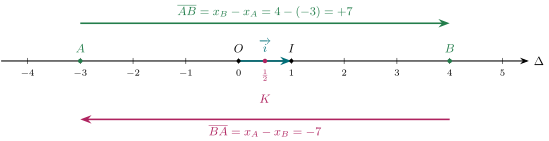
On an axis , consider the points , and .
- We have , and . We do check Chasles' relation: .
- The distance is , and the midpoint of has abscissa .
- To find the point of the axis satisfying , we translate the equation using the abscissas: .
11.2 Planes and coordinate systems
11.2.1 Basis of the plane and coordinates of a vector
We call basis of the plane any pair of two non-collinear vectors (in particular and ).
Exercises of the chapter
- Algebraic measures, Chasles' relation and harmonic division on an axis solved
- Linear combinations, determinant and change of basis solved
- Collinearity condition with a parameter and recognizing a basis solved
- Parallelogram, parallelism, midpoint and centroid solved
- Choosing an intrinsic coordinate system attached to a triangle and proving collinearity solved
- Change of origin of the coordinate system and characterization of a central symmetry solved