Applications of vector calculus
Course · Mathematics (Grade 10, Lebanon), chapter 10 · Lebanon, Grade 10 · the beginning of the chapter, the rest on Adloun
How can we prove that three survey markers are perfectly aligned, that two beams of a roof frame are parallel, or that the three medians of a triangular plate intersect at the same balance point, without ever measuring an angle or using a set square? Vector calculus offers a remarkably efficient answer: it translates these geometric properties of incidence and parallelism into simple relations of collinearity or sums of vectors.
This chapter uses vector operations to establish three major tools of plane geometry: the vector characterization of the collinearity of three points, the characterization of the parallelism of two lines (with the vector form of Thales' theorem), and the characteristic properties of the midpoint of a segment, which make it possible to prove with vectors the midpoint theorem as well as the concurrence of the medians at the centroid of a triangle.
Curriculum: LB-2
Required skills
- Characterize the collinearity of three points by the collinearity of two vectors having a common point and prove that three points are collinear by decomposing vectors with Chasles' relation.
- Characterize the parallelism of two lines and by the collinearity of the vectors and ; recognize a parallelogram or a trapezoid by a vector relation.
- Use the different vector characterizations of the midpoint of a segment , in particular the relation for every point of the plane.
- Apply the vector form of the midpoint theorem () in geometry problems.
- Characterize the centroid of a triangle by the relations , and .
10.1 Collinearity of points
10.1.1 Vector characterization of collinearity
Let , and be three points of the plane. If two of them coincide, they always belong to the same line. Assume from now on that and are distinct: saying that the point belongs to the line amounts to saying that, when , the lines and have the same direction, since they already have the point in common.
Let , and be three points of the plane, with . The following statements are equivalent:
- the points , and are collinear (that is );
- the vectors and are collinear;
- there exists a real number such that:
Proof
Since , the vector is nonzero.
- If , the points , , are collinear, the vector is collinear with , and the relation is satisfied for .
- If , the vector is nonzero. Saying that and are collinear (that is, that there exists a nonzero real number such that ) is equivalent, by definition of the collinearity of two nonzero vectors, to saying that they have the same direction, so that the lines and are parallel. Since these two lines have the point in common, they are parallel if and only if they coincide, that is, if and only if , and are collinear.
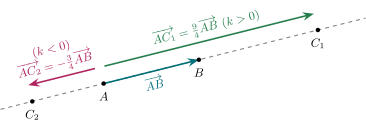
When (with ), the value of the real number specifies the exact position of on the line :
- if , the point belongs to the ray ; in particular, belongs to the segment if and only if (with for and for );
- if , the point belongs to the ray with origin opposite to .
10.1.2 Vector method for proving collinearity
Method : Proving that three points , and are collinear
- We form two vectors having a common point among the three points studied, for example and .
- We choose two non-collinear vectors of the figure (such as and in a triangle , or and in a parallelogram ) and we express and in terms of these two vectors only using Chasles' relation.
- We find a real number such that . The vectors and being collinear and having the initial point in common, we conclude that the points , and are collinear.
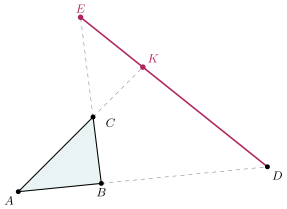
Let be a triangle. We plot the points , and defined by:
Let us prove that the points , and are collinear by decomposing and in terms of and :
By Chasles' relation going through the point :
and on the other hand:
Multiplying the expression of by , we get:
Thus : the vectors and are collinear, so the points , and are collinear.
Exercises of the chapter
- Proving the collinearity of three points by vector decomposition solved
- Vector characterization of parallelism and nature of a quadrilateral solved
- Characteristic property and loci solved
- Midpoint theorem and segments joining the midpoints of a quadrilateral solved
- Centroid, symmetry and line parallel to a side solved
- Triangles having the same centroid solved