Vectors in the plane
Course · Mathematics (Grade 10, Lebanon), chapter 9 · Lebanon, Grade 10 · the beginning of the chapter, the rest on Adloun
When a ship leaves the port of Beirut or Tripoli, stating only the distance traveled is not enough to determine its position: we must specify the direction followed and the sense of the displacement. Likewise, in mechanics, the effect of a force exerted by a cable on a crane depends at once on its magnitude, on the line along which it acts and on the sense of the pull. These quantities, characterized simultaneously by a direction, a sense and a length, are modeled in mathematics by the notion of vector.
This chapter sets up vector calculus in the plane: after defining a vector from translations and bipoints and characterizing the equality of vectors by the parallelogram, we study the addition of vectors (Chasles' relation and parallelogram rule), vector subtraction, then the multiplication of a vector by a real number, which leads naturally to the fundamental notion of collinear vectors.
Curriculum: LB-2
Required skills
- Characterize a nonzero vector by its direction, its sense and its norm; recognize equal vectors and opposite vectors.
- Express in terms of vectors that a quadrilateral is a parallelogram and construct the representative of a vector with a given initial point.
- Construct the sum and the difference of two vectors; use Chasles' relation and the parallelogram rule to transform or reduce sums of vectors.
- Construct the product of a vector by a real number and calculate its norm .
- Apply the rules of vector calculus to expand, factor and solve first-degree vector equations.
- Recognize and prove that two vectors are collinear using a relation of the form .
9.1 The vector
9.1.1 Bipoint, translation and definition of a vector
An ordered pair of points of the plane is called a bipoint: the point is its initial point and the point is its terminal point. With this bipoint is associated the translation that maps to : it slides every figure of the plane without turning or deforming it, sending each point to the unique point such that the quadrilateral is a parallelogram (possibly flattened when belongs to the line ).
Two bipoints and define the same translation when the segments and have the same midpoint. We then say that they represent the same vector, and we write:
The vector is the geometric object common to all the bipoints that define the translation mapping to . Each of these bipoints is called a representative of the vector. A vector can also be denoted by a single letter with an arrow above it, such as , or .
When the points and are distinct, the vector is entirely characterized by three geometric data:
- its direction: that of the line (two lines have the same direction if and only if they are parallel);
- its sense: the sense of travel from to on the line (a direction has exactly two opposite senses);
- its norm (or length): the distance , denoted :
If , the norm of is the nonnegative real number .
In everyday language, the words “direction” and “sense” are often confused. In geometry, the direction denotes a family of parallel lines (for example the north-south direction), whereas the sense specifies which way we travel along this direction (from south to north, or from north to south).
9.1.2 Zero vector and opposite vector
- For every point of the plane, the vector is called the zero vector and is denoted . Thus, for all points and :
The zero vector is the only vector of norm zero (); it has neither a defined direction nor a defined sense.
- The opposite vector of a nonzero vector , denoted , is the vector that has the same direction, the same norm, but the sense opposite to that of . By convention, the opposite of is . For all points and of the plane:
9.1.3 Equality of two vectors and parallelogram
Let , , and be four points of the plane. The following statements are equivalent:
- ;
- the vectors and are both zero, or else they have the same direction, the same sense and the same norm;
- the segments and have the same midpoint;
- the quadrilateral is a parallelogram (possibly flattened if , , and are collinear).
Proof
The equivalence of (1) and (3) is the definition of the equality of two vectors. The equivalence of (3) and (4) is the known property: a quadrilateral is a parallelogram if and only if its diagonals have the same midpoint. Finally, when , saying that is a parallelogram amounts to saying that the sides and are parallel, of the same length, and traveled in the same sense from to and from to , which is statement (2); this last equivalence is accepted.
In the equivalence , the order of the letters of the last two vertices is reversed: we go around the quadrilateral following , whereas the two vectors and are oriented in the same sense on the opposite sides. Moreover, the equality is also equivalent to , to and to .
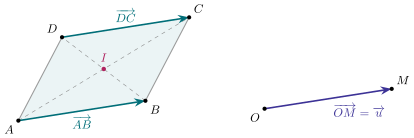
For every vector of the plane and for every fixed point , there exists a unique point of the plane such that:
Exercises of the chapter
- Equalities of vectors, chained parallelograms and midpoints solved
- Reducing sums and differences of vectors by Chasles' relation solved
- Algebraic calculation on vectors and vector systems solved
- Constructing points defined by a vector equation solved
- Algebraic recognition of collinear vectors, with a parameter solved
- Decomposition in a geometric basis and proof of collinearity solved