Trigonometric lines
Course · Mathematics (Grade 10, Lebanon), chapter 8 · Lebanon, Grade 10 · the beginning of the chapter, the rest on Adloun
Since Mediterranean Antiquity, astronomers and navigators have located the height of celestial bodies above the horizon and measured arcs on the celestial sphere. When a lighthouse regularly sweeps the coast of Beirut or Tyre, or when a wheel turns at constant speed, the motion repeats at each full turn: trigonometry, first introduced in the right triangle for acute angles only, is then extended to every real number thanks to the wrapping of the real line around a circle of unit radius.
This chapter first defines the radian and relates the length of an arc of a circle to its central angle. It then introduces the trigonometric circle, oriented arcs and the principal measure of a curvilinear abscissa in . Finally, it defines the four trigonometric lines (, , and ), their geometric interpretation, their signs by quadrant, the fundamental relations that link them, the special values as well as the formulas for associated angles.
Curriculum: LB-2
Required skills
- Convert angle measures from degrees to radians and conversely, and calculate the length of an arc of a circle .
- Plot on the trigonometric circle the image point of a real number, find the set of its curvilinear abscissas and calculate its principal measure in .
- Define and interpret geometrically , , and , and find their sign according to the quadrant.
- Prove and use the fundamental relations , and to calculate the trigonometric lines of a real number knowing one of them.
- Know the special values at , , , , and use the formulas for associated angles (, , , , ) to simplify expressions and calculate exact values.
8.1 Degrees and radians
8.1.1 Definition of the radian and length of an arc of a circle
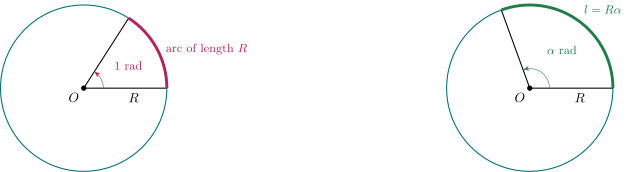
Let be a circle with center and radius . One radian (denoted ) is the measure of a central angle that intercepts on the circle an arc of length equal to the radius .
On a circle of radius , the length of an arc intercepted by a central angle of measure expressed in radians () is proportional to and is equal to:
In particular, on a circle of radius , the length of the intercepted arc is equal to the measure of the central angle in radians (). Likewise, the area of the corresponding circular sector is .
Proof
The length of an arc of a circle is proportional to the measure of the central angle that intercepts it. Since an angle of intercepts by definition an arc of length , an angle of intercepts an arc of length . For a full turn, the circumference of the circle is , which corresponds to a full angle of and to a disk of area , hence by proportionality .
8.1.2 Conversion between degrees and radians
A straight angle measures or . The measure in degrees and the measure in radians of the same angle are linked by the proportionality relation:
In particular, and .
| Degrees | |||||||||||
|---|---|---|---|---|---|---|---|---|---|---|---|
| Radians |
Let us convert into radians: . On a circle of radius , a central angle of intercepts an arc of length .
8.2 Locating a point
8.2.1 Oriented plane, trigonometric circle and wrapping of
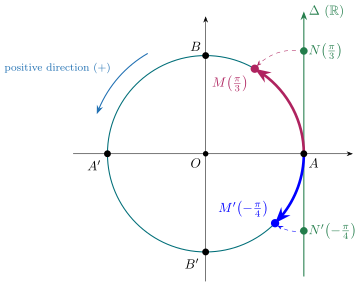
- Orientation of a circle and of the plane: on every circle of the plane, there are two directions of travel. By convention we choose as positive direction (or direct sense, or trigonometric direction) the counterclockwise direction, and as negative direction (or indirect sense, or retrograde direction) the clockwise direction. An orthonormal coordinate system is said to be positively oriented (or direct) if we go from to by a quarter turn in the positive direction.
- Trigonometric circle: in the plane equipped with a positively oriented orthonormal coordinate system , we call trigonometric circle the circle with center , radius , oriented in the positive direction and equipped with the origin point (such that ). We also denote (such that ), and .
Consider the line tangent to the trigonometric circle at , equipped with the coordinate system in which every real number is represented by the point . By wrapping the graduated line without slipping around about :
- the ray of nonnegative real numbers () wraps in the positive direction;
- the ray of nonpositive real numbers () wraps in the negative direction.
To every real number there thus corresponds a unique point of the circle , obtained by traveling along , starting from , an arc of length in the positive direction if and in the negative direction if :
- the point , denoted , is called the image point of the real number on ;
- the real number is called a curvilinear abscissa of the point , or a measure in radians of the oriented arc .
Exercises of the chapter
- Degree-radian conversions, arc length and principal measure solved
- Calculating the four trigonometric lines in a given quadrant solved
- Formulas for associated angles and reduction of expressions solved
- Calculating trigonometric sums and products by symmetry solved
- Proving trigonometric identities solved
- Algebraic calculations starting from solved