Absolute value – Approximation
Course · Mathematics (Grade 10, Lebanon), chapter 7 · Lebanon, Grade 10 · the beginning of the chapter, the rest on Adloun
On the coastal highway linking Beirut to Tripoli, a kilometer marker indicates the position of a vehicle, but the distance traveled between two cities does not depend on the direction of travel: it is always positive. Likewise, when an engineer or a physicist states that a mechanical part measures to within , he expresses that the gap between the actual length and the target value does not exceed , whether this gap is below or above.
This chapter introduces the absolute value of a real number, which measures on the graduated line the distance to zero and makes it possible to express the distance between any two real numbers by . After establishing its fundamental algebraic properties and the triangle inequality, we characterize centered intervals by their center and their radius using the inequality , then we specify the notions of approximate value to within , lower or upper approximation, truncation and rounding.
Curriculum: LB-2
Required skills
- Calculate the absolute value of a real number and simplify expressions containing absolute values or radicals of the form .
- Interpret as the distance between the points with abscissas and on the real line and use it to solve equations and inequalities.
- Know and apply the properties of the absolute value, in particular the triangle inequality .
- Find the center, the radius and the width of a bounded interval and express membership in by .
- Find an approximate value of a real number to within , a lower or upper approximation to within , a truncation and a rounding.
7.1 Absolute value of a real number
7.1.1 Definition and geometric interpretation
Let be a real number. We call absolute value of , and denote by , the larger of the two numbers and :
For every real number , we have the fundamental double inequality:
- ; ; .
- To write without an absolute value bar, we study the sign of : since , we have , so .
- Likewise, since (because ), we have , hence .
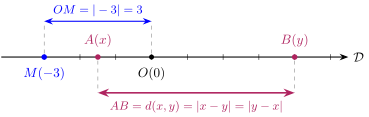
We equip a line with a coordinate system .
- For every point with abscissa on , the absolute value is the distance to zero of the real number , that is the geometric distance :
- Let and be two points of with respective abscissas and . We call distance between the real numbers and , denoted , the geometric distance :
Proof
If , the point is located to the right of on the oriented axis, the geometric distance is , and since , we have . If , the point is to the right of , the distance is , and since , we have . In all cases, . In particular, for , we recover .
7.1.2 Algebraic properties of the absolute value
For all real numbers and :
- Nonnegativity and separation: , and .
- Evenness (opposite): and, more generally, .
- Square and square root:
- Product and quotient:
In particular, for every natural number , .
Proof
- If , ; if , . Moreover, is equivalent to or , that is .
- . Replacing by , we obtain .
- Whether is equal to or to , its square is . By definition of the square root of , is the unique nonnegative real number whose square is . Now and : by uniqueness, .
- The two real numbers and are nonnegative. Let us compare their squares using property 3:
Two nonnegative real numbers having the same square are equal, hence . For , writing , the product property gives , and dividing by , we get .
Exercises of the chapter
- Radicals, comparisons and writing without absolute value solved
- Distances on the graduated line, equations and ring of intervals solved
- Weighted sum of absolute values as a function, and minimum solved
- Centered intervals, intersection and condition on a parameter solved
- Double inequalities, truncations, roundings and uncertainty on a quotient solved
- Triangle inequality and error control on a polynomial solved