Sets
Course · Mathematics (Grade 10, Lebanon), chapter 4 · Lebanon, Grade 10 · the beginning of the chapter, the rest on Adloun
Grouping together objects that share a common property — the points of a circle, the divisors of an integer, the solutions of an equation or the numbers having a certain type of notation — is the founding act of mathematical language. Set theory provides a universal, concise and rigorous grammar to describe these collections, compare them and combine them.
This chapter introduces the notions of set, element and subset, then the set operations (intersection, union, complement, difference) as well as the associated counting formulas. It ends with the reasoned construction of the chain of the sets of numbers and the study of rational and irrational numbers.
Curriculum: LB-2
Required skills
- Go from the set-builder notation of a set to its roster notation, and conversely; recognize the empty set, a singleton, a pair, and find the cardinality of a finite set.
- Distinguish the membership relation () from the inclusion relation (); prove the inclusion or the equality of two sets by double inclusion; find the power set of a finite set of small cardinality.
- Find the intersection , the union , the complement and the difference of subsets of a universal set ; use distributivity and De Morgan's laws.
- Recognize a partition of a set and apply the relation to counting problems using a Venn diagram.
- Identify the nature of a real number (, , , , ), relate rational numbers to repeating decimal expansions and prove by contradiction the irrationality of .
4.1 Sets
4.1.1 Membership, roster notation and set-builder notation
A set is a collection of distinct mathematical objects, called the elements of .
- When an object is part of the set , we say that belongs to and we write .
- Otherwise, we say that does not belong to and we write .
A set can be defined in two complementary ways:
- In roster notation: we give the exhaustive list of its elements between braces, separated by commas (or by semicolons when a comma could be ambiguous). For example, the set of vowels of the Latin alphabet is written .
- In set-builder notation: we characterize the elements of the set among those of a reference set by a property that they alone satisfy. We then write:
which is read: “the set of elements of such that is true”.
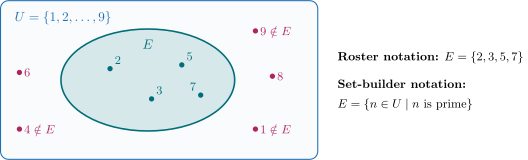
In the roster notation of a set, the order in which the elements are listed does not matter, and the same element must not be repeated:
In practice, each element is written only once.
- Let . Listing the natural numbers satisfying this double inequality, we obtain the roster notation: .
- Let . Since , the real solutions of the equation are and : in roster notation, .
- Conversely, the set consists of the squares of the first five nonzero natural numbers. In set-builder notation it is written:
4.1.2 Empty set, singleton, pair, finite set and cardinality
- The set that contains no element is called the empty set and is denoted (or sometimes ).
- A set that contains only one element is called a singleton and is denoted .
- A set that contains exactly two distinct elements and is called a pair and is denoted .
- When a set has a finite number of distinct elements (), we say that is a finite set and the integer is called the cardinality of , denoted (or ). By convention, .
Two sets and are equal, which is written , when they have exactly the same elements: for every object ,
If and are not equal, we write : this means that there exists at least one element of that does not belong to , or at least one element of that does not belong to .
- The set is equal to , because the square of a real number is always nonnegative, so for every . Thus, .
- The set is the singleton , of cardinality .
- Be careful not to confuse the number , the empty set and the singleton : the set contains one element (which is the number ), so . Likewise, is a singleton whose only element is the empty set: .
4.2 Subset of a set
4.2.1 Inclusion and subsets
Let and be two sets. We say that is included in , or that is a part (or a subset) of , and we write , when every element of is also an element of :
When is not included in , we write : this means that there exists at least one element such that .
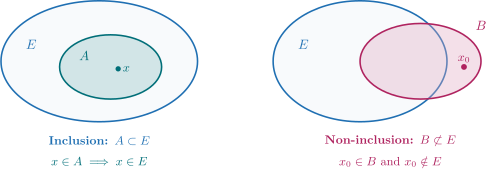
Membership relates an element to a set, whereas inclusion relates two sets. If , we write:
On the other hand, a singleton is included in if and only if its only element belongs to : .
Let , and be any three sets.
- Empty set and reflexivity: and .
- Transitivity: if and , then .
- Antisymmetry (double inclusion):
- Monotonicity of the cardinality: if is a finite set and if , then is finite and , with equality if and only if .
Proof
- The property is true because there is no element in that could make the implication fail. Moreover, for every , we obviously have , hence .
- Assume and . Let . Since , we have ; then, since , we deduce . Every element of therefore belongs to , which proves that .
- By definition, amounts to saying that for every , , that is and , which is expressed exactly by and .
- The elements of are all among those of , so is finite and ; if there is equality, no element of is missing from , so .
Method : Proving the equality of two sets by double inclusion
To prove that two sets and are equal when their elements cannot simply be listed:
- First inclusion (): we fix an arbitrary element and we prove, by a succession of implications, that .
- Second inclusion (): we fix an arbitrary element and we prove that .
We can also proceed directly by successive equivalences: , provided we check that each step is indeed an equivalence.
Let be the set of multiples of , and the set of even numbers. Let us show that , but that .
- Let . There exists an integer such that . Setting , we obtain , so . Thus, .
- On the other hand, (because ) but (because is not a multiple of ). So and .
4.2.2 Power set of a set
Let be a set. The set whose elements are all the subsets of is called the power set of and is denoted . For every set , we therefore have:
Whatever the set , we always have and , so and . In particular, is never empty: it has a single element, which is .
If is a finite set of cardinality (), then the set is finite and its cardinality is:
Exercises of the chapter
- Roster notation, membership , inclusion and power set solved
- Proving inclusions and equalities of sets by double inclusion solved
- Set operations, De Morgan's laws, distributivity and partition solved
- Inclusion-exclusion formula and counting with a Venn diagram solved
- Nature of a real number and characterization of decimal numbers solved
- Repeating decimal expansion and proofs of irrationality by contradiction solved