Power of a real number
Course · Mathematics (Grade 10, Lebanon), chapter 5 · Lebanon, Grade 10 · the beginning of the chapter, the rest on Adloun
Calculating the distance of a star in light-years, expressing the size of an atom in nanometers, finding the side of a square or the edge of a cube of given volume, or modeling the growth of a population at a constant rate: all these situations rest on the notion of power of a real number. Initially defined as a repeated multiplication for a natural number exponent, the operation of raising to a power is gradually extended to integer exponents, then to rational exponents thanks to -th roots, and finally to all real exponents.
This chapter reviews the rules of calculation on integer powers and square roots, introduces the -th roots of a real number, then builds the powers with rational exponents and with real exponents of a positive number, taking care to preserve, at each step, the same algebraic laws.
Curriculum: LB-2
Required skills
- Apply the rules of calculation on powers with integer exponents of a nonzero real number; find the sign of and write a decimal number in scientific notation.
- Master the properties of square roots (, , ); use the conjugate expression to rationalize the denominator of a quotient.
- Know the definition and the properties of the -th root of a nonnegative real number (and of any real number when is odd); simplify expressions involving radicals of different orders.
- Go from the radical form to the rational power for , and use the rules of calculation on rational exponents.
- Handle powers with real exponents (, ), compare and according to the position of the base relative to , and solve elementary exponential equations or inequalities.
5.1 Integer power of a real number
5.1.1 Definition for an exponent in , then in
Let be a real number and let be a nonzero natural number.
- The -th power of , denoted (which is read “ to the power ” or “ to the -th”), is the product of factors all equal to :
In particular, , (the square of ) and (the cube of ).
- For every real number , we set by convention:
- For every real number and every integer , the power with the negative integer exponent is defined as the reciprocal of :
In particular, is the reciprocal of .
For every positive integer , we have . On the other hand, if , the expression is not defined in this course (dividing by is impossible, and is an indeterminate form).
5.1.2 Rules of calculation and sign of an integer power
Let and be two nonzero real numbers, and let and be any two integers.
- Product of powers with the same base:
- Quotient of powers with the same base:
- Power of a power:
- Power of a product and of a quotient:
Proof
When , the equality results from grouping factors equal to followed by factors equal to , that is factors in total. If one of the exponents is negative, for example and with , then : after canceling the smaller number of common factors, there remains in the numerator if , or if . The other formulas are established in the same way by associativity and commutativity of multiplication in .
Let be a nonzero real number and let be an integer.
- If , then whatever .
- If , the sign of depends on the parity of : when is even and when is odd.
- More generally, for every real number , , that is:
Thus, a power with an even exponent of a real number is always nonnegative ( for every and ), whereas a power with an odd exponent has the same sign as its base.
We must never confuse and . In , the exponent applies only to , that is . For example:
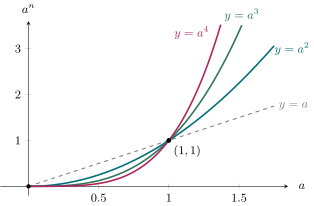
On , the larger the integer exponent , the smaller (); on , the order is reversed ().
5.1.3 Powers of and scientific notation
Every nonzero decimal number can be written in a unique way in the form:
This form is called the scientific notation of ; the decimal number , which has a single nonzero digit before the decimal point, is its mantissa.
Let us simplify the quotient for , and give the scientific notation of .
- By the rules on exponents:
- For , let us separate the numerical factors and the powers of :
5.2 Square roots of a real number
5.2.1 Definition and fundamental properties
Let be a nonnegative real number. We call square root of , and denote by , the unique nonnegative real number whose square is equal to . In other words, for all real numbers and :
By definition, we therefore always have and . The symbol is called the radical and the real number placed under the radical is the radicand.
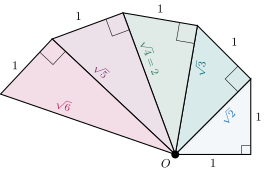
Spiral of Theodorus of Cyrene: by constructing successively right triangles in which one leg is the previous hypotenuse and the other leg measures , the Pythagorean theorem provides segments of exact lengths
Exercises of the chapter
- Calculations on powers with integer exponents and scientific notation solved
- Square roots, relation , conjugate expression and nested radicals solved
- -th roots: simplifications, reduction to the same index and comparisons solved
- Rational exponents and algebraic identities on fractional powers solved
- Powers with real exponents and comparisons solved
- Solving equations and inequalities involving real powers solved